What’s The Word- Thunderbird!


Me and Quine were standin’ out in front of CBGB’s one night, around 1980, smoking cigarettes, catching a breeze, shootin’ the shit when an old black wino came stumbling out of the Palace Hotel next door. He was dressed in a ragged sharkskin suit, wore a battered, Lester Young style pork pie hat, and he had the mouthpiece of a sax hanging from a cord around his neck. He stuck a dirty, calloused hand out—“Yo, young blood, lemme hold a dollar“. “Yo, professor, lemme hold a dollar“. His eyes were milky red, his lips were cracked. “I used to play with Bird“.
Me- “You played with Bird?” “Yeah, man” he replied. “I played with Bird. I played with Trane too..Bird and Trane….Thunderbird and Night Train! Ahhahahaha“. I gave him a dollar.

This memory was sparked by an entry a few days ago on the Blues For Redboy blog, one of my favorites. Red Boy had posted the Casual-Aires version of (What’s The Word)Thunderbird (Brunswick) along with a record I’ve never heard before, and now want very much– Thunderbird Twist by the Thunderbirds on the Delta label, from here in NYC, year unknown to me. Great record, I hope you agree. And I hope Redboy doesn’t mind my borrowing his copy for my blog (feel free to lift anything from this blog for your page, R.B.). There’s a lot of good versions of Thunderbird, and a lot of good songs called Thunderbird that ain’t the (What’s The Word) Thunderbird tune that sparked the ignition in my brain that led to this blogeration.
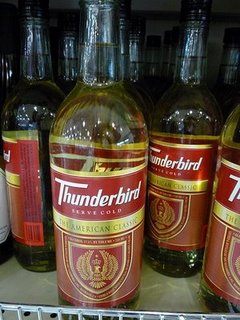
For those who don’t know, Thunderbird is a fortified wine much preferred by degenerates and alcoholics everywhere. I drank a lot of this shit hanging out at the Seminole reservation next to where I grew up in Florida when I was a teen. My liver still hurts from it….well, my liver hurts because I have hepatitis C and cirrhosis, but the memory of Thunderbird, and Night Train (see the October posting All Aboard….The Night Train) and Mad Dog 20/20 bring back memories of
some truly foul hangovers. These wines are created for one reason– fast inebriation, and they have been celebrated in song for just that reason. Shall we proceed to the vinyl?
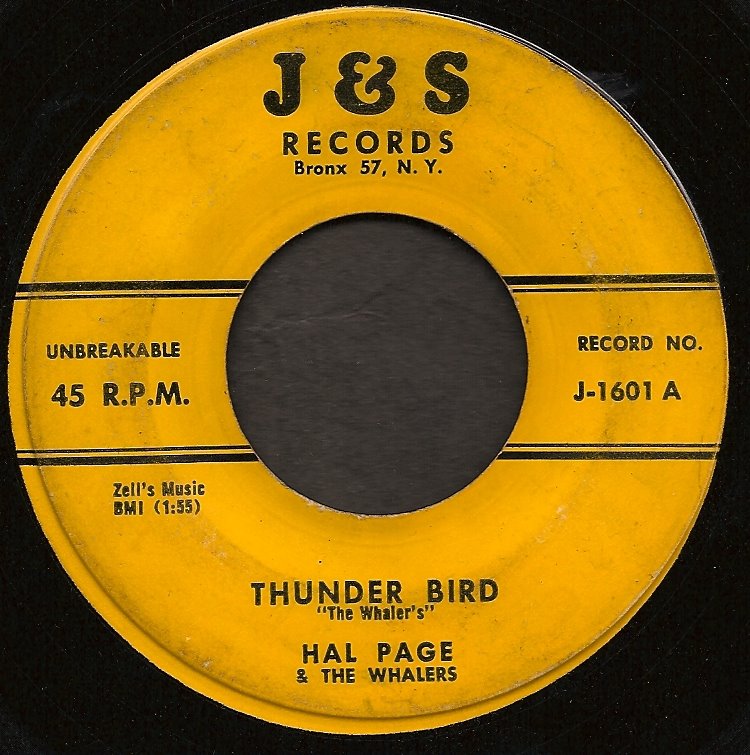
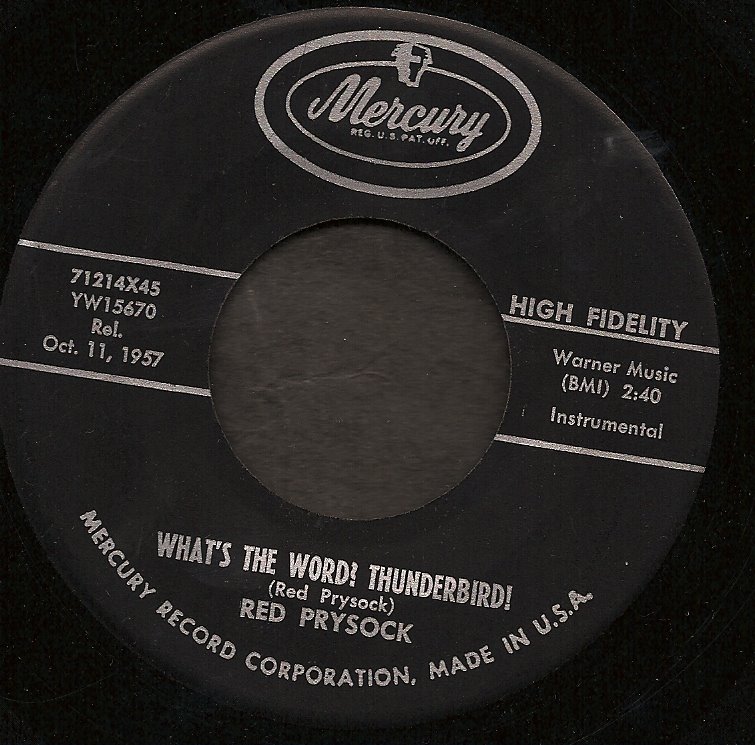
My favorite version of Thunder Bird is by Hal Paige & the Whalers, a fine New York based R&B stomping outfit who recorded excellent sides for Atlantic and Fury as well as this one on the Bronx based J&S label (which originally issued Johnnie & Joe’s Over The Mountain, Across The Sea before Chess picked it up). It’s a raw, crude, fast paced rocker with the classic lines– “what’s the word?/thunderbird, where do you cop?/ beauty shop, what’s the price?/ cut it twice” giving it cross audience appeal (alkies and dope fiends). It was covered on Mercury by tenor sax honkin’ man Red Prysock, retitled What’s The Word? Thunderbird! The label dates it to Oct. 11, 1957.
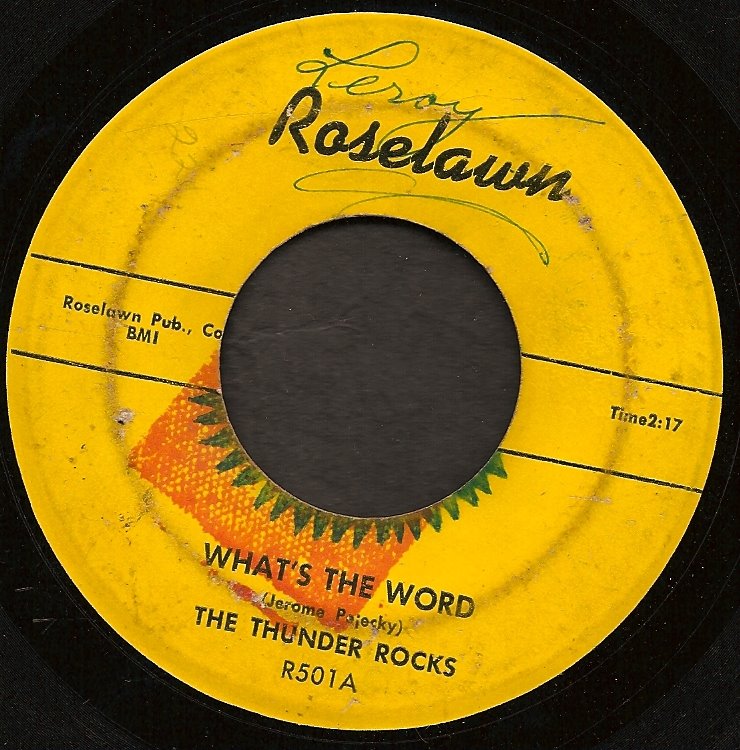
The same tune shows up again, missing the dope references on the Roselawn label by the Thunder Rocks, this time titled What’s The Word in version that is pure guitar rock’n’roll.
West coast guitar great Rene Hall cut a tune called Thunderbird for Specialty that is a completely different song, but still a great record. That’s Plas Johnson on the tenor sax and Earl Palmer beating out the drums. Hall is one of the most under rated guitarists (and arrangers) in rock’n’roll history and is a subject I will get around to writing about one of these days.
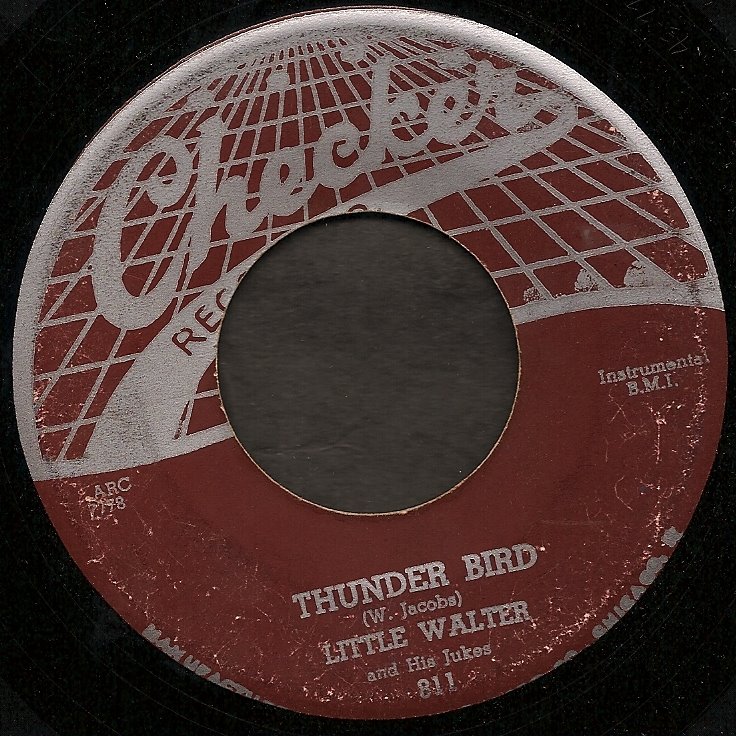
Blues man Little Walter Jacobs knew from shitty wine, it killed him at age 32, and he too used the Thunder Bird title for one of his greatest Checker sides. It was the b-side of his second biggest hit– My Babe, and it’s classic Little Walter all the way with his saxophone like tone soaring over Fred Below’s always propulsive drumming. That’s Robert Jr. Lockwood on lead guitar. It was issued in January of 1955.
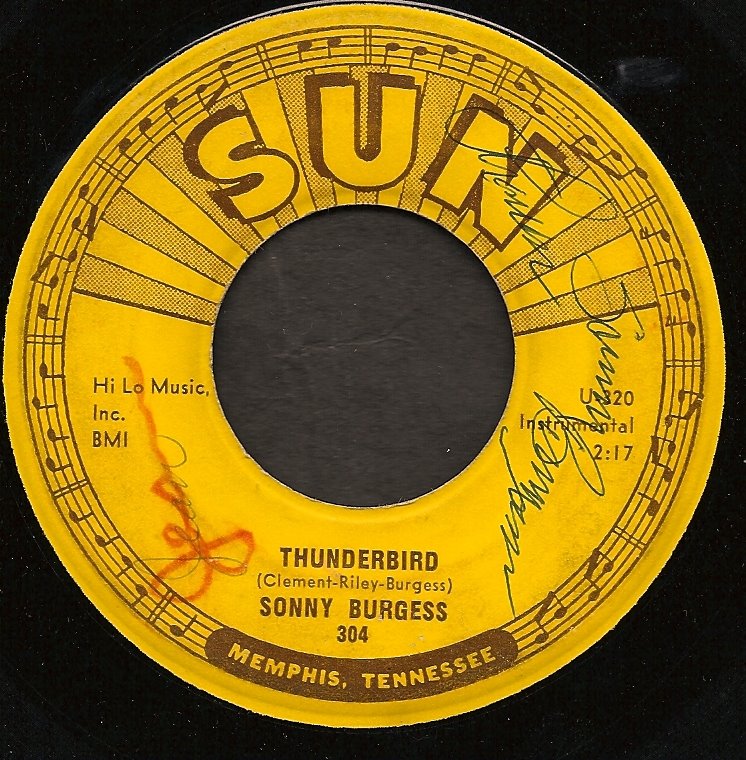
Sonny Burgess, the great Sun rockabilly singer mastered the art of sounding inebriated on such killer discs as Red Headed Woman b/w We Wanna Boogie (Sun 247, 1956), and Ain’t Got A Thing b/w Restless (Sun 253, 1957). Oddly enough, like Elvis he was a teetotaler. Sam Phillips couldn’t get a hit with Burgess’ magnificent voice, so in the wake of the mega smash Raunchy he tried Burgess out as an instrumental artist issuing his tune called Thunderbird backed with the slow groove Itchy (Sun 304, 1958). Much confusion has ensued over the years since virtually every copy pressed had the labels reversed! The fast song is Thunderbird. Itchy is the slow, Link Wray style side. Issued under Burgess’ name, it’s something of an early supergroup with Billy Lee Riley providing the harmonica and Charlie Rich tickling the ivories. James Van Eaton who played on all the Jerry Lee Lewis and Billy Lee Riley Sun sides is on the drums. He was one of the great unsung heroes of Sun Records (dig the way he propels Jerry Lee on his early Sun discs). That’s Sonny’s autograph on the label pictured above, he signed it when he came out to my radio show in the early nineties. Sonny’s a heck of a nice man, and one of the greatest rockers of all, in my opinion.
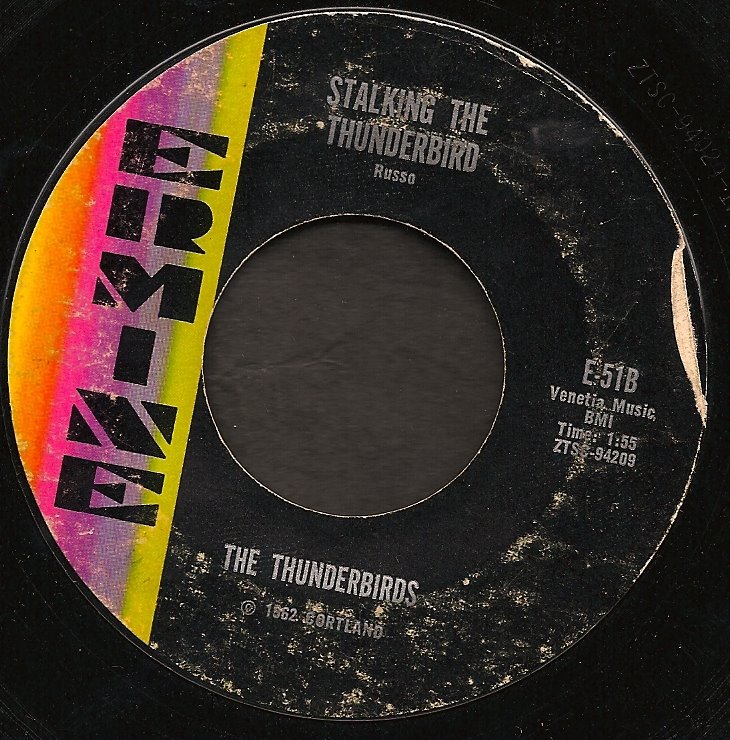
On the Ermine label is a group called the Thunderbirds who are almost certainly not the guys performing the Thunderbird Twist heard above, but this oddball instro-mental– Stalkin’ The Thunderbird was issued in 1962 and that’s about all I can tell you about it.
In this era of economic collapse I’m sure we’re going to see a lot less Cristal and a lot more Thunderbird in the alcoholic intake of musicians, and while it may be vile tasting stuff, it surely inspires better music than fine champagne. This I know is true.
ADDENDUM TO YESTERDAY’S POST: Comedy writer/producer/archivist and all around genius Eddie Gorodetsky sent a version of Thunderbird by Slim Gaillaird from a Dot LP which I’ve never heard before and it’s so incredible I just had to add it.
Check out these lyrics: “What’s the word/Thunderbird/what’s price?/thirty twice/what’s the flavor?/Ask your neighbor/what’s the reaction?/Satisfaction/Who drinks the most?/Us colored folks!” Talk about having a way with words! Thanks Eddie, you’re the best. And thank you Slim Gaillard in heaven-a-roonie.

ADDENDUM TO THE ADDENDUM: Reader KevanA pointed out that I used to play the Nitecaps (of Wine Wine Wine fame) version of Thunderbird on my radio show quite often. That version, which is great, slipped my mind when I was writing the above. It can be found here. Thanks Kev….

The Phil Spector Trial- A few thoughts….


[youtube https://www.youtube.com/watch?v=Ahi4OxvEgsY&hl=en&fs=1%5D
A few thoughts on Phil Spector, currently incarcerated awaiting sentencing for second degree murder charges:
* You Lost That Lovin’ Feelin’ is one of the worst rock’n’roll records ever made.
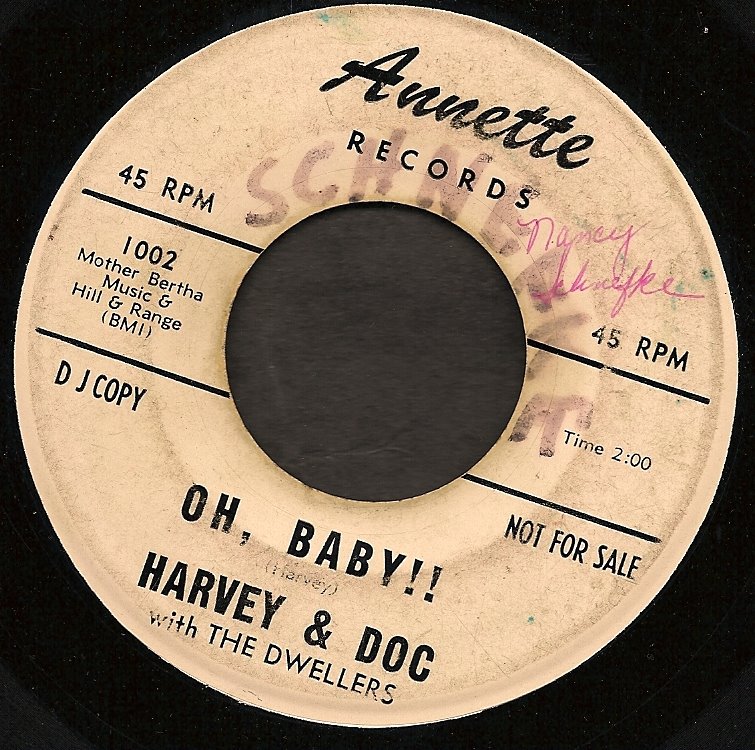
* Spector’s best record is this one– Oh Baby issued on the Annette label under the name of Harvey & Doc with the Dwellers (Doc being Doc Pomus).
* His best group, the Sleepwalkers never recorded. I can’t remember where I read it, but I do remember an interview with Kim Fowley where he recalls their only gig, a band, dressed in 40’s Noir/gangster garb (Phil on lead guitar), takes the stage in trench coats and blows the audience away with a Link Wray/Peter Gunn type spooky rock’n’roll sound. The other members include Steve Douglas and Sandy Nelson, then members of Kip Tyler & the Flips who where occasionally managed by Phil’s soon to be institutionalized sister Shirley.
* Having seen Phil pull a gun on somebody once (at Doc’s funeral), I’m fairly sure he pulled the trigger, although my guess is it was an accident and manslaughter would have been a more fitting charge. No doubt Phil rejected a plea bargain to such charges. I also think Bruce Cutler bought off a juror in the first trial (my opinion, based on no facts, only that Cutler was caught doing it in one of John Gotti’s trials). That said, prison life will not be easy for Phil, I hope he’s under suicide watch 24/7.
* A working girl friend of mine used to trick with Phil, after each meeting she’d come in the bar and quickly down 3-4 shots of tequila and then excuse herself and go to the ladies room and throw up. Her scatological stories were so vile even I don’t feel like repeating them.
* When it’s all said and done, it’s hard not to feel sorry for Phil. I feel even worse for Lana Clarkson (seen here doing her Little Richard impersonation from the Home Shopping Channel) and her family.
Spector’s lawyers attacking her obviously backfired with the jury (who could have found Phil guilty of involuntary manslaughter). They’ll probably get stiffed on their fees, as Phil is broke.
* Nick Tosches began working on a book about Spector several years back (even interviewing Spector’s first wife Annette, who had never given an interview before), but he soon gave the project up. When I asked him about it he just shrugged. The subject just couldn’t hold his interest long enough to write a book about it. Nik Cohn had a similar experience in the early seventies. Come to think of it, I’ve run out of things to say myself….
[youtube https://www.youtube.com/watch?v=vZbQnZGlBh4&hl=en&fs=1%5D

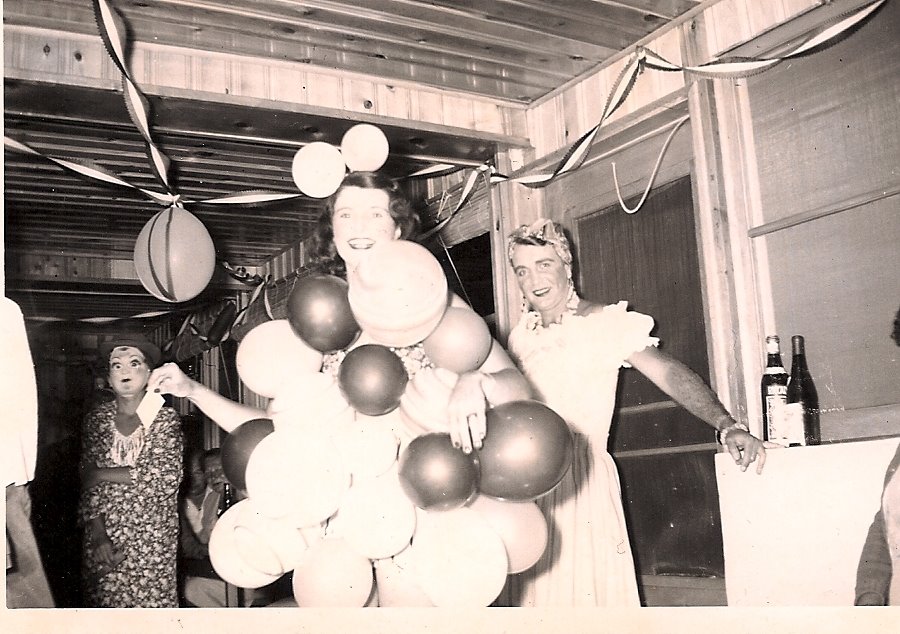
Gillian’s Found Photo #8

Gee, but this is a fucked up photo, I’m not even sure what to say. The thing on the left, near the rear seems to have wandered in from a Diane Arbus shoot somewhere in the neighborhood, the lady with the balloons, lord only knows, the sad ass queen on the right, probably a bank president. My guess it this was taken in New Orleans, Lundi Gras night (the night before Fat Tuesday when the all the most decedent balls are happening). I can remember coming into my own joint at six a.m. and finding some of the ugliest and most vile human couplings imaginable, right there in the bar, post- AIDS. Of course, this could just as well have be in New York, Wichita, or Gila Bend, Arizona. Anyone wanna guess?

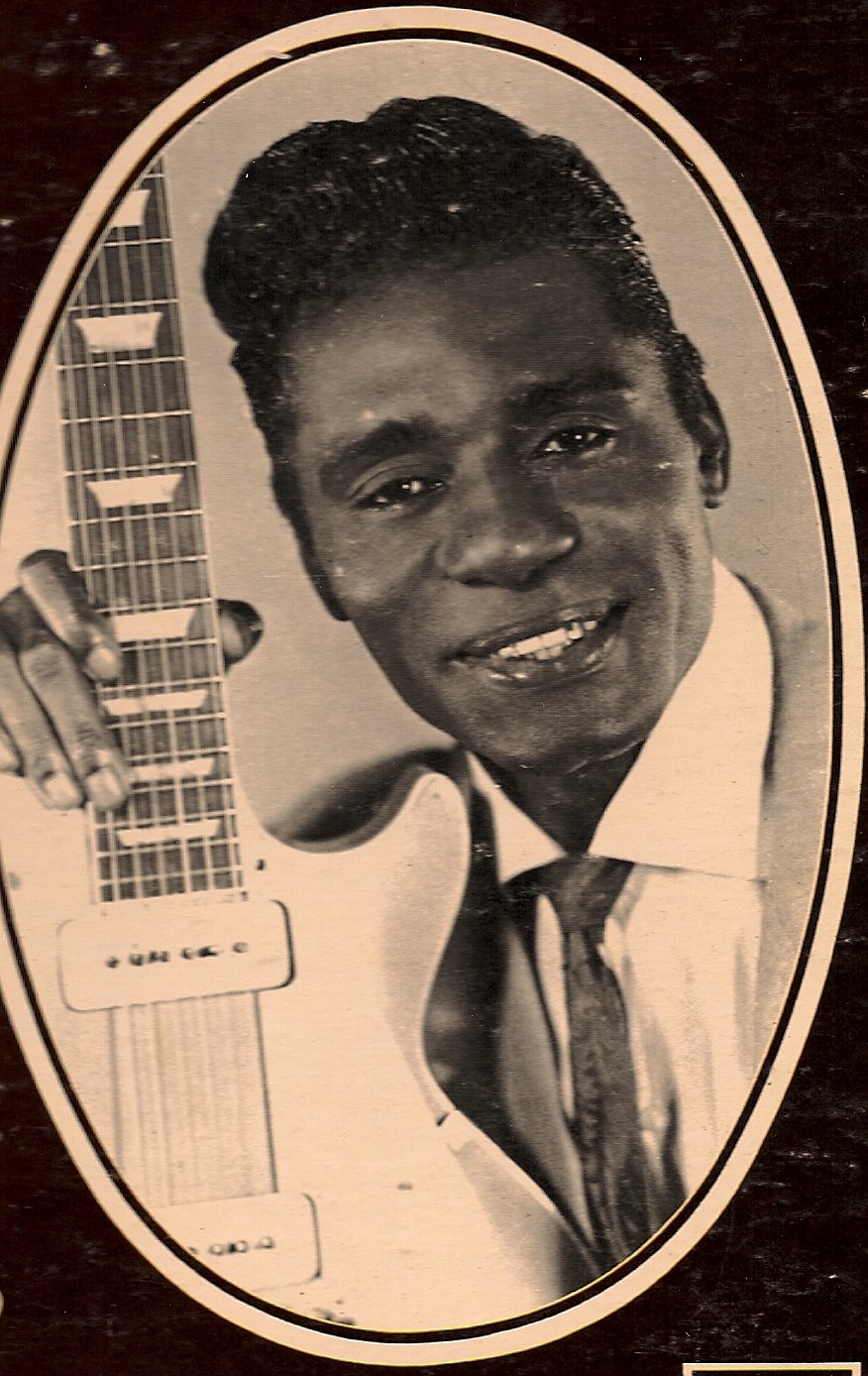
Guitar Slim


“… suddenly a wave of humanity come washing over the street– kids, men, women, and couriers. “Here comes Slim! Slim’s on the way!” A fleet of three red Cadillacs pulls up, and here’s the man himself, emerging in a bower of red-robed beauties, dressed to match the Caddies, plus a retinue of courtiers, janissaries, mountebanks, and tumblers. “Need to change into my singing pants, gents,” says Slim. The small hall fills to bursting with his excited public, so when he finally appears, we urge Slim to get rid of the rooters, needless distractions. Slim nods gravely, plugs in his trademark hundred foot long guitar cord (an accessory that allows him to roam the streets outside the clubs he plays, corralling customers) and invites his sidemen to kick off the blues in B-flat. The cats vamp as Slim circles the room, addressing each of his admirers one by one, saying/singing how he hates to see them leave. But leave they do– except for the ladies in red, the most pulchritudinous of whom identifies herself as a shake dancer scooped up by him in Vegas only last month. “You know that thousand dollar advance you gave him?” she asks. “Sure” I answer “Well, I got it all”, she winks, her face a portrait in dimples. “At three hundred a week”. But by then Slim’s already getting down, singing the blues and picking up a storm on guitar.”
— Jerry Wexler, Rhythm and the Blues (Knopf, 1993)
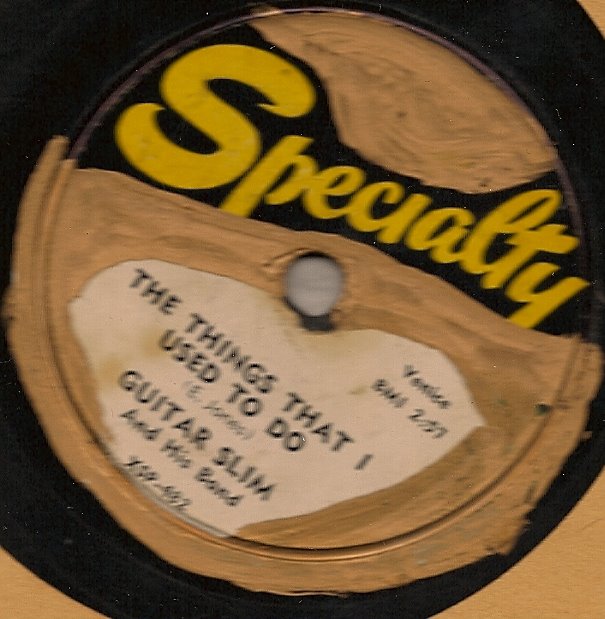
Guitar Slim’s The Things I Used To Do (Specialty, 1954) is one of my all time favorite records. The way the guitar riff rises and falls, it sounds like ole Slim’s heart is heaving and sighing. The sound of his guitar, with its wirey, distorted edge, sounds like some type of bird being strangled, or perhaps a yelping dog sinking in quicksand. But you know how those pulchritudinous women can make you feel, especially when they’re trying to impress the janassaries and mountebanks. It can just plum get a man down. The Things I Used To Do was the best selling blues record of the year 1954 and spent six weeks at #1 on Billboard’s R&B charts. Ray Charles played piano on it and some say did the arrangement, you can hear him exclaim”yeah” in the stop before the song’s finale.
Guitar Slim was born Eddie Lee Jones in Greenwood, Mississippi, on December 10, 1926. He never knew his father, his mother died when he was six. He was sent to live with his grandmother on a plantation in Hollandale, Mississippi where he picked cotton and plowed behind mules. Staring up a mules ass all day would make anyone desire a posse of janassaries and pulchritudinous shake dancers to say nothing of the tumblers. His first musical experience was singing in church on Sunday mornings, but soon Saturday night came to his attention. Little Eddie began hanging around the local juke joint where he fell under the spell of guitarist Robert Nighthawk (Robert Lee McCoy, see Nov. posting on him). Young Eddie Lee’s first instrument was piano and he was playing boogie woogie and blues, sometimes behind his hero Nighthawk, as a teenager. He hooked up with a guitarist named Johnny Long together they played a few jukes, picking up a coin or two, maybe a fish sandwich if they got lucky. Eddie married in 1944 and was drafted shortly afterwards. Eddie Lee Jones served in the Pacific theater, defeated the Japanese and was duly discharged in 1946. He was back in Hollandale working at a cotton press that same year. He hung around for eighteen months and then left Mississippi and his wife for good. Where he was for the ensuing year and half only the pulchritudinous women know but he was sighted working as a dancer in Willie Warren’s group in Lake Village, Arkansas. It was Warren who taught Slim to play guitar and after achieving proficiency on six strings, Jones headed for New Orleans to begin his career in earnest.
Renamed Guitar Slim, he put together a band with Huey “Piano” Smith and was soon playing at the legendary Dew Drop Inn, making his formal debut there on August 26, 1950 sandwiched in between a female impersonator (Bobby Marchan, lead singer of Huey Smith & the Clowns was employed there in such a capacity) and, what else? Of course, a shake dancer.
Musically, Slim had discovered a new musical role model in Texas powerhouse guitar player Clarence “Gatemouth” Brown, whose hits on the Peacock label like Boogie Rambler, My Time’s Expensive, and Boogie Uproar featured a fairly explosive guitar style. Like T-Bone Walker he played clean, single string leads, but was more explosive, more demonstrative. Where T-Bone playing was cool and breezy, Gatemouth’s style was red hot and burning. Remind me to blogerate about Gatemouth’s Peacock sides sometime. Guitar Slim would never develop Gatemouth Brown’s chops, but he would more than make up for it in enthusiasm and wildness.

Sometime in 1951 he cut his first discs, four tunes recorded for Imperial, issued on two 78’s which went nowhere. He made another record in ’52 for Bullet Records in Nashville– Feelin’ Sad, a blues that only hinted at what was to come (Feelin’ Sad would later be covered by Ray Charles on the Ray Sings The Blues LP for Atlantic in ’59).
Johnny Vincent, then working as a talent scout and producer for Art Rupe’s L.A. based Specialty Records signed Slim in 1953. His first session, held in New Orleans at Cosimo Matassa’s J&M Studio (the place that recorded more great rock’n’roll records than even the fabled Sun Studio in Memphis) on October 23, of that year saw Slim fronting a band of first call New Orleans session players- Earl Palmer on drums, Lee Allen and Alvin Tyler on saxophones, Frank Field on bass and the aforementioned Ray Charles on piano. From this session the Things I Used To Do emerged. It took dozens of takes to nail the master, since overdubbing was impossible on J&M’s primitive recording gear and everytime Slim would play a great solo he’d stop the take and say– “Did you hear that?” or “Listen to that!”. Ray Charles’ audible “yeah” at the end of the tune came from relief at having finally gotten through a take, not emotional enthusiasm. An excited Johnny Vincent quickly shipped the masters to L.A. for Rupe to issue.
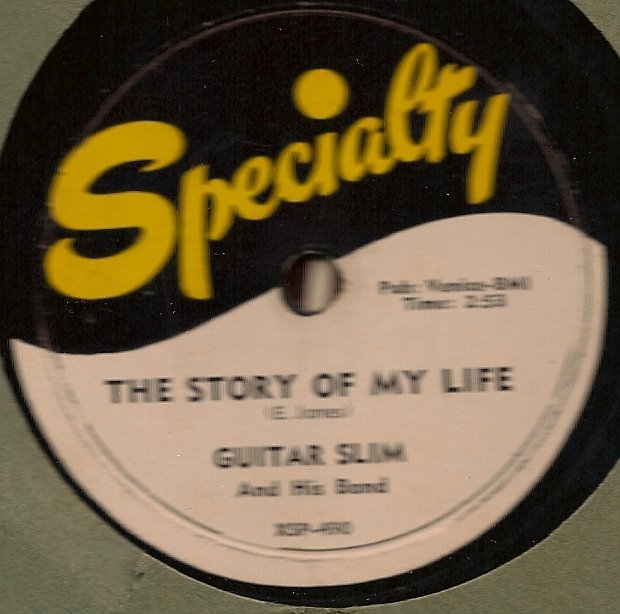
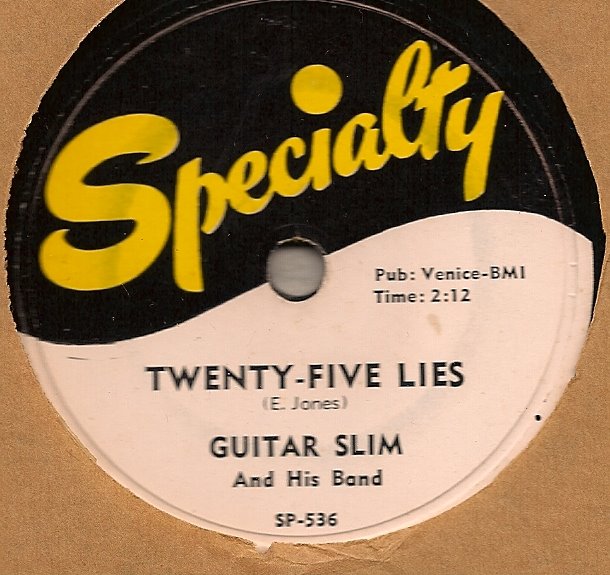
Art Rupe, who would become one of the most important record men in history (recording, amongst others Little Richard, Sam Cooke & the Soul Stirrers, Lloyd Price, Larry Williams, Willie Joe & his Unitar, et al), in a rare show of bad taste thought The Things I Used To Do was the worst piece of shit he had ever heard. Legend has him using those exact words– worst piece of shit he ever heard. Still, he released the record so as not to hurt Vincent’s feelings (that part of the story I don’t quite buy, Rupe wasn’t the type to waste money on a person’s feelings, but that is how Johnny Vincent told the story and Rupe never disputed it, at least not in any interview I’ve read). The Things I Used To Do was a smash and Specialty would record Guitar Slim several more times, issuing a total of eight singles between 1954-56, although none would come close to matching the sales of The Things I Used To Do. Still, Guitar Slim waxed some incredible sounds while at Specialty– The Story Of My Life might be the single most depraved blues guitar solo ever recorded, or at very least one of ’em*. It was a record Frank Zappa often name dropped in interviews, telling clueless rock writers “if you’ve never heard The Story Of My Life by Guitar Slim you haven’t lived”. Specialty wouldn’t issue an LP on Guitar Slim until 1970, and later in the CD era virtually every outtake in it’s vaults would find their way to plastic, including this little false start and studio chatter included version of I Got Sumpin’ For You Baby which gives us a glimpse of Slim at work in the studio. Some highlights from these years — Well I Done Got Over, Trouble Don’t Last, the rocker Guitar Slim, Quicksand, Think It Over, Twenty Five Lies, and Reap What You Sow. On these tunes you can hear the church that Slim left behind in his voice, in his guitar playing we hear the future coming too fast and furious to make sense of. In fact in those days Guitar Slim couldn’t find an amp loud enough so he’d plug into the P.A. head direct and turn it to the maximum setting.
Unable to match his initial hit, Guitar Slim and Specialty Records parted ways in 1956. Atlantic picked him up and recorded him for its Atco subsidiary, but either the fire was burning dim or Wexler and Ertegun didn’t know how to get the best out of him because the sides he cut for Atco are decidedly mediocre compared to the Specialty recordings, although as a fan of the poultry in blues form I’ve always liked this rather stupid chicken rocker— The Cackle, an outtake which didn’t escape until the 1980’s. Slim and Atlantic soon went their separate ways, he would never record again.
Guitar Slim was still a popular live attraction, and gigs are how musicians make their money. Guitar Slim always gave the crowd their money’s worth, and usually more. He would enter from the rear of the club, being carried in on the shoulders of his bearers, playing his guitar (with the one hundred foot long cord) as they hefted him through the adoring crowd and deposited him on the bandstand. He would solo his way off the bandstand and into the street, sometimes stopping traffic.
Here’s a great story: Somewhere in Texas, Gatemouth Brown, T-Bone Walker, Pee Wee Crayton and Slim, all on the same show which was billed as “The Battle of the Guitar Players”. Slim enters the dressing room and announces– “Gentlemen, we have the finest guitar players in the country all gathered here tonight, but by the end of the night, ain’t nobody’s s gonna even know any of you was here”. His showmanship was such that he knew he could steal the show even from such guitar acrobats as T-Bone Walker and his hero Gatemouth Brown.
Slim lived and drank as hard as he sang and played, and by 1959 he started missing shows (Earl King was often called in to substitute, even touring as a fake Guitar Slim), or would show up too sick to play, and on February 7, 1959, before a scheduled appearance at New York’s Apollo Theater (he was one of the few blues man who was popular with the sophisticated Harlem audience), Slim’s liver and lungs gave out. A year earlier a doctor had told him if he didn’t quit drinking he’d soon be dead, a warning that fell on deaf (and probably ringing) ears.
Eddie Lee “Guitar Slim” Jones died in New York City at the Cecil Hotel in Harlem. 118th Street, the same street my grandmother grew up on (although she lived on the east side in what was then the Italian section, now mostly Hispanic, the Cecil was on the west side). Slim was 32 years old. Unlike the plane crash that killed Buddy Holly, Ritchie Valens and the Big Bopper four days earlier, Guitar Slim’s death brought no display of public grieving, no bio pic was ever made, and thank God, nobody ever wrote an allegorical song about it. He never gave an interview, was never filmed or recorded live.
In this day of portable recording devices on every cell phone may I bemoan the fact that no live recording– audio or visual, of Guitar Slim has ever been found. Damn shame, too. I guess we’re lucky he ever got recorded at all.

* I can think of only four that come close– Young John Watson’s Space Guitar on Federal, Clarence Holliman’s solo on Bobby Blue Bland’s It’s My Life, Baby on Duke, and Ike Turner’s whammy bar workout on Billy Gayles’ No Coming Back also on Federal. If we count records that weren’t issued until long after they were recorded, and why not, we can include Pat Hare’s I’m Gonna Murder My Baby, recorded for Sun but un-issued until the 70’s. Oddly enough all these were recorded between 1953-6, over a decade before distortion pedals were invented.

William Lindsay Gresham

William L. Gresham’s Nightmare Alley (1947) is that rarest of all beasts, a great book that became a great movie. A hard boiled noir set in a traveling carnival, it’s main character Stan Carlisle, a hustler turned spiritualist, may be the most cynical character in American popular culture. Tyrone Power played him well– oily, unctuous, not quite likable, it’s easily Power’s most memorable role (full credits can be found here)
Nightmare Alley was written by William Lindsay Gresham, who was born in Baltimore in 1909, raised in Brooklyn, New York, and wrote only five books in his lifetime. Largely forgotten today, Gresham deserves to be remembered as one of America’s best low life chroniclers.
There’s not a whole helluva lot of info on Gresham’s life. Growing up in Brooklyn he was fascinated by the Coney Island sideshows (which are still there, probably the last in the world). He worked there as a kid and may have traveled with a show as a young man. Like all good young leftist would be writers of the era, he volunteered and served as a medic on the Republican side of the Spanish Civil War (see George Orwell’s Homage To Catalonia, 1952, for an excellent look at that war from a volunteer medic’s viewpoint). Returning to the U.S. he went to work as an editor for various pulp mags, many of which he contributed short stories to, and published his first novel Nightmare Alley in 1947. Nightmare Alley was well received on publication and would eventually go through dozens of paperback editions. It’s still the easiest of his books to find today and was included in the Library of America Crime Novels of the 1930 and 40’s collection in 1998 along side classic works by James M. Cain, Horace McCoy, Edward Anderson, and Cornell Woolrich (edited by Robert Polito, this is one of the Library of America’s best collections and worth searching out). The movie was released the same year, directed by Edmund Goulding, it would later become a staple of late night TV and is considered a film noir classic.
Gresham was an alcoholic and a mean drunk and today is better remembered for being an abusive husband to poet Joy Davidman, his first wife, who would leave him for C.F. Lewis before dying of cancer, a chain of events used for the basis of the Richard Attenborough’s film Shadowland (1993), than as a writer. After Davidman left him he quickly married her cousin Rene Rodriguez.
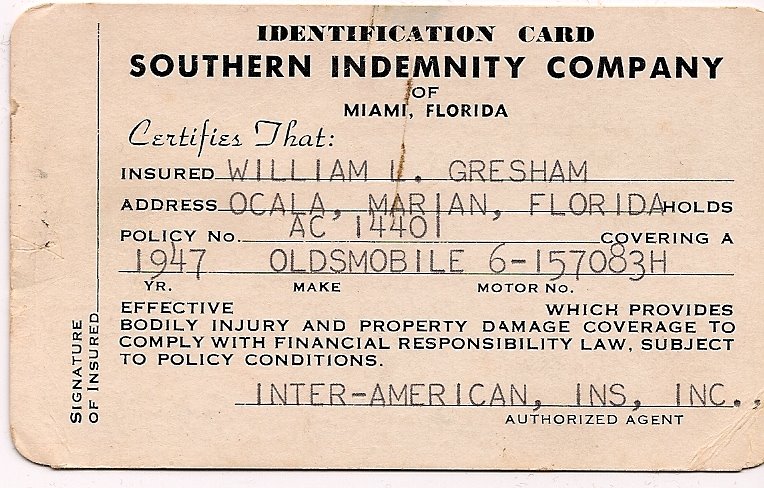
The above card which reads “You Would Rather Die Than Face Truth” was something he carried in his wallet for many years, I bought it from the same guy who sold me his insurance card (also above). In the same sale of Gresham artifacts Nick Tosches ended up with the original Tarot deck whose cards are reproduced as chapter headings in the original, hard back edition of Nightmare Alley.
Gresham’s drinking kept him from being able to capitalize on his initial success and he often found himself drying out in the nuthouse. This setting would provide the material for his second (and final) novel Limbo Tower which appeared in 1949. Set in the mental ward at a New York hospital, it didn’t sell and no movie was made from it. It’s easy to see why Limbo Tower, fine as it is, didn’t find an audience. Limbo Tower is a relentlessly grim book, and I like grim books but grim is not a selling point. It had none of Nightmare Alley’s color and a double dose of its cynicism. It’s commercial failure hit Gresham hard and he would spend the next ten years on an extended bender, supporting himself by writing stories for pulp mags for quick cash, and not much of it. His final three books were all non-fiction.
In 1954 Gresham revisited the world of traveling shows with the wonderful Monster Midway, another look at the world of freaks, hustlers, and all manner of sideshow flotsam and cretins that road shows attract. It’s first chapter is a glossary of carny lingo. The characters are sketches of real show folk Gresham knew. Although hard to find, Monster Midway is well worth looking for, I’m sort of amazed it’s been out of print since the mid-50’s.
Gresham would publish two more books– a quickie bio of Harry Houdini– Houdini: The Man Who Walked Through Walls (1959) and a book on bodybuilding: The Book Of Strength: Body Building The Safe and Correct Way (1962) written as he was dying in a shabby, rented room at a time when he could barely lift a toothbrush never mind a barbell. Although Gresham joined A.A. and quit drinking a year or two before his death, he had already ruined his health and once sober, Gresham deteriorated rapidly. First he was diagnosed with tuberculosis, then cancer which resulted in having part of his tongue amputated, finally he started going blind. With nothing but poverty, darkness, and a painful death in his future, Gresham checked into a cheap SRO hotel in Times Square and took an overdose of sleeping pills, killing himself. His exit was nearly as bleak as the end of Nightmare Alley itself (“…it’s only until we get a real geek…”).

His death received almost no attention, as a writer he was long forgotten. The only obituary he got was in the bridge column of the New York Times (although that final factoid comes from
the notoriously unreliable Winkapedia so don’t hold me to its accuracy, I’m feeling a bit lazy this morning).
I’m no literary critic, but I do like to read, so for those of you out there that have never read Gresham or have never seen the movie Nightmare Alley (which after years of legal problems with producer George Jessel’s estate is back in the regular late night rotation on the Fox Movie Channel and is readily available on dvd) here’s something I think you’re really gonna like. Step right this way…

Gillians Found Photo #7


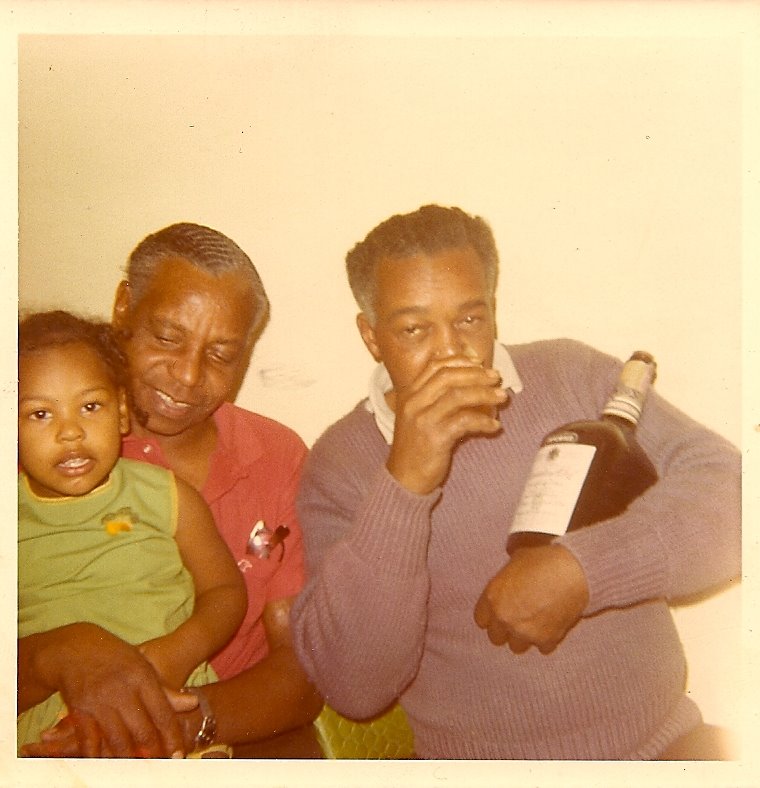
This week’s found photo– date and place unknown. It’s a Polaroid, faded to a lovely jaundice. I like the way the fellow on the right is cuddling his bottle like it’s a baby. Can anyone tell what type of hootch it is? His eyes come right out of a Wynonie Harris song (“your eyes look like two cherries/in a glass of buttermilk”). His breath seems to seep right through time, you can almost smell the booze breathe. The child in pigtails seems like she’s knows something that the adults will never figure out. She’s almost haunting. Where and when is this is from? What are they celebrating? It’s any one’s guess.

Dylan & Otis Rush

Over on his website, Bob Dylan is giving away this tune– Beyond Here Lies Nothing, to promote the upcoming album from which it was culled. It’s a great tune, in fact I think it’s my favorite Dylan song in decades, maybe since the Pat Garrett & Billy The Kid soundtrack, but it sounded awful familiar. It took a bit of brain racking but it finally dawned on me where I’d heard the tune before, it’s Otis Rush’s All Your Love (Cobra) with new lyrics. It’s not just the melody and riff that Dylan copied but the entire ambiance of Rush’s Cobra recordings are recreated on the Dylan tune. The saxophone has the same haunting, hollow tone, the echo of the room is nearly identical, he really went out of his way to channel the sound of that Rush got on his Cobra recordings (his first and best sides, you can find the complete Otis Rush on Cobra for download here, in two parts, note the password, but you should buy them and hear them properly). It was Rush’s Cobra discs that Lester Bangs (who was turned on to them by Bob Quine and me who were raving about them when Flyright re-issued them in ’80, I already had heard six of the tunes from a record trade with Jeff “Mono Man” Connelley which netted me three Rush Cobra 78’s for a Sonics Etiquette 45) described as sounding like “being mugged by an iceberg”. I haven’t heard the rest of the Dylan record which is called Together For Life and is due to be released on April 28th, but I hope he just took the best Otis Rush Cobra tunes and re-wrote the lyrics. Is this plagiarism? I’m not so sure, I mean maybe Otis Rush got the tune from somebody else. As far as stealing “riffs”, gimme a break, no one’s come up with a new guitar riff since 1956. Let’s face it, if you hold a guitar long enough you’ll play a blues scale, and if you play a blues scale enough ways you’ll play every rock’n’roll riff there is, if you play the blues scale backwards you’ve just played Rumble. Anyway, I don’t really care if Dylan stole the tune or not, I just thought I’d bring up the subject since it’s obvious Dylan’s been listening to Otis Rush’s Cobra recordings, and if you are a Bob Dylan fan you should listen to the Otis Rush discs too. Why? Cuz they’re great records and you don’t need Bob Dylan to tell you that. That’s what I’m here for.

Bill Pietsch remembered….

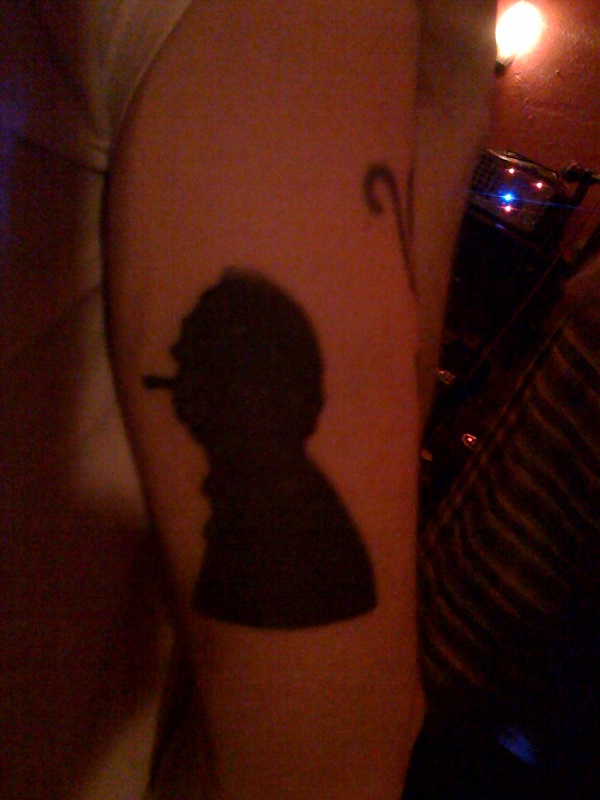
Can anyone identify the above arm? It seems someone out there went and got a silhouette of the late, great, Bill Pietsch (see my September blog entry if you’re unfamiliar with Bill’s life), the long missed drummer of the Church Keys, and sometimes front man for Purple Wizard, permanently inked onto their flesh. I’m not much of a tattoo fan, but Bill was a close friend and I was a huge fan of his and I’d quite curious about who is attached to this thing. The pic is taken from the cover of the Purple Wizard LP.

Gillian’s Found Photo #6

This week’s delve into Fang’s found photo archive asks the musical question Are You A Boy or Are You A Girl? as the Barbarians once put it. What I like about this photo is that it evokes the sleazy feeling of Hebert Selby Jr’s Last Exit To Brooklyn (Grove Press, 1957). The sad, queen in a cheap room somewhere, getting ready for a night out. The gloves are a nice touch, they cover up the tell-all hands. It also reminds me of a funny story. A friend of mine was working, renovating an apartment in the French Quarter in New Orleans for a gay couple who owned a parrot. The couple would be at their jobs all day while my friend was left alone to work while the parrot would say over and over again– “You’re just an all wrong drag queen”. The only other phrase it knew was– “ooh ooh oooh”. Anyway, getting back to this week’s found photo, I wonder what’s in the record collection? Judy Garland no doubt, but what else do you think is in there?

Marianne Faithful


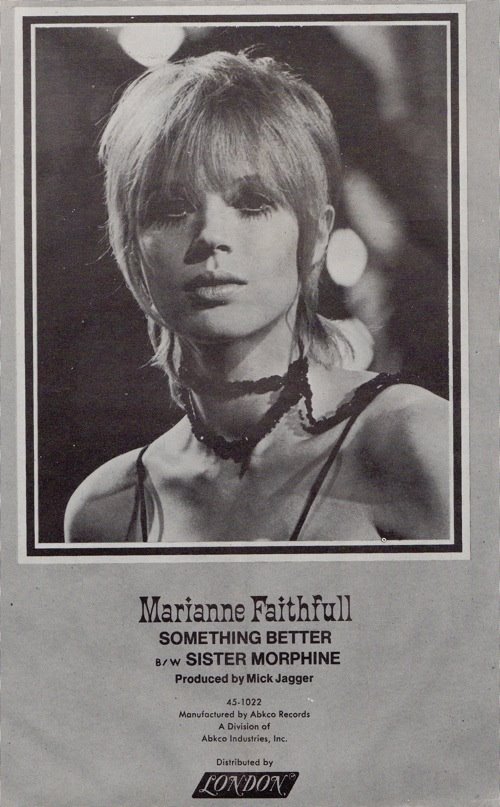
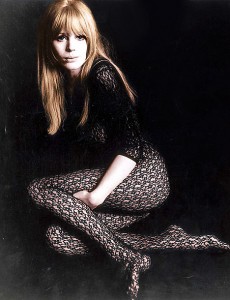
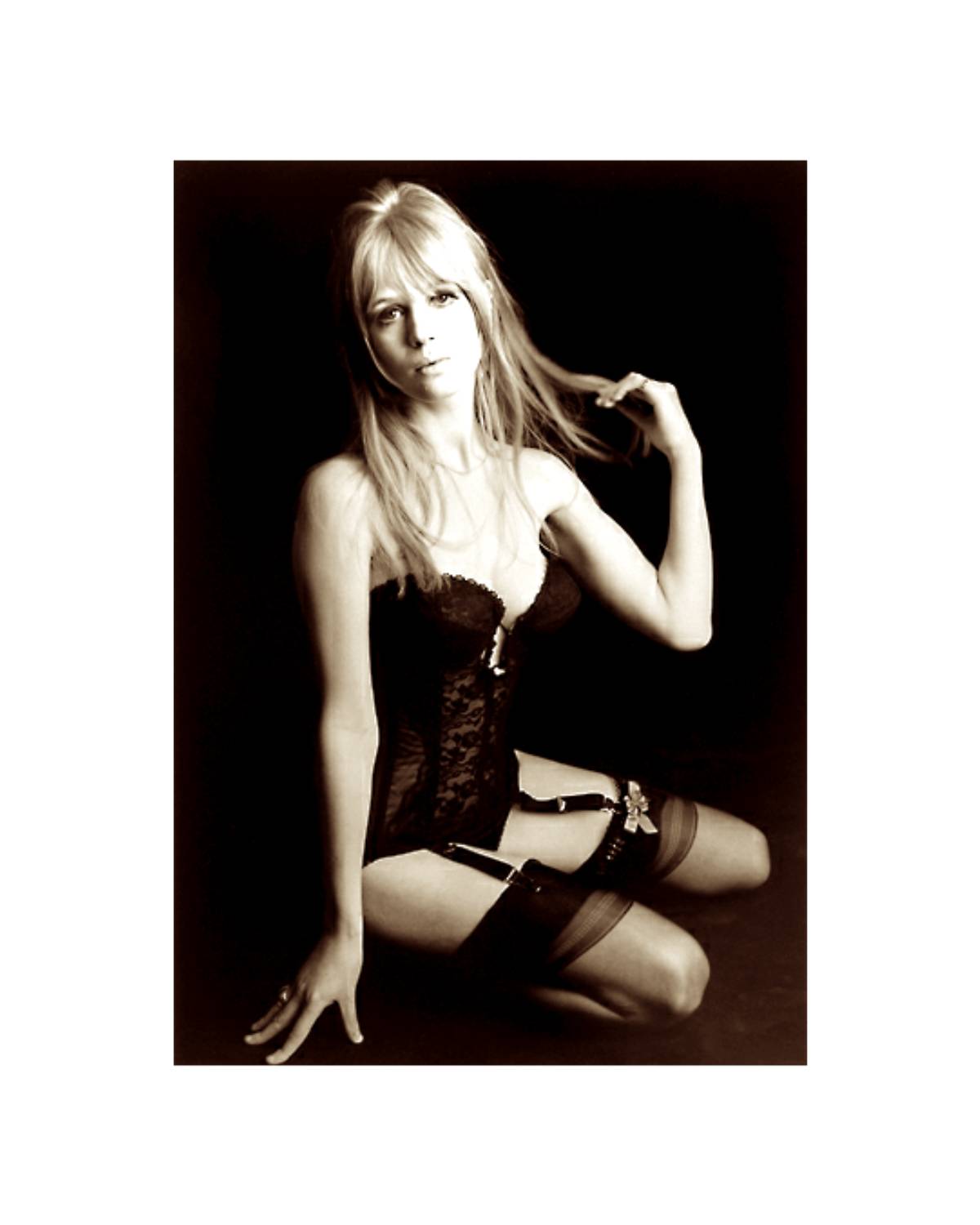
I went to see Marianne Faithful last night which gives me an excuse to run the above photos, two of my favorites, and some clips, including the only watchable parts of the otherwise awful flick Girl On A Motorcycle (1968).
The show was great. Hal Wilner has put together an excellent band for her, including a small string section that allowed her to do “As Tears Go By” in its original arrangement.
She did lots of material from her new LP, one of those superstar duet jobs that I’ve only heard a few tunes from, I really liked her version of Merle Haggard’s “Sing Me Back Home” (which she sings with Keith Richards on the record). Anyway, the live show included a great version of Sister Morphine that allowed guitarist Marc Ribot to really shine. I kept thinking how great it would sound if Quine was up there with him (Quine played on her Strange Weather LP). Anyhoo, here’s the original version of Sister Morphine if you never heard it (with Ry Cooder on guitar), the Stones’ covered it note for note on Sticky Fingers, even giving themselves the songwriting credit on the original pressings of the LP. I’ve always loved this tune which appeared as a single on Decca (U.K. only) around 1970 when she was living out the lyrics. I might as well throw in a couple of other early Decca era tunes that I like and you might have missed–here’s her version of Leadbelly’s Black Girl (later a hit for Nirvana), and here’s Is This What I Get For Loving You, a record I’ve owned since I was seven years old and drooling over her on Hullabaloo (clip below) and Shindig. If you’re not totally burned out on Rolling Stones related reading (I was going to to an entire posting on Stones’ books since I buy and read ’em all, but does anyone actually care at this point?), her
1994 autobiography Faithful (with David Dalton, Little Brown) is a classic, right up there with Anita O’Day’s High Times Hard Times (with George Eells, Putnam, 1981) in the she-junkie literary canon. Anyway, Marianne Faithful may not look like she did in the sixties but as a performer she’s actually stronger than ever, her voice, originally a breathy, clear, alto, emerged at the end of some hard mileage so fragile and cracked that it used to sound like it her vocal chords would snap mid song. These days her voice is a surprisingly strong and flexible instrument. It still sounds like she gargles with broken glass and whiskey, but it’s a voice that has served her well through four decades and four million cigarettes. By the end of a 90 minutes set her pipes was still strong enough for her to deliver her final encore acappella. Marianne Faithful, from her Ye-Ye girl roots to today’s weathered pro, reinvented herself the hard way, ya got to love her for that.

Thanks to Mary Lee Kortes, Eric Ambel and Hal Wilner for getting me to leave the house on a Saturday night in NYC, I can’t even remember the last time I went out to see music in this city on a Saturday night.