Photos From The Hound Archives pt. 1 (ie filler day)


Not inspired to write much today but I did want to post these pix.
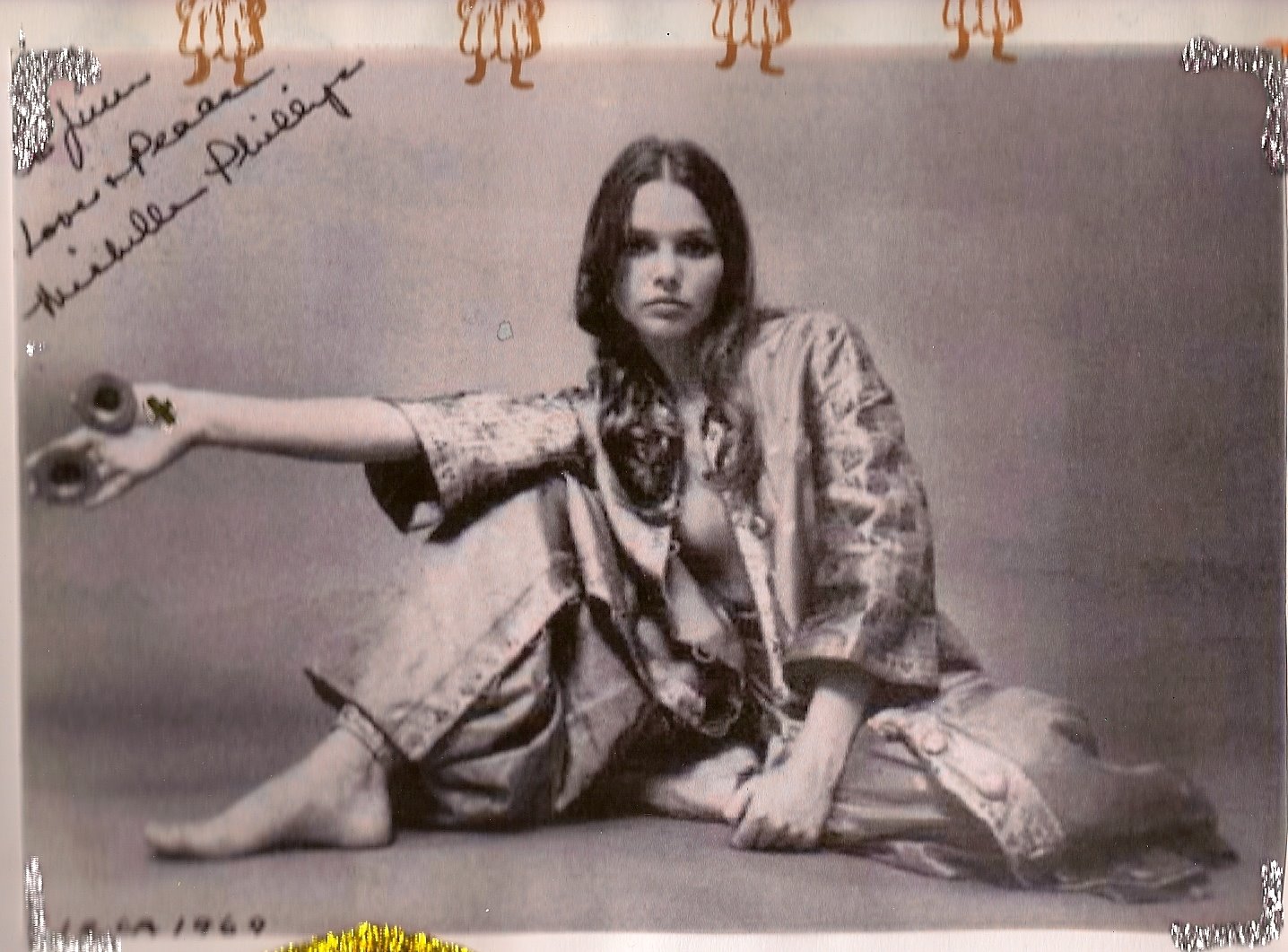
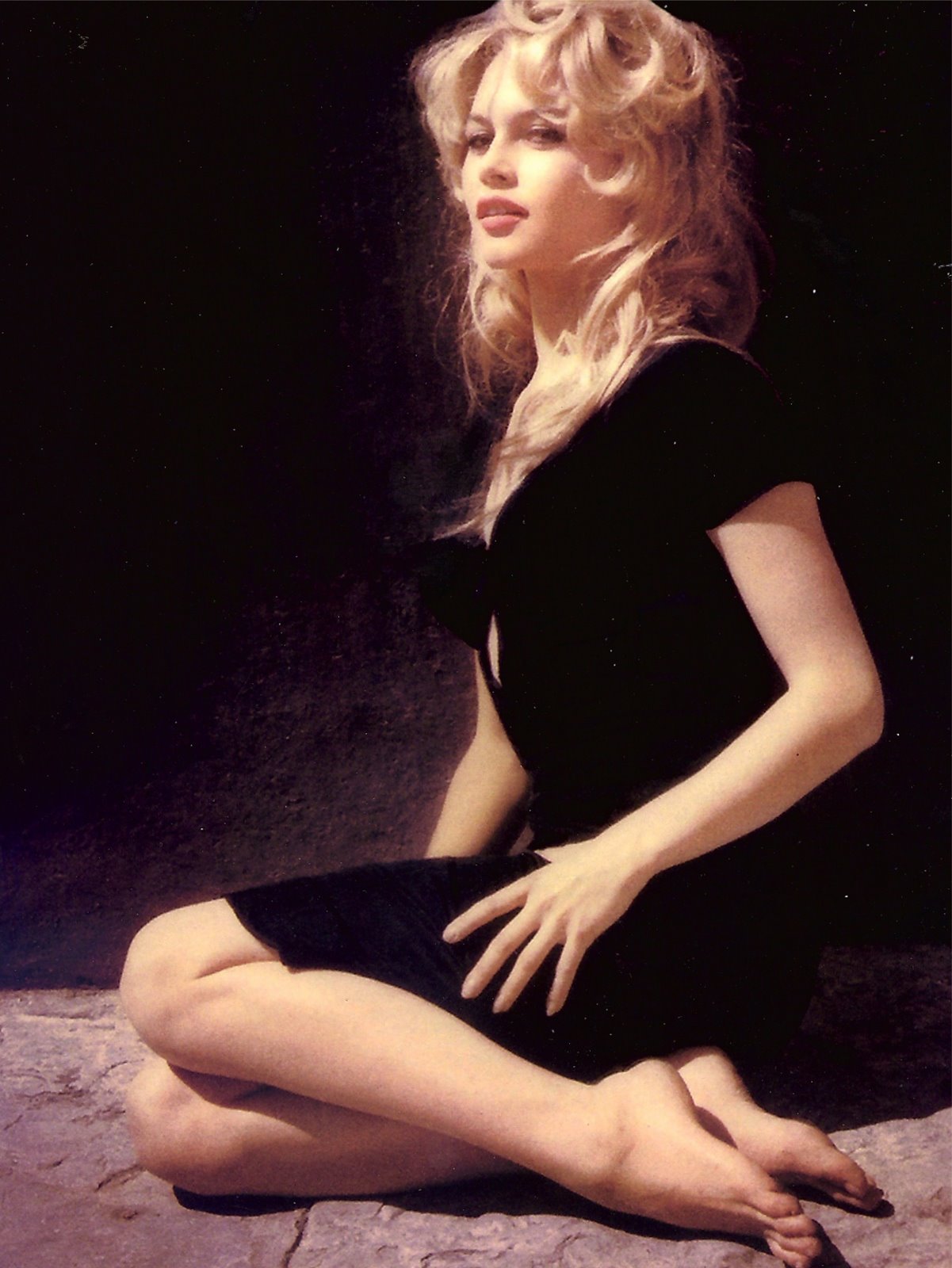
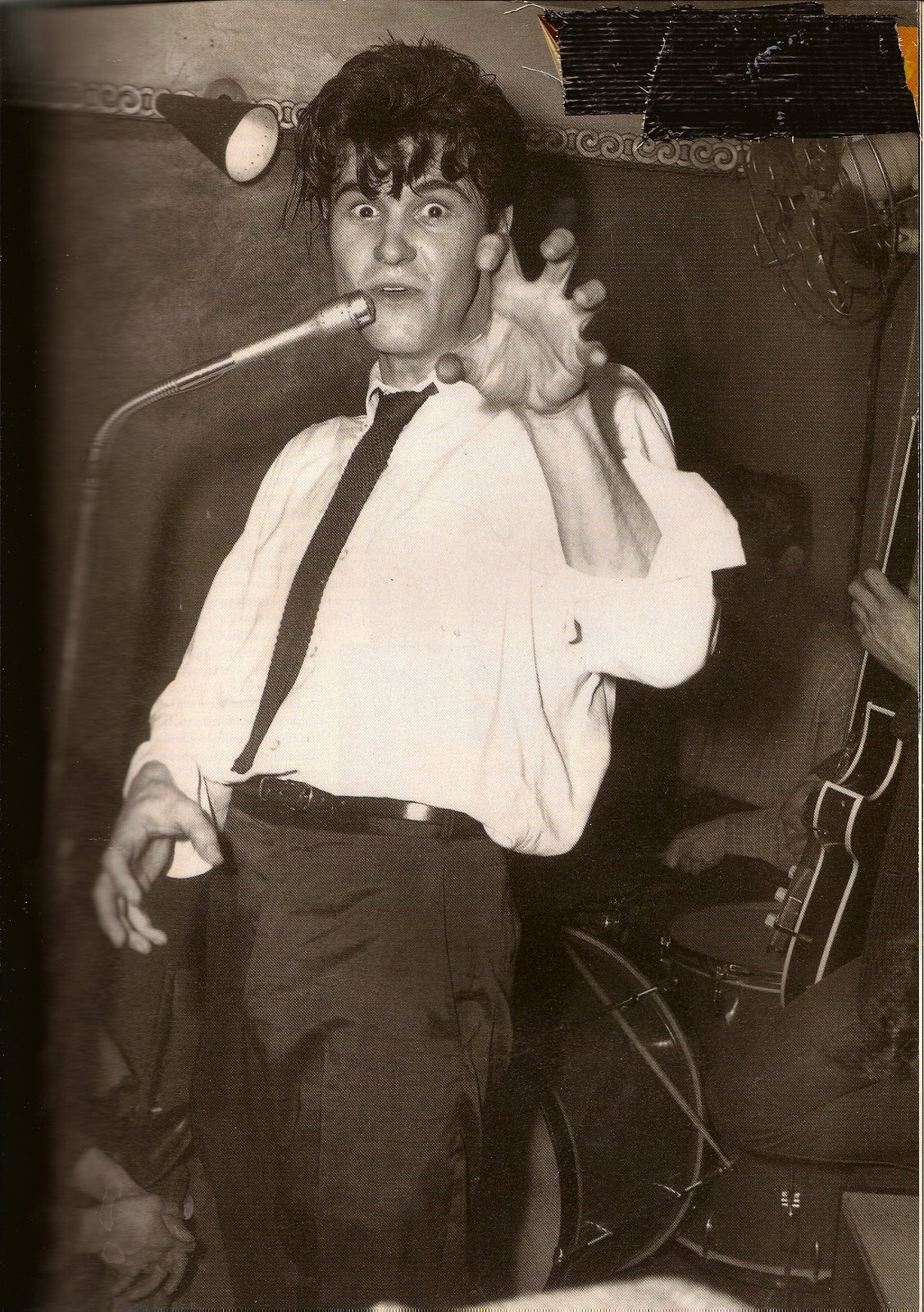
The top photo of course is Brigitte Bardot, it’s just there to grab your attention and because I like the photo.
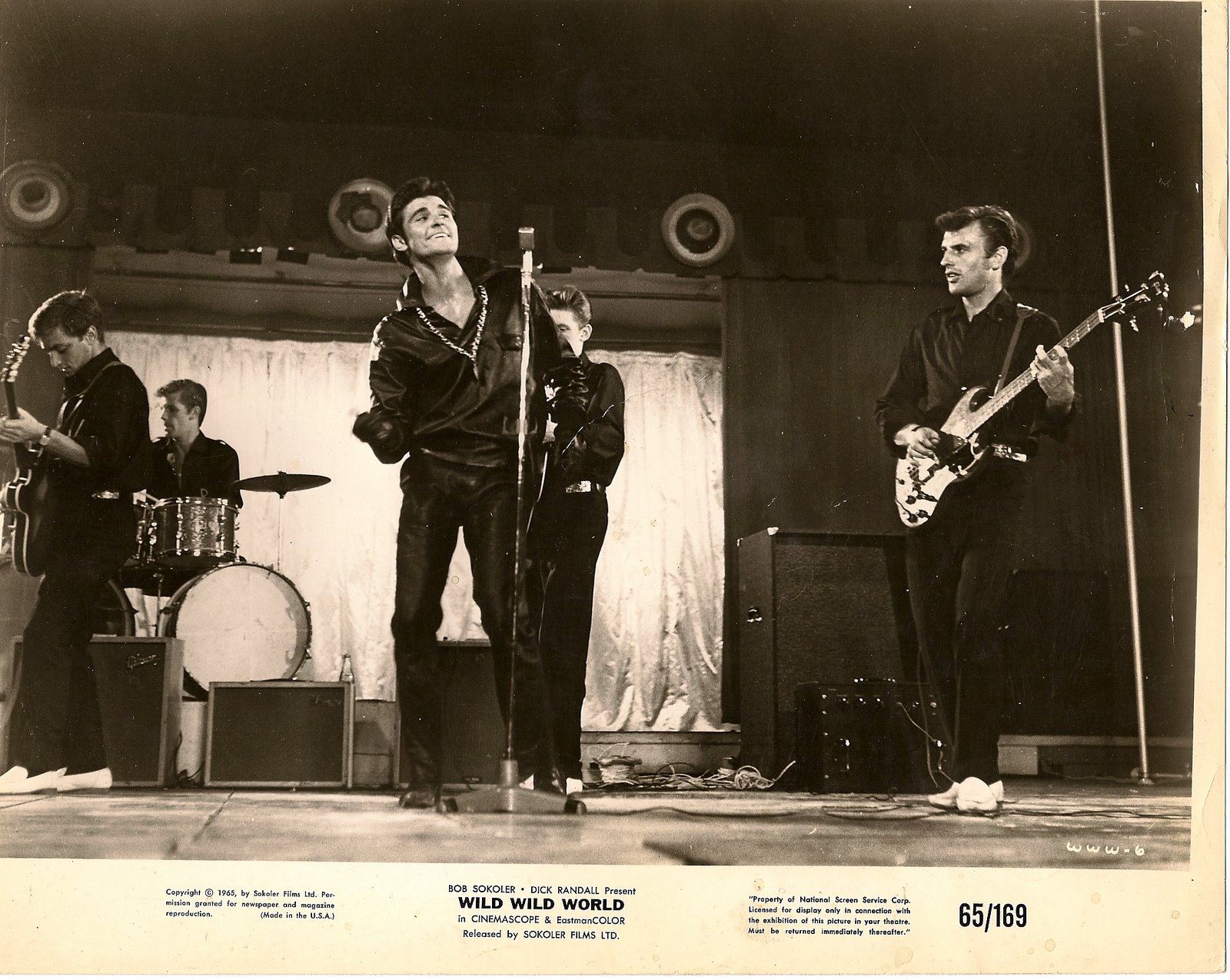
The second from the top is another photo of Vince Taylor (see entry below), what’s interesting is that the guy with the bass on the right is Stanislas “Stosh” Klossowski, son of the artist Balthus and evidently some sort of Prince, or Count, or something, as well as Keith Richards’ best pal. He’s just one of those people that always seemed to be at the right place at the right time, and I guess if you were in Paris in 1965 the place to be would have been in Vince Taylor’s backing band.
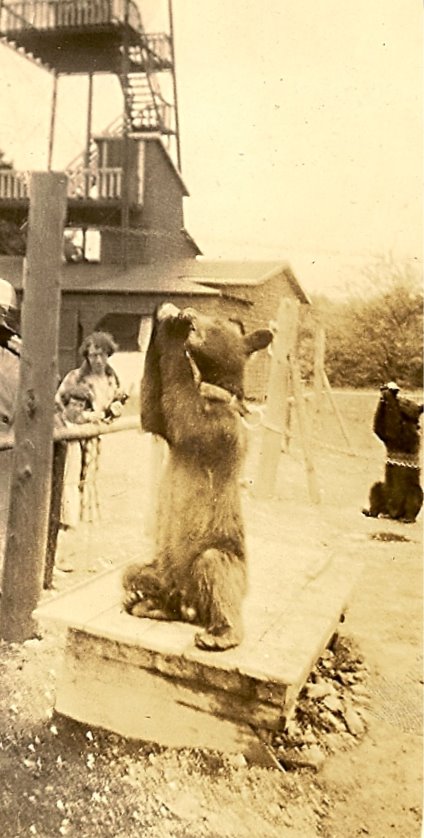
The middle photo is the dancing bear shot I promised months ago in my discussion of Cormac McCarthy’s Blood Meridian. Yes, that’s the same bear that appears in the bar scene in the last pages of the book, would I lie?
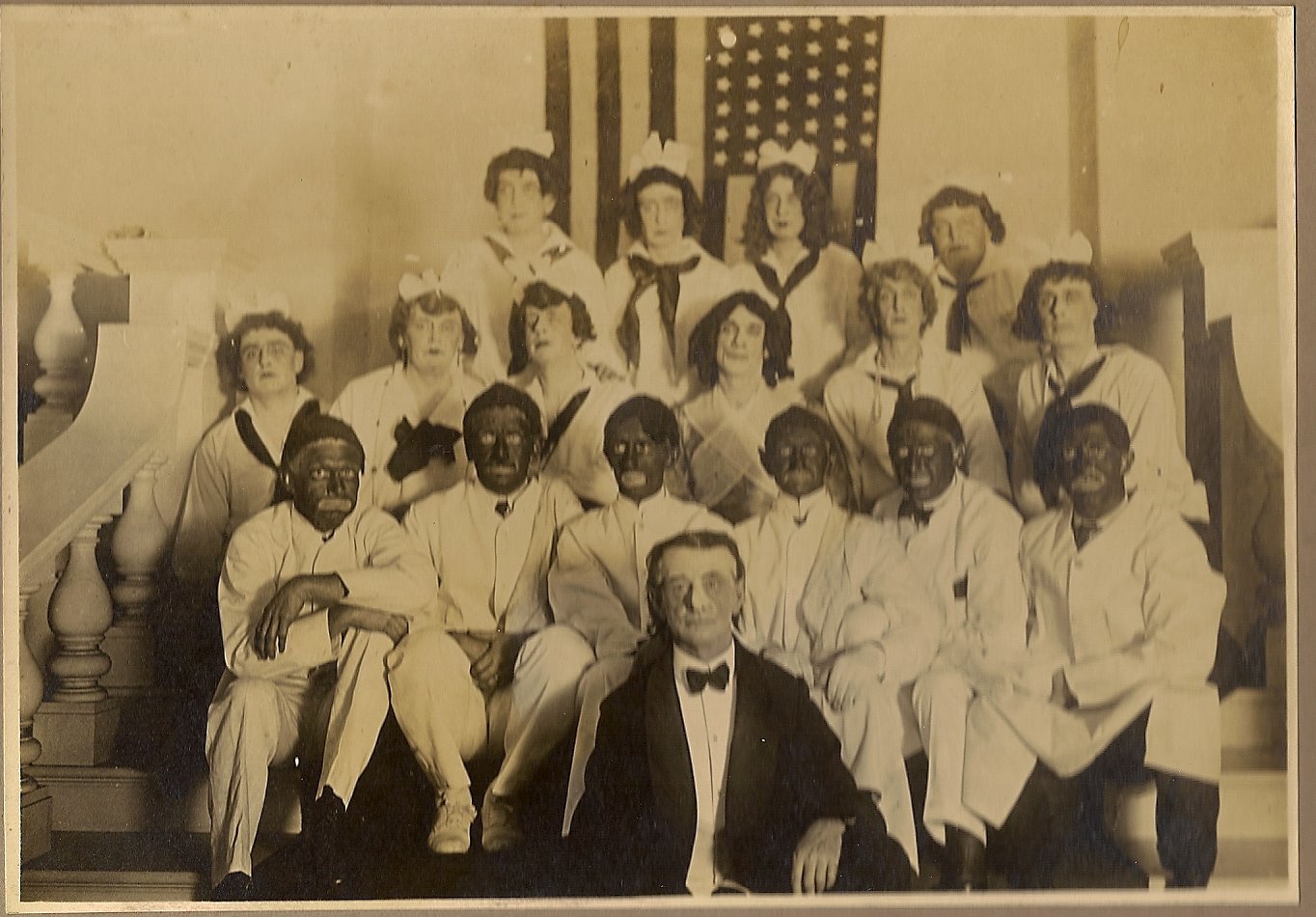
The bottom photo? You tell me? Eleven ugly drag queens, six guys in black face and a Victor Bockris look alike out front. Try outs for the New York Dolls reunion is my guess….

X-Mas part two

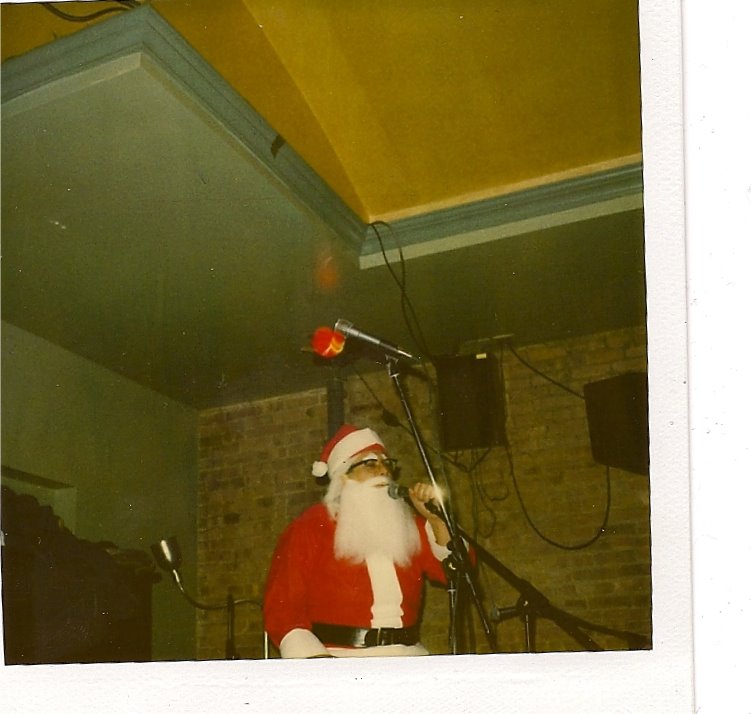
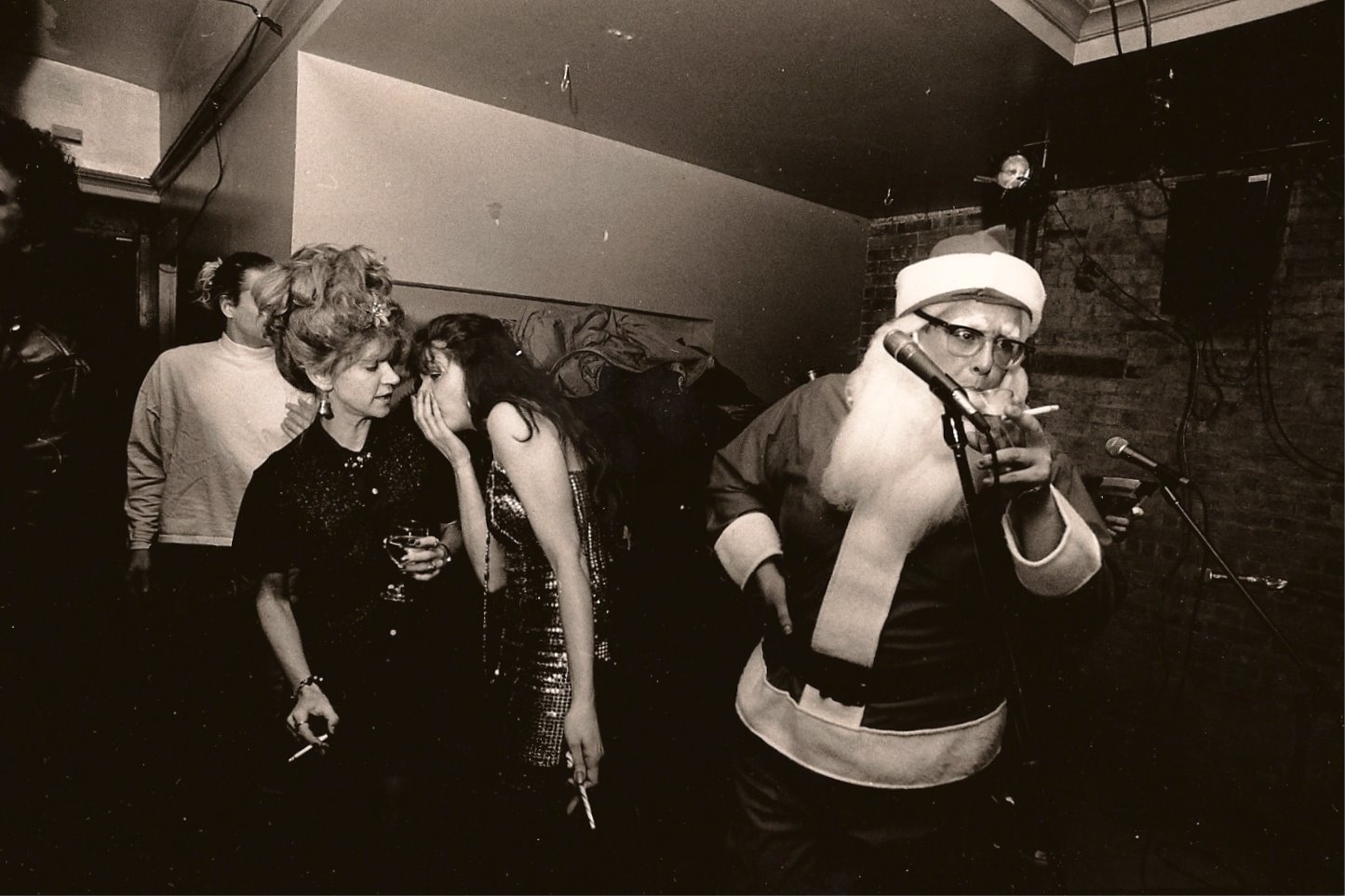
Found another picture of Rocket Redglare as Santa from our live Christmas Hangover Hop (91?, I’m still not positive of the year). He actually borrowed a friends baby to help out his Christmas panhandling, when he returned the kid it was covered in opiated sweat.
   So here’s more Christmas records if you can stand ’em. Only got two requests, the Slade record which I don’t own and James Brown’s Santa Claus Go Straight To The Ghetto. Since we’re starting with soul Christmas (pre-Kwanza) I’ve always dug Gary US Bonds Call Me For Christmas and here’s a totally different Christmas In Viet Nam than last week’s. This time by a real grunt, Pvt. Charles Bowen.
  Babs Gonzales had a way with words, as heard here on his Be Bop Santa. More like Junkie Santa, eh? Speaking of hepsters, Louis Prima’s Santa, How Come Your Eyes Are Green This Year When Last Year They Were Blue? is well worth hearing once a year.
    I don’t think I posted any Christmas mambo records last week, to rectify that here’s the Enchanters’ Mambo Santa Mambo and Big John Greer’s We Want To See Santa Do The Mambo.
Some real obscurities for you now– Barry & the Highlights– Christmas Bell Rock is pretty cool. So is the Moods’ Rockin’ Santa Claus. Mark Anthony made the second greatest Christmas twist record ever—Mama’s Twistin’ With Santa Claus, not a bad claim to non-fame. I don’t anything about Big Bud but his Rock Around The Christmas Tree is wild, out of tune sax solo and all.
Rockabilly legend Sonny Cole (“I Dreamed I Was Elvis”) knew how to put two novelty items together by sending Santa To The Moon. Even better is the Episodes- The Christmas Tree, a rare garage Xmas novelty from God knows where.

   Last post I promised some country Christmas discs so for you achy-breaky types  Jody Levins’ Jingle Bell Boogie is a cool hillbilly disc.  Speaking of hillbillies, my old pal Buck Owens (R.I.P.) made tons of great Christmas records, but his best for my money was Blue Christmas Lights. George Jones’ Mom and Santa Claus is another classic, as is his duet with Tammy What’s her face Mr and Mrs Santa Claus. If you’re the cry in your beer type at Christmas, try Jerry Lee Lewis’ I Can’t Have A Merry Christmas Without You, a non-lp 45 from ’72. Sad Christmas records are the best, no?

   Everyone’s heard Chuck Berry’s classic Run Run Rudolph, but this version is by a garage band called the Outlaws (not the Joe Meek or southern rock Outlaws either), just a cool American garage disc. This version of Jingle Bells, courtesy of the Vel-Mares sounds like Santa’s arriving via surf board. Same can be said for the incredible Trashmen whose Dancin’ With Santa is a classic of Xmas-surf trash.
Ral Donner’s Christmas Day sounds pretty much like Elvis, which means it’s pretty great. And Little Joey Farr’s Big White Cadillac is a good kid rocker, not my favorite genre but this little twerp can actually rock.The 4 Imperials Santa’s Got A Coupe De Ville  is a whacked out greaseball rocker. Speaking of greaseballs, how ’bout Jack Scott’s Jingle Bell Slide from the guy who wrote a song called Greaseball but the record company made him change it to Leroy. Patsy Raye is another one who knew how to double up on the novelty trends, combining beatniks and Christmas on her wiggy  Beatnik’s Christmas Wish. 

     Sick of Christmas records? Me too, but if you need more check out the Christmas shows from Hound Radio broadcasts past, they’re arranged by date so just keep scrollin’ down to those third week of Dec. shows. Meanwhile, maybe I’ll dig out that Rocket manuscript and see how much of it I can type into the machine here before my fingers cramp up…..

X-Mas part one

The above photo was taken from a live Hangover Hop WFMU radio broadcast done in I believe Dec. of ’91. That’s the late actor/degenerate Rocket Redglare as Santa Claus. The drink and cigarette weren’t the worst things he ingested that day.
For years comedy writer/producer/collector Eddie Gordetsky made Christmas tapes and then CD’s and sent ’em out to every cool person in the world. They were full of incredible, obscure, Christmas discs of all musical genres (and some that fit no known genre). This year he sent out an e-mail admitting he hated Christmas records and there would be no CD this year, he just sent out blank CD’s with a note to make your own and pass it along. So I’ll use this, and maybe another blog to do just that.
Truth is, I’m not crazy about Christmas either. New York City is full of stressed out shoppers and moronic tourists, all shoving and pushing. Traffic is a nightmare. The parties aren’t even fun anymore (and I don’t drink anyway courtesy of my damaged liver which doesn’t like to leave the house much anymore). And all that false “cheer” just depresses me.
I do like Christmas records because basically, rock’n’roll is a novelty music, and as such it translates to such things as Christmas records pretty well. Some groups best records are their Christmas records.
If you want to hear an entire three hours of Christmas discs you can find my Dec. ’93 show here. I think that was the best one. Not as good but with some different tunes is one from Dec. ’92 here. If you like your Christmas in smaller doses (recommended) here’s a few of my favorites.
Santo & Johnny’s Twistin’ Bells and the Ventures’ Sleigh Ride are my two favorite Xmas instrumentals.
On the vocal group R&B side of things the Marshall Brothers’ Mr. Santa’s Boogie, the Penguins’ Jingle Jangle, Marvin & Johnny’s It’s Christmas, the Marquees’ Christmas In The Congo, the Falcons’ Can This Be Christmas?, the Hepsters’ Rockin’ and Rollin’ With Santa Claus, the Youngsters’ Christmas In Jail, the Martels’ Rockin’ Santa Claus, and my old favorite Hank Ballard & the Midnighters’ Santa Claus Is Coming would all be at the top of my list.
On the rockabilly/white rocker front I’ve always loved Johnny Preston’s I Want A Rock’n’Roll Guitar, Cordell Jackson’s (I miss her Christmas cards) Be-Bopper’s Christmas, Little Joey Farr’s
Rock’n’Roll Santa, the Davis Sisters’ Christmas Boogie, Tommy Lee & the Orbits’ Jingle Rock, the Holly Twins’ I Want Elvis For Christmas (that’s Eddie Cochran doin’ the Elvis impersonation), Hasil Adkins’ Santa Claus Boogie (sounds more like Santa’s Hunch to me), Gary Remo Quartet’s St. Nick Rock, Brendan Hanlan and his Bat Men’s Christmas Party (dig that guitar solo), 3 Aces & a Joker’s Sleigh Bell Rock (flip side of “Booze Party”) and Chuck Blevins’ Sleigh Bell Rock. If those don’t liven up your Christmas party, try taking your clothes off.
     The best soul Christmas record of all time is Clarence Carter’s Back Door Santa. There’s plenty of other good ones though, including Johnny & Jon’s Christmas In Viet Nam, Clyde Lasley & the Cadillac Babies’ Santa Came Home Drunk, Detroit Jr.’s Christmas Day  and Nathaniel Mayer’s Mr. Santa Claus (too bad Nat won’t be around this Christmas, R.I.P., I bet him and Rockets have a lot to talk about on the other side).
     For Christmas blues here’s Eddie C. Cambell’s wonderful Santa’s Messin’ With The Kid, Charles Brown’s Miserable Christmas, Washboard Pete’s Christmas Blues, Lightnin’ Hopkins’ Santa, John Lee Hooker’s Blues For Christmas, Sonny Boy (What Number Sonny Boy Am I Again?) Williamson’s Sonny Boy’s Christmas Blues (actually it’s #2, Rice Miller, I am Sonny Boy #523 btw), Louis Jordan’s Santa Claus, Santa Claus, Robert Nighthawk’s Merry Christmas Baby is also a nice guitar workout, as is Hop Wilson’s Merry Christmas Darling.
     For those who like rockin’ R&B, the best Christmas record ever is Huey Smith & the Clowns Christmas album– Twas The Night Before Christmas (Ace). From said lp here’s Rock’n’Roll Santa and the best version ever of Silent Night. The whole LP can be found here.  Bobbie & Boobie’s Cool Cool Christmas  rocks like crazy, as does Jimmy Butler’s Trim Your Tree (dirty too).
    Now here’s some oddball Christmas records I like starting with my all-time favorite Christmas disc– Canned Heat & the Chipmunks (they were both on Liberty, why not?) jamming out on Christmas Boogie. Good thing Bear Hite didn’t step on one of the Chipmunks, he’d a crushed the little fella. I’d say this is Canned Heat’s best record ever. Commander Cody’s Lost Planet Airmen’s Daddy’s Drinking Up Our Christmas is another great one, it’s the only record of theirs I own. The Sonics sure deliver the goods on Don’t Believe In Christmas for you garage fans. Bob Seger & his Last Heard never sounded more like Mitch Ryder & his Detroit Wheels than they did on this one– Sock It To Me Santa. Again, this might be his best record (at least in his top three along with “East Side Story” and “Ramblin’ Gamlin’ Man”). Hope this brings some cheer to your Christmas season, especially you broke mother fuckers.
    I’ve done worn myself out for the moment, I’ll get to more great rock’n’roll and some cool country Christmas discs in another posting in the next week or so. Feel free to post requests or your own favorites, if I have ’em I’ll try and post ’em.

Rockin’ With Sun (Ra)


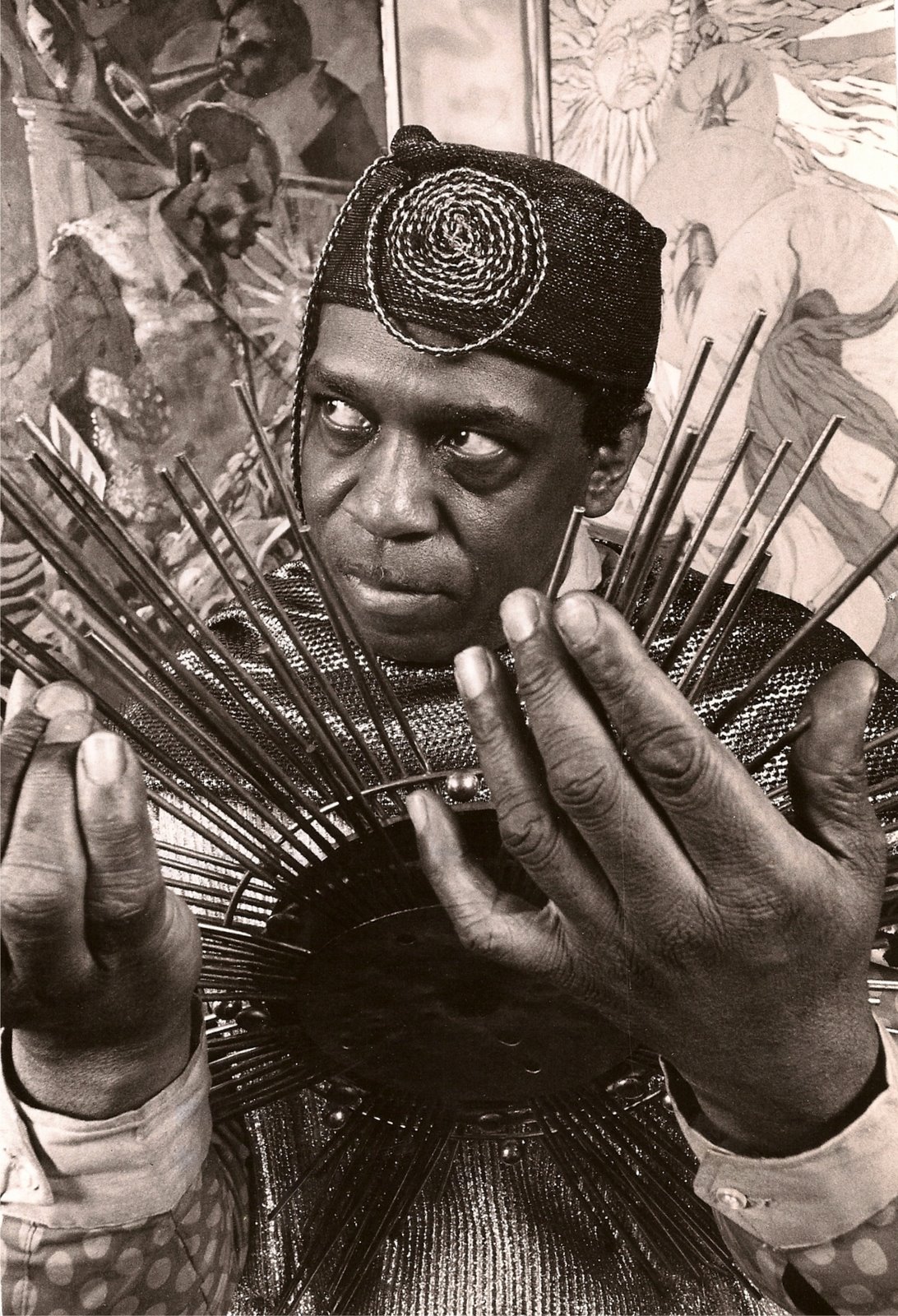
Sun Ra (Herman Poole Blount, b. May 22, 1914 in Birmingham, Alabama according to his birth certificate, Le Sony’r Ra born on Saturn according to his passport) was one of the most prolific and significant jazz musicians of the 20th century. And one of the best dressed. He recorded hundreds of LP’s, led one of the finest bands in the world for four decades, composed and arranged countless tunes. He was probably one of the few jazz musicians who could play “inside” and “outside” (ie straight or free-form) at the same time.
For those wanting more info on Sun Ra, John F. Szwed’s Space Is The Place: The Lives and Times Of Sun Ra (Pantheon Books, 1997) is essential reading. In fact it’s essential reading for anyone interested in jazz or just singular oddballs of the American variety. It’s safe to say we’ll not see the likes of Sun Ra again. Szwed’s study is a good read but it’s just the beginning and the study of Ra’s career could fill several more volumes easily.
But I’m not the guy for that job, not being much of a jazz critic or historian, the subject of today’s blog is Sun Ra’s rock’n’roll output. For those who didn’t know, Sun Ra was responsible for some truly unique rock’n’roll records. Although they represent a minuscule portion of his recorded output they’re all interesting records, and a couple of ’em are downright masterpieces.

Sun Ra’s first stab at rock’n’roll was issued on Ra’s own Saturn label in 1955 by the Cosmic Rays. In classic doo wop 45 fashion one side was a ballad– “Dreaming” and the other an upbeat near rocker– “Daddy Gonna Tell You No Lie“. Both sides have a pronounced mambo beat and feature lead singer Calvin Barron along with three unknown harmony singers. Sun plays piano, the sides were recorded in Chicago. When collectors kept asking Sunny to re-issue it he couldn’t find the master tape so instead issued an a cappella version which was recorded in his living room while rehearsing the group for their studio debut.
A very strange doo-wop recorded was issued under the name of Juanita Rogers & Lynn Hollings with Mr. V’s Five Joys on the Pink Clouds label in 1958 and is most certainly Sun Ra’s doing. The a-side–“Teenager’s Letter Of Promises” is an oddball disc by any standard, even Sun Ra’s. Juanita Rogers is the Frankie Lymon like lead vocal, Lynn Hollings is doing the strange narration.
Speaking of strange, Yochanan (The Space Age Vocalist) was a Chicago street character that Ra befriended. Yochanan appeared in local nightclubs and on Maxwell Street where he was booked as the Man From Outer Space, the Man From Mars and the Muck Muck Man. He claimed to be from the Sun and appeared decked out in turban (always a good look for a R&R singer), sandals, robes, etc. His performances were both eccentric and wild and as quoted on Szwed’s book, one Hattie Randolph remembers catching his shtick in a nightclub in Kokomo, Indiana–“When he started his act and began leaping over the tables, one woman jumped up and shouted, ‘He’s possessed’! and ran out of the club”. One listen to his first single and it’s easy to believe–
Hot Skillet Momma” b/w “Muck Muck (Matt Matt)” attributed to Yochanan (The Space Age Vocalist) is one of the greatest rock’n’roll records I’ve ever heard. It makes Screamin’ Jay Hawkins sound like Johnny Mathis. The world was not ready for Yochanan in 1957 when this disc was issued, and it’s probably still not ready. Sun Ra however believed in Yochanan enough to issue another single two years later– “I’m The One From The Sun” b/w “Message To Earthmen“, not quite as wild but still a great record. Saturn issued two outtakes in 1968 when “The Sun Man Speaks” was coupled with an alternate version of “Message To Earthmen“.
Not really a rock’n’roll record (this one truly defies classification) is this 1974 recording “I’m Gonna Unmask The Batman” by Sun Ra and his Astro-Galactic Infinity Arkestra. Sunny seemed to have a thing for Batman as he along with a few members of the Arkestra and a couple of guys from the Blues Project cut a Batman TV theme budget LP in ’66 which can be found here. Not great but interesting in a cheesy sort of way.
More on the rhythm and blues side is this 1958 Saturn 45– “Hours After” (actually a version of Erskine Hawkins’ “After Hours”) b/w “Great Balls Of Fire” (not the Jerry Lee Lewis hit) which shows the Arkestra at their bluesiest. This one seems like an attempt to garn some jukebox play around Chicago where the band was based at the time. Also, it’s a rare example of Sun Ra recording with a guitarist, in this case Sam Thomas.
     My buddy Junie Booth played bass with the Sun Ra Arkestra for many years, he told me when they went to Birmingham, Alabama for Sunny to be presented with the key to the city, midway during the ceremony Sunny turned to him and said-“I hate this fuckin’ town, that’s why I always told people I was from Saturn”.
ADDENDUM TO YESTERDAY’S POST: I forgot to mention all of the above 45s and more are available on the 2 CD set Sun Ra: The Singles (Evidence ECD22164-2).  It’s 49 tunes span three decades and include all the issued Saturn 45’s and some alternate takes. Evidence also has fifteen Cd’s of Sun Ra Saturn material covering  21 + LP’s, many of which are practically impossible to find.

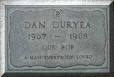
Dan Duryea- Best Of The Bad Guys


     Dan Duryea was one of the most memorable character actors in film history, yet today his name is barely known. A cryin’ shame because he played a sniveling, cowardly, yet somehow likable creep better than anyone except  maybe Richard Widmark.  Anyone who has seen his performance as Johnny, Joan Bennett’s pimp in Fritz Lang’s classic Scarlet Street (1945) (clip above) can attest to his skill at portraying sleazebags. Scarlet Street was the second time Lang cast Duryea as Bennett’s pimp, the first being Woman In The Window (1944)(Bennett, one of the first actresses to start her own production company hired Lang to direct her in four film noir’s between 1941-48. The other two were Man Hunt (1941) and Secret Beyond The Door (1948)) Enough parenthesis for you?

To get the boring background stuff out of the way is what second paragraphs are all about, no? Dan Duryea was born in White Plains, N.Y. in 1907, attended Cornell (where he succeeded sex deviant Franchot Tone as the president of the Drama Society). Upon graduation he entered the advertising biz, retiring after a brief heart attack. His acting career got off to an excellent start when he landed the starring role in Dead End on Broadway, followed by another stint on the Great White Way in Little Foxes as the snivelling weakling Leo, a role he reprised in the William Wyler film, his Hollywood debut. For his next two movies he played Gary Cooper’s nemesis, first in Howard HawksBall Of Fire (1941) (written by Billy Wilder) where his character bore the brilliant moniker Duke Pastrami, and then landing the role as cynical reporter Hank Hannerman in baseball tearjerker Pride Of The Yankees (1942). He would go on to work steadily until his death in 1968 with 110 screen credits.

     Like Widmark, he was a highly respected professional whose off screen life couldn’t have been more different from his onscreen persona. He was well liked, married to the same woman for 31 years (his son Peter worked as TV actor from 1964-1976), he rarely seen in the gossip columns.
     Most of Duryea’s roles fall in to two categories, either as the heavy/pimp/criminal/con man in film noir’s including Fritz Lang’s Ministry Of Fear (1944), and Woman In The Window (1944) Anthony Mann’s The Great Flamarian (1945) (opposite Eric Von Strohiem!), Main Street After Dark (1945), Lady On A Train(1945), Black Angel (1946), Larceny (1948), Manhandled (1948), Criss Cross (1948), Too Late For Tears (1949), Johnny Stool Pigeon (1949), One Way Street (1950), The Underworld Story (1950) Anthony Mann’s vastly underrated Thunder Bay (1953), World For Ransom (1954) Storm Fear (1955), The Burgler (1957), Slaughter On 10th Avenue (1957) and his last crime picture Walk A Tightrope (1965).
   Dan’s sneering onscreen persona translated equally well to westerns. In Along Came Jones (1945) he was yet again Gary Cooper’s nemesis, he starred in B westerns  Black Bart (1948) (opposite Yvonne DeCarlo) and Al Jennings Of Oklahoma (1951), put in a memorable appearance in Anthony Mann’s amazing Winchester 73 (1953), and puts in excellent performances in Rails Into Laramie, Ride Clear Of Diablo, and Silver Lode (all 1954), Foxfire (1955). He would again get top billing in The Marauders (1955), He Rides Tall (1964), Taggart (1964), and  The Bounty Killer (1965), all worth looking for on the Western channel.
     As his film offers became more low budget (by 1960 he’d been reduced to Platinum High School where he was billed between Mickey Rooney and Conway Twitty) and film noir pretty much died out, Duryea found plenty of work in TV. He was seen on the small screen steadily throughout the fifties and sixties, working right up to his death in ’68.  He portrayed a gunslinger in the very first episode of Rod Serling’s Twilight Zone, was a regular on the prime time soap Peyton Place, as well as appearing in such classic shows as Bonanza, Burke’s Law, Wagon Train, Naked City, Route 66, and Combat. He died of cancer at age  61 and his grave can be found at the amazing Forest Lawn Cemetery.

Alias Vince Taylor

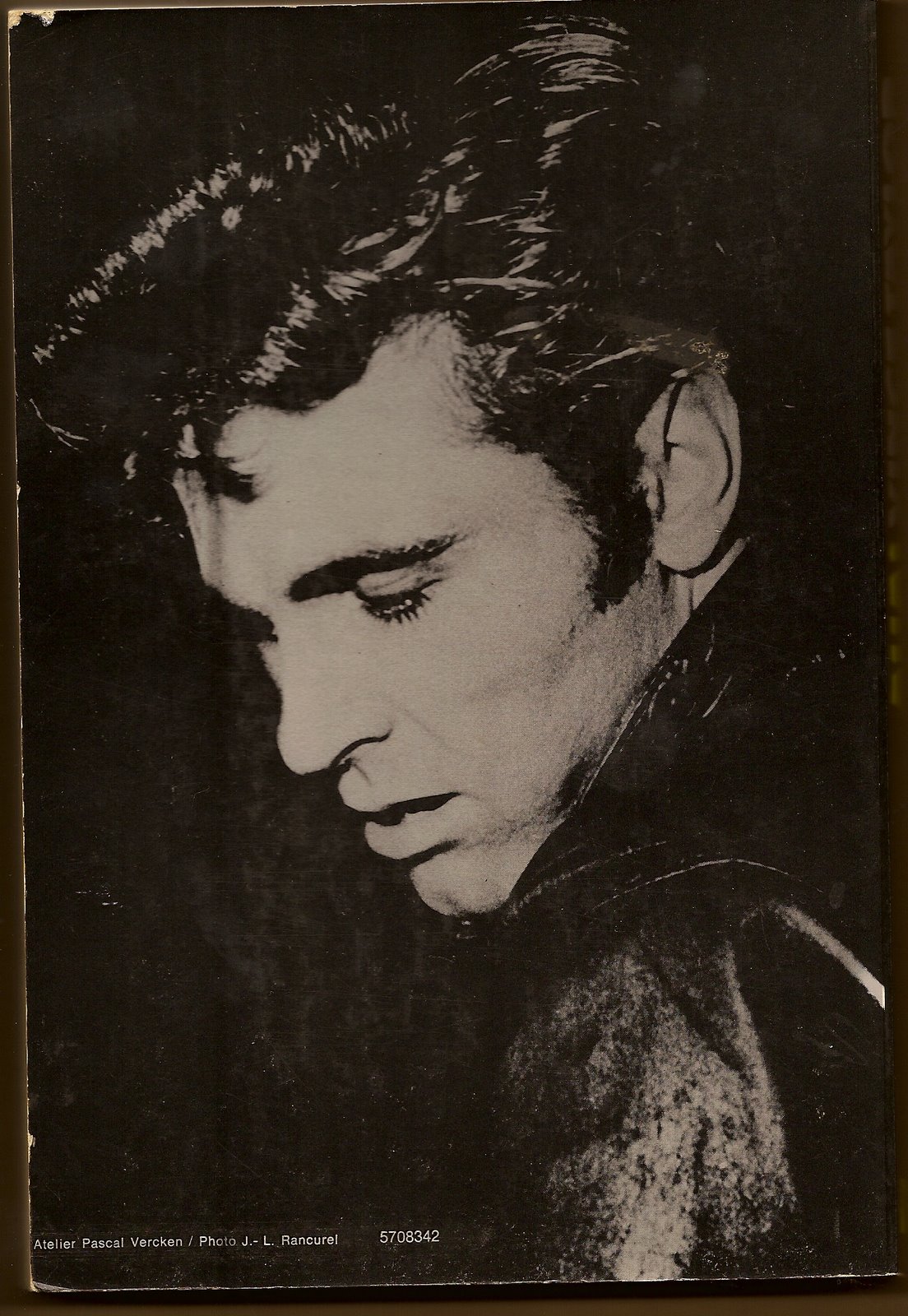
Back cover of his autobiography: Alias Vince Taylor


Vince, just after his mind was blown….


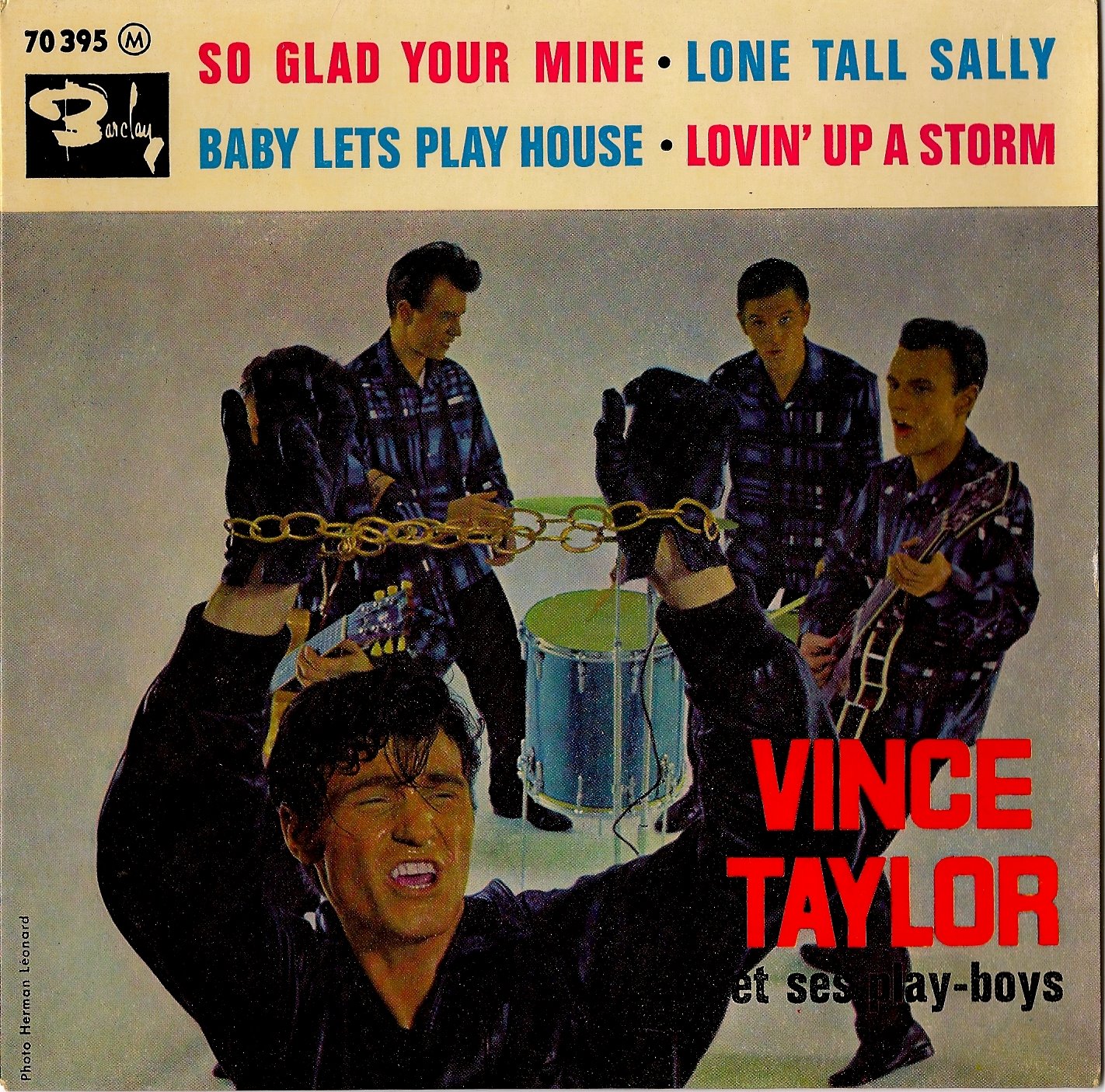
In France, The EP was the thing.

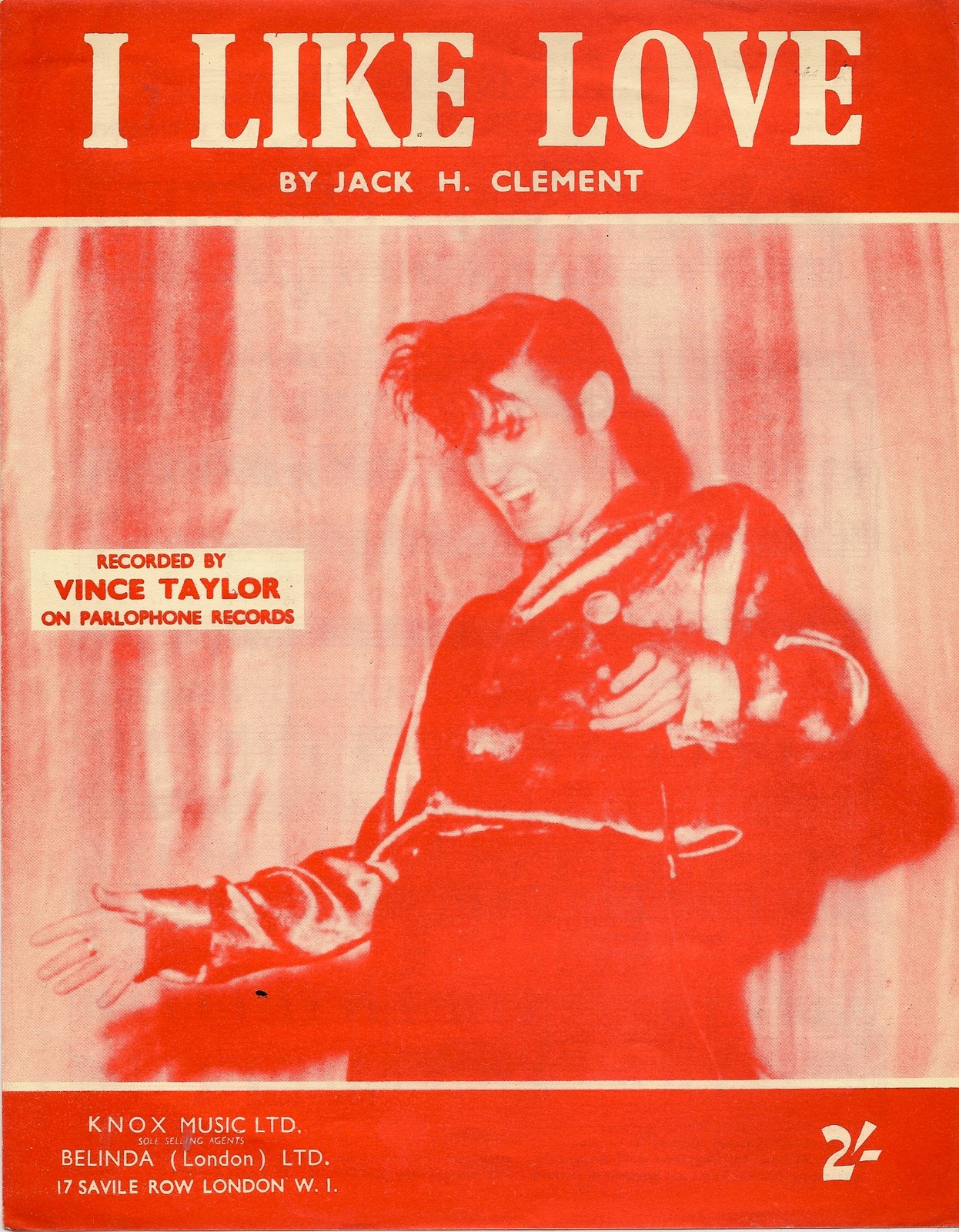
Rare Sheet Music.

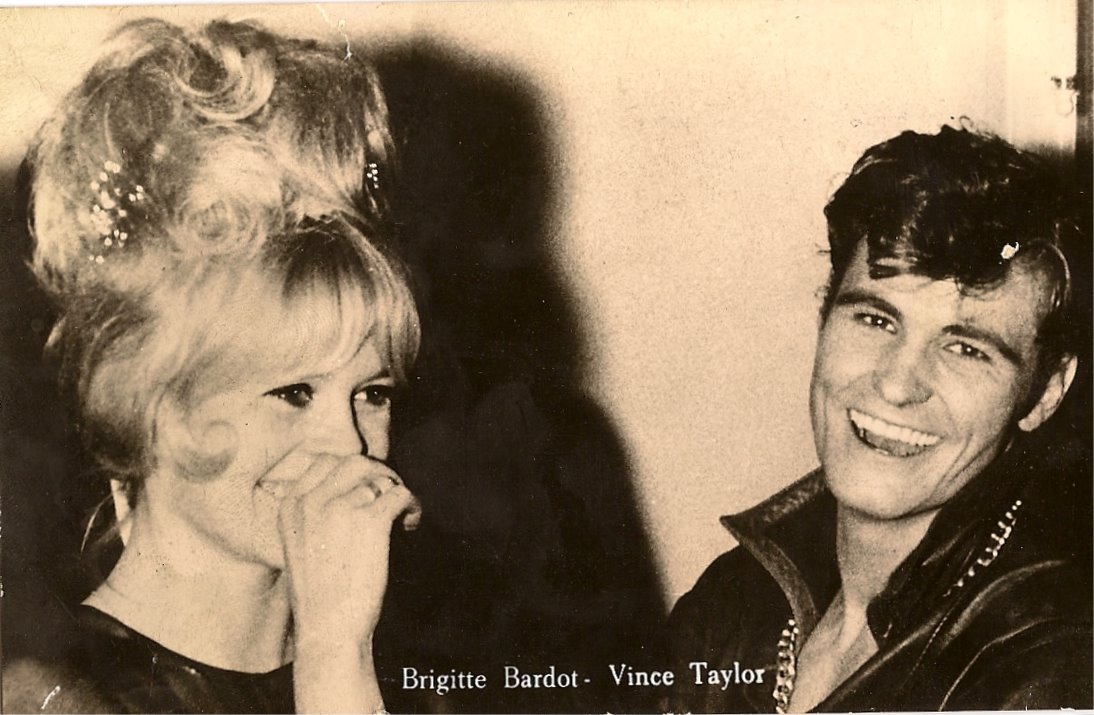
French bubble gum card, circa 1960


Two icons.

The best rock’n’roll stories are the ones where the performer goes nuts or dies. This way we don’t have to watch their heads get soft in public, or see them make fools of themselves trying to keep up with the times. This is one of those stories where the guy goes crazy. Boy, did he.
Vince Taylor was probably born off kilter, but rock’n’roll and LSD didn’t help matters. Born Brian Maurice Holden in July of 1939 in Isleworth, Middlesex, England, his family moved to New Jersey, USA in 1946 where his father got a job as a coal miner. Coal mines in New Jersey? See? This story is already weird. Fast forward to 1958. Brian had an older sister named Shelia who moved to Hollywood and married Joe Barbera, half of the animation team of Hanna-Barbera who had just hit it big with the Huckleberry Hound cartoon. With such a stroke of luck, young Brian, who fostered fantasies of turning himself into the next Elvis realized that back home in England there wasn’t much competition and with his greasy, good looks stardom would be assured. In one telling of the story he hears a Tommy Steele record and says “If that passes as rock’n’roll I can’t miss”, or something like that. Bankrolled by his sister’s new found wealth, young Brian set his plan in motion.
Renaming himself Vince Taylor (in an homage to one of his heroes– Gene Vincent), Vince, his sister Shelia, and his newly acquired manager Joe Singer headed east, landing in London in the summer of 1958 where he was soon a regular at the 2i’s coffee bar the incubator of British rock’n’roll (ironic for a country with so many pubs and so imbued with booze culture that rock’n’roll would emerge from a coffee bar). Taylor put together the first of what would be dozens of back up bands, this one featuring Tony Sheridan (who gave the Beatles their first recording session) on guitar and future Shadows rhythm section Brian “Licorice” Locking on bass and Brian Bennett on drums. Vince was signed by Parlaphone, and his first single, a rather pedestrian reading of Ray Smith’s “Right Behind You Baby” went nowhere, but his second platter– “Brand New Cadillac” was and is one of the pinnacles of British rock’n’roll. Based on a riff that sounds like a cross between Peter Gunn and “Lucille”, it is easily the best pre-Beatles British rock’n’roll record (beating out the other two contenders Johnny Kidd’s “Shakin’ All Over” and Cliff Richard’s “Move It” on sheer menace). Passing himself off as an authentic American (he being the rarest of all Brits, one with good teeth, could pull it off) gave Taylor great cache in the U.K.. With his brooding good looks and a wild stage show, Taylor was a natural. The fact that he had trouble singing in time and in key was of little consequence when the competition was the likes of Wee Willie Wayne, Tommy Steele, and Johnny Gentle.
Although it would go on to be considered of a classic it didn’t exactly tear up the charts and for his third 45 Taylor was on the tiny Palette label which issued his other great achievement in wax– “Jet Black Machine” a killer uptempo hot rod tune that brings the menacing quality in his sound to the forefront. It was his last great disc, but it too failed to chart, and despite the fact that he was a good live draw, in the U.K. he was already a spent force as a recording act.
Vince Taylor played an extended engagement at the Top Ten Club where he drove audiences to seismic frenzy, toured a bit, hired and fired musicians weekly and despite the hysteria caused by his live show, within a year he was back at the 2i’s where he started, his manager Singer disappeared and Vince was already displaying the erratic behaviour that would eventually destroy his career. He was insanely jealous and if he phoned his girlfriend and she wasn’t home, he’d blow off the show, spending his night searching for her in the pubs and coffee bars of Soho. He fought with his musicians to the point that he would lose one band to Marty Wilde, and their replacement to Duffy Power (there’s a rumor that goes that Larry Parnes who packaged and managed most of the early British rock acts, gave them their stage names according to their performance in his bed– hence Billy Fury, Johnny Gentle, etc.).
It was around this time Taylor adopted what became his signature look, a black leather sweat suit, long leather gloves, and a large chain as an accessory. There’s much debate as to whether he copped his look from Gene Vincent (who’d been outfitted similarly by British producer/promoter Jack Goode for his first U.K. tour), or if Goode and Vincent got the idea from Taylor. It was a look that Elvis would copy to much acclaim on his ’68 Comeback TV special and eventually become part of every rock idiot’s wardrobe. Nobody wore it as well as Vince Taylor, and if “Brand New Cadillac” and “Jet Black Machine” hadn’t ensured his immortality, he would still be remembered as one of rock’n’roll’s most photogenic images. Still, Taylor’s popularity had peaked in England and rock’n’roll was practically out of style in the U.S., lucky for Vince his career was given a reprieve when he took his band to Paris in 1960, appearing at the bottom of a bill that featured Vince Eager, Wee Willie Wayne and Nero & the Gladiators. Taylor in full leathers, chain, black kohl eye make-up and his hair dyed black and sculpted with grease stole the show with his stylized moves and malevolent stage presence, and was immediately signed to the French Barclay label, owned by Paris’ answer to Morris Levy, Eddie Barclay who put him to work recording covers of Eddie Cochran, Little Richard, Elvis and other rock’n’roll classics, issuing a ten inch LP and many EP’s (packaging was very important to the visually oriented French, and the EP picture cover became France’s greatest contribution to rock’n’roll). Barclay issued dozens of Vince Taylor records, many promoted by Scopitones, short films made especially for the video jukebox Scopitone machine that was popular only in France (the U.S. rights to it were owned by George Jessel, the comedian who produced the amazing movie Nightmare Alley with Tyrone Power), the clips seen here were made for the Scopitone machines.
In 1962 he headlined a bizarre show called Twist Appeal– L’Erotisme Au Xxe Siecle (Eroticism In The 20th Century) in which Taylor performed between displays of erotic dancers, sets and costumes by Erte, a famous ballet designer. Vince was packing them in and this was the pinnacle of his career as a French rock’n’roll icon.
Fueled by alcohol and prellies (preludin, the same brand of speed favored by the Beatles in their Star Club days) Taylor became more and more undependable. He blew off a two week booking at Hamburg’s Star Club, and seemed to travel between the U.S., the U.K. and France without rhyme or reason, eventually settling in St. Tropez with model Helene April who supported him financially for a spell.
In April, 1965 he opened for the Rolling Stones at Paris’ Olympia, this time backed by a new band– the Bobby Clarke Noise (whose bass player Stanislas “Stash” Klossowski would strike up a friendship with Keith Richards after the show, they remain best friends to this day). By all accounts Vince was still in fine form as a performer, but not for long. By May it was all over for Vince. On a trip back to the U.K. he attended a party for Bob Dylan and tried LSD for the first time, it was just what he needed to push his already loopy mind over the edge.
Vince scored some more acid and returned to Paris for a gig, he was filthy, unshaven and bug-eyed, clutching a bottle of Mateus wine. He insisted his name was Mateus, he was the new Jesus, son of God, and he appeared onstage that night wrapped in a sheet extolling the audience to follow him as he led a procession out the door of the venue and across the Seine to St Germain Des Pres preaching all the way. From here Taylor joins the likes of Syd Barrett, Skip Spence, and other acclaimed acid burn outs as one of those legends we love to speculate about. According to long suffering drummer Bobbie Woodman, from this point on all Vince did was eat eggs. There were comeback attempts in ’67, ’72, ’74 and ’75, all disastrous. He wrote his autobiography Alias Vince Taylor: Le Survivant (Editions Delville, 1976) but it was never translated into English. A French girl started reading it to me once but we lost touch before she could finish, although I do remember her proclaiming it “merde'”.
At some point (possibly in 1966) David Bowie came in contact with a very distraught Taylor and used his impressions of him as the basis for his Ziggy Stardust character. A sad claim to fame for the guy who cut “Brand New Cadillac”. Joe Strummer whose band the Clash would record a rather mediocre cover of “Brand New Cadillac” in the early 80’s tells a similar story of running into a very paranoid Taylor in a bar, ranting about the Duke of Windsor trying to kill him.
Vince Taylor still took the occasional rent money gig, cutting an awful live LP in ’77 (his second, his first was a fake audience dubbed live disc for Barclay in ’65) and was appearing at Teddy Boy festivals, rock’n’roll revivals and in tiny clubs until the early 80’s. He moved to Switzerland in 1983, married Nathalie Minster and spent six months in the bug house. He died of lung cancer in Switzerland on August 7, 1991. Did I mention he slept with Brigitte Bardot?

It’s Tuesday


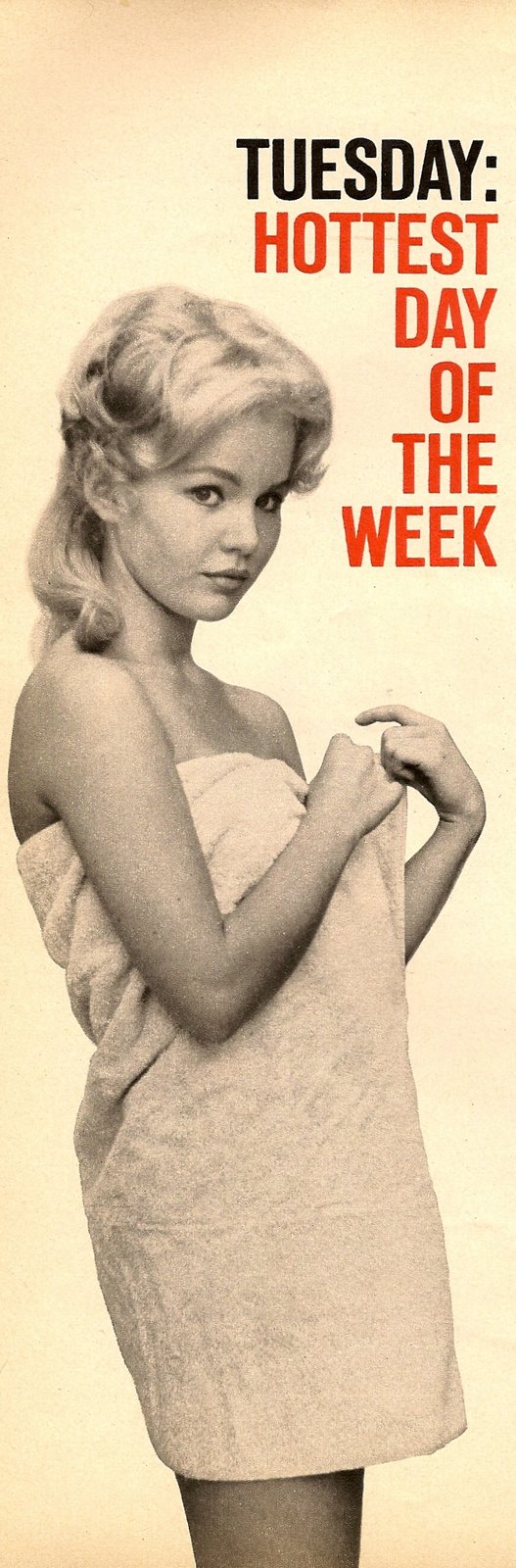
Isn’t Tuesday Weld great? From her first flick Rock Rock Rock where she shares screen time with the Johnny Burnette Trio in their only film performance, to the retarded Sex Kittens Go To College where she proves to be much sexier than the va-va voom overstated Mamie Van Doren, to the utterly nutso Pretty Poison (clip seen above), she’s livened up many movies and TV Shows (The Loves of Doby Gillis, 77 Sunset Strip, Naked City, et al). I’m convinced the only reason people bought that Mathew Sweet record Girlfriend was the cover shot (above). She was born Susan Weld in New York City in 1943, and whatever she’s doing today I hope she’s having a great time.
Among her better film appearances are Play It As It Lays (with Anthony Perkins, who also co-stars in Pretty Poison), Thief (with James Caan), Who’ll Stop The Rain, Looking For Mr. Goodbar, and Wild In The Country (with Elvis what’s his face). Her entire filmography can be found here.

Wild Jimmy Spruill


      The day I was born (May 23, 1959) the #1 record was Wilbert Harrison’s “Kansas City“. A re-make of a tune originated by Little Willie Littlefield and written by Jerry Lieber and Mike Stoller (itself based on an old tune by Jim Jackson), it featured an ultra-twangy guitar solo by Wild Jimmy Spruill. For this and other reasons I’ve always felt some sort of cosmic bond with Jimmy, who was in my opinion one of the greatest guitar wranglers in the history of rock’n’roll. You won’t find his name in the Rock’n’Roll Hall Of Fame (unlike such great talents as Art Garfunkel, Steven Stills and Bono and I don’t mean Sonny), but if you have any taste in music at all you’ve heard his playing.  As a session musician he played on hits like Bobby Lewis’ “Tossin & Turnin'”, King Curtis’ “Soul Twist”,  Dave “Baby” Cortez’ “The Happy Organ”, the Charts “Deserie” and tons of others.  Today however we shall be discussing his best records, including those issued under his own name.  First let’s get the background part out of the way.

James Spruill was born in shack in the country outside of Fayetteville, North Carolina on June 9, 1934.  His family was so poor Jimmy remembered them using newspapers and paste to seal the cracks in the wall of their house to keep the wind out.
His parents tried sharecropping but couldn’t make a living and eventually moved north first to Norfolk, Virginia, then Washington, D.C.  Jimmy started playing guitar as a tyke, building his first guitar out of a cigar box (he would build guitars his whole life, when I met him he was working on a custom job for John Hammond Jr.). As soon as he could raise a hard on he hopped  a bus to New York City where an older brother was already settled and got a job as the super of a Harlem tenement.  While practicing his guitar on the stoop he was spotted by record producer Danny Robinson (brother of Bobby Robinson, another local record mini-mogul who would figure large in Jimmy’s career).  Robinson got Jimmy his first record date, playing with the Charlie Walker  on “Driving Home pts. 1 & 2” , and another date days late with the Charlie Lucas Combo where he cut a tune called “Walkin‘” which featured his already fully formed “scratchy” guitar style. The year was 1957  and for the next eight years Spruill was the regular session guitarist on dozens of discs the Robinson brothers produced for their many labels— Fire, Fury, Enjoy, VIM, Holiday, Everlast, etc. 
 One of the most musically fruitful associations was with Allen Bunn aka Tarheel Slim, another North Carolina transplant who played guitar, and together with Spruill they cut one of the greatest rock’n’roll records to ever come out of Harlem– “Number 9 Train” b/w “Wildcat Tamer” (Fury).  He would go on to play on nearly all of Tarheel Slim’s Fury recrordings including his sole hit (with Little Ann) “It’s Too Late“.
     Perhaps the greatest pairing however was with the aforementioned Wilbert Harrison. Harrison (also from North Carolina, he sang in a Geechie accent that betrayed his Georgia Sea Island roots) had been kicking around for years, cutting sides for Savoy, but he really hit pay dirt both musically and commercially when Bobby Robinson put him together with Spruill for a series of discs that are among the greatest rock’n’roll records ever made:  “Goodbye Kansas City“, “Don’t Wreck My Life“, “Let’s Stick Together” (which Wilbert would re-record one man band style as “Let’s Work Together”, it was copied note for note by Canned Heat who had a hit with it, Bryan Ferry would take his version of it to the top of the U.K. charts in the early 70’s), “The Horse“, Willie Mabon’s “Poison Ivy” (which has one of the best lyrics ever– “Each day when I shave/in my house coat/two men have to hold me/or I’ll cut my throat….I’m like Poison Ivy/I’ll break out all over you”),  and “1960” among them.
Robinson also brought Elmore James to New York City for his last sessions in ’63, recording him with a band fronted by Jimmy Spruill, here on “Bobby’s Rock” you can hear them trading licks.
      Another great pairing was sax honker Noble “Thin Man” Watts’ who utilized Spruill on his best records such as “Hard Times (The Slop)” (Baton), “Jookin‘” (Enjoy) and “Blast Off” (Baton), they would strike up a life long friendship. The best of Noble Watts Baton sides can be found here. And before it’s slips my mind here’s a great one, Bobby Long’s “Jersey City” on the obscure Fountainhead  label that features one of Spruill’s finest solos.

     In 1957 Bobby Robisnon began issuing Wild Jimmy Spruill’s solo 45’s, the first “Jumpin’ In” on Everlast wasn’t very good but after that he cut a string of hard stinging classics where his guitar twangs, scratches and practically bounces off the speaker cones.  Issued on labels like Fire, Enjoy, Vest, and VIM were monsters like “Hard Grind“, “Scratchin‘”, “Slow Draggin‘”, “Scratch ‘n Twist“, “Cut and Dried“, and even a vocal (something Jimmy wasn’t so good at) “Country Boy“.  If you’re the CD buying sort all of the above solo discs are available on the new Night Train CD Wild Jimmy Spruill-  Scratch & Twist (Released and  Unreleased Recordings 1956-1962).  I recommend it highly, I bought one myself. Here’s one of the un-issued tracks– “Raisin’ Hell“.
     From 1957 into the early 1990’s Jimmy led a band– Wild Jimmy Spruill & the Hell Raisers who in addition to backing up acts from Chuck Berry to James Brown played all over the New York City area from long gone joints like the Rockin’ Palace on 156th St and 8th Ave to the Central Ballroom, Small’s Paradise, the Baby Grand (all still there) and had a long residency at the Sportsman’s Lounge on 8th Ave that lasted into the 90’s. When not working clubs they played weddings, parties, private clubs, and bar mitzvah. As great as his records are, you really had to see Jimmy to believe it. He played guitar with his feet, elbows, teeth, butt, over his head, between his legs, behind his back, throwing the thing around the stage and never missing a note.  Hence the Wildman moniker. In the early nineties he began appearing downtown, mostly at a club called Tramps with a version of the Hellraisers augmented by guitarist Larry Dale of “Let The Door Bell Ring” (Glover) and “Drinkin’ Wine” (Atlantic) infamy and pianist Bob Gaddy  who cut the great “C’mon Little Children” for Old Town.  They were one of the greatest bands I ever saw in my life.  
     At that time (around ’93-4) I was occasionally contributing short pieces to the New York Times‘ Style Of The Times section.  I suggested to my editor an article on these guys (“…these were the guys that invented rock’n’roll boss…”).  In the process of interviewing Jimmy for the piece (which never ran, it wasn’t exactly a “style” piece, what was I thinking?) we became friends, as a fellow Gemini we got on great.  Truth be it, I loved the guy.  He was brilliant, funny and crazy in the best way. One time
I took the train way up to the Bronx, where Jimmy lived with his wife and one of his adult twin daughters in a self decorated apartment across from the playground the locals call “the coops”.  Jimmy, who bragged at having over fifty jobs (Geminis get bored easily), and was then working as a decorator. His apartment had self installed stucco walls and a giant built in fish tank.  Very cool.  He never made much money in music but he was a happy man, he liked to go to Atlantic City and gamble a bit, he built guitars for friends and still played when ever some one called with a gig. In his own mind he was a success because he did whatever he wanted and money be damned, he refused to be a slave to it.
 In February of 1996 he headed to Florida by bus to visit old pal Noble Watts who was recording a new record for Rounder in his home studio.  Jimmy stopped in North Carolina to visit friends en route and lost his wallet.  On the return trip he had a heart attack on the bus and passed away.  Since his body carried no ID he was interned in a morgue in the North Carolina town where he’d been discovered dead.  In the meantime, back in the Bronx his wife and daughters were frantic.  It wasn’t like Jimmy to not call and after he’d been missing for weeks the local TV news ran stories about the missing blues man, until finally his corpse was located and identified.  Had he lived no doubt he’d have been rediscovered by fans and collectors who were just becoming hip to his old records (the Krazy Kat label in the UK issued a quasi-bootleg in the late 80’s of his best solo records, they didn’t even have a photo of him for the cover, using an awful drawing instead). He would have toured Europe (a place he was anxious to see), played festivals, maybe even made a few bucks.  But it was not to be. I think about him all the time.  Wild Jimmy Spruill, there’s one I really miss.

A Stranger In My Own Hometown

New York City, 2008, welcome to the Paramus Mall. Since the Republican takeover of NYC with Adolph Guiliani in the 90’s we’ve seen more and more chain/big box type stores and less and less of the weird little mom and pop shops. Endless branch banks, fast food joints (the NY Times put the number of Dunkin’ Donuts opened in Manhattan in the last five years at over 500), cell phone stores, Duane Reade drug stores (that sell aisle after aisle of psuedo-ephedrine products), and if you live in Park Slope lots of designer baby clothes. There’s only two decent book stores left in Manhattan (St. Marks Books and the Strand), there’s not a good record store in the borough. Even the movie theaters are starting to suck.  I used to go the the movies every day, now I doubt if I go twice a year. Film Forum plays the same stuff over and over, year after year (latest schedule, Les Blank retrospective, Godard’s Made In The USA, Preston Sturges retrospective, Fellini’s Amacord, not exactly breaking ground here are we)? There are multi-plexes in every neighborhood.
     Of the “art houses”, or what’s left of them only the Anthology Film Archives shows any imagination and that place is the coldest, dirtiest most rat ridden theater since the Deuce was cleaned up. At least they showed the Monks documentary. There’s three movies showing in Europe right now that are probably the only three current films I want to see, there’s The Baader-Meihof Complex, a film about the IRA hunger striker Bobby Sands called Hunger and Gomorrah which is supposed to show at the IMF theater in the Village in January. A clip from the Monks film and the trailers for The Baader-Meinhof Complex and Hunger are above. Getting back to the point, what gives? Is there no market in New York City for adventurous film programming? A cool records store?  Or anything that you can’t find in any mall out there in that wasteland we used to call our country? I guess not. It seems the suburbanites who moved here in the 90’s to be closer to their now non-existent Wall Street jobs, the proximity to 5,000 Starbucks, and idiot celebrity watching, rather than absorb the culture that this city once had to offer, prefer to bring their suburban life with them, and they’ve killed our town. There’s not much of the New York City I loved left.  When I moved here in the late 70’s we (rejects from society) had the town to ourselves, no law and order (I ran an illegal after hours club for a year before the cops showed up in 83-84, now even a legal bar is subject to endless police harassment). I never saw a kid get carded at CBGB. If this city is to have any sort of cultural life we need an atmosphere for
creativity to grow in. Not a police state.  Whether it was abstract expressionism or punk rock, virtually every interesting thing that happened in NYC in the 20th century was incubated in bars and clubs.  Maybe this economic meltdown will help by driving commercial real estate down but it’s unlikely since most landlords would rather let a space sit empty for years than rent at a reasonable price.  And if they let it sit the city gives them a tax break!  
If you don’t like the noise, go back to New Jersey. And when you come visit don’t set your car alarm when you park here.
*******************
On a different subject has anyone noticed on the latest CD release of the Rolling Stones More Hot Rocks (Big Hits & Fazed Cookies) has an alternate take of “Let It Bleed” ? I only noticed by accident. BTW one of the best Stones live/rehearsal tapes to ever surface, a mix of a show in Dallas, ’72 and the afternoon rehearsal can be found here. Amazing sound quality (stereo!), and probably the best they ever sounded without Brian.  In the UK, a few years back the the Elvis Blues CD  had this unheard take of Stranger In My Own Hometown, one of my all time favorite Elvis tunes. Neither of these alternates are mentioned on the packaging so I assume they were released by mistake. BTW, if you never heard Percy Mayfield’s original version of “Stranger In My Own Hometown”, from Ray Charles’ Tangerine label, here it is.
*********************
Here, from an old Hound show aircheck is my musical re-creation of a Thanksgiving dinner:
Lionel Hampton- Turky Hop, Nat Kendricks & the Swans- Mashed Potatoes, Robert Williams & the Groovers- Cranberry Blues, Andre Williams- Please Pass The Biscuits, Nite Caps- Wine Wine Wine, Marvin & Johnny- Cherry Pie and of course Alfred E. Newman- It’s A Gas. Happy Holiday.

Guitar evanglists, singing preachers and the like….

[youtube https://www.youtube.com/watch?v=IwvZyoLnKSs&hl=en&fs=1%5D


I’ve been collecting gospel records since 1977. It started at a bargain bin in a Woolworth in Ft. Lauderdale’s only black neighborhood where I spotted a peculiar looking LP in the 39 cent bin.
The cover photo showed a heavy set, middle age black woman wearing a turban and a huge feathered boa playing an arch top electric guitar. It was Sister Rosetta Tharpe (bottom clip) and I’d never heard of her but for 39 cents it was worth it just for the photo. When I brought the record home and played it imagine my surprise when the sound of Sam Price’s boogie piano backed by a slapping string bass and drums came rolling out of my speakers. This was followed by a guitar solo that could have come off of an obscure Sun rockabilly 45, then a woman’s voice began belting out “Strange Things Happening Everyday“. A call and response rocker that except for the religious bent of the lyrics could have easily fit in with the rockabilly and R&B 45’s I was just then discovering. Record collecting of course is part archeology, and I’d struck a new layer in the excavation of rock’n’roll’s past. I’ve been mining that vein ever since, especially since the rise in prices, record conventions and Ebay have taken most of the fun out of record collecting. Gospel discs though are still relatively cheap, and you can still find ’em if you know where to look.

In his groundbreaking book The Gospel Sound (Good News and Bad Times, revised and updated Limelight Editions, 1985, still the only decent book on the subject) author Anthony Heilbut divides the Gospel sound into to three major groups, the solo singers, usually female best exemplified by the big voiced contraltos like Mahalia Jackson and Marion Williams, choirs such as New York’s famed Abyssinian Baptist Choir, the Edwin Hawkins Singers (who scored maybe the only real gospel pop hit with “Oh Happy Day), etc. and the quartets (which usually have five members but all gospel singing groups are called quartets) like the Golden Gate Quartet, Dixie Hummingbirds (middle clip), 5 Blind Boys Of Alabama (top clip), Pilgrim Travlers, the Soul Stirrers (where Sam Cooke first came to national attention, heard here in a church rattling live rendition of “Nearer To Thee” from the Shrine Auditorium Concert in ’53), the Swan Silvertones, et. al.
There are performers who don’t fit into the above categories like the Staple Singers, female groups like the Ward Singers, and my favorite, the guitar Evangelists.
One thing they all have in common is they developed in the Holiness In God Church Of Christ also known as the Sanctified Church where music is extremely important and folks “fall out” (lose control of their brains) and often speak in tongues. The white branch of the HIGCOC are often called Holy Rollers for this reason. Elvis is just one white rocker with such a background.
Hardcore gospel fans usually prefer the big voiced female singers whose art is
comparable to opera singing in the level of physical difficulty although unlike oper, gospel singing usually involves a great degree of improvisation. Anyone who has heard Clara Ward sing “When I Get Over” understands that Aretha Franklin (just voted by the ever irrelevant Rolling Stone magazine the all time greatest pop singer) has not an original cell in her large body. Every nuance, every vocal trick and aside that makes Aretha a star was copped from Clara Ward (who also influenced Little Richard in a very different way, check out the Ward Singers’ “Packin’ Up” to hear where Richard’s “wooo” came from).
Record companies started recording gospel music almost as soon as they started recording and singing preachers and guitar Evangelists as well as jubilee style groups were among the first “race” records issued.
Columbia had a winner on their hands with Blind Willie Johnson, whom they recorded from 1927-30, a street singer and great slide guitar player who would come to the attention of white folks when Sam Charters devoted a chapter to him in his groundbreaking 1959 book The Country Blues (revised edition De Capo, 1975).
I first heard him on the Folkways compilation LP that was issued as a companion to the book. It was said a cop arrested him for trying to incite a riot by singing “If I Had My Way, I’d Tear This Building Down” on a Dallas street. Ry Cooder practically made a career out of rehashing Johnson’s ethereal “Dark Was The Night, Cold Was The Ground“, one of the true masterpieces of slide guitar playing. Johnson’s music is easy to find, Sony has a two cd set of his complete works and Yazoo has a nice collection which last time I looked could be found here. Johnson’s collection of voices, from a the gruff, throat full of broken glass heard on “If I Had…” to a fluttering falsetto, show an instrument every bit as sensitive as his heralded guitarmanship.
Another favorite from the scratchy old 78 collection is under the nome du disc Black Billy Sunday (real name: Dr. J. Gordon McPherson) whose 1931 session for Paramount produced this masterpiece–“This Ole World’s In A Hellava Fix“. It’s the kind of record that is always timely.
It was said that this was Hank Williams’ favorite, the Guitar Evangelist (aka Rev. Edward W. Clayborn) 1927 Vocallion recording of “Death Is A Dream“. Good enough for Hank, good enough for the Hound.
I have no idea who the 2 Gospel Keys were but they made two of the greatest records I’ve ever heard. “I Don’t Feel At Home In This World Anymore” and “You Got To Move” (which the Stones’ covered using Mississippi Fred McDowell’s version as their template) capture the sound of the Holiness church in all it’s earthly glory. It’s enough to get you saved, or at least shaved. They recorded for New York’s Apollo label in 1948, then went back to church and never recorded again.
Rev. Anderson Johnson was from Miami, Florida and issued his own discs on his Glory label. He was a rockin’ electric guitarist and had a declaiming style of singing
that added a touch of humor to his rockin’ electric sermons. My favorite is this one,
God Don’t Like It”(especially the apology at the end) and also his version of “Let That Liar Pass On By” which bears no small resemblance to Ray Charles’ hit “Leave My Woman Alone“.
Rev. Utah Smith was from New Orleans where he ran the Two Wings Temple branch of the Holiness Church. He recorded these two songs twice each, and each version was issued on two different labels. Maybe he was also into numerology?
It matters not, but “Two Wings” and ” Take A Trip (Gospel Ship)” are two of the greatest post-war guitar Evangelist recordings, both recorded in ’53 these versions were on the Kay-Ron label.
One of the most prized 78’s I own is this one on the Chart label out of Miami, Elder Beck’s utterly crazed “Rock’n’Roll Sermon“. Whilst in the process of warning of the sins of rock’n’roll, Rev. Beck just can’t help hisself and the whole thing mutates into a version of “Rock Around The Clock” that would make Bill Haley’s spit curl stand up straight. It’s rare as hell but can be found on the great R&B compilation Blowin’ Through Yokahama (Atomic Passion), one of my all time favorite LP’s (Norton Records has it in their mail order catalogue).
Although they didn’t record for the “race” market, Rev. Louis Overstreet, his guitar, his four sons, and the Congregation of St. Luke’s Powerhouse Church Of God In Christ (pictured above, his sons bearing no small resemblance to Alvin & the Chipmunks, and where’s that Stratocaster today?) were captured by Arhoolie’s Chris Strachwitz in 1962 at their Phoenix, Arizona church, and as heard here on “Yeah Lord
rafter shakin’ was their business.
Rev. Charlie Jackson, from New Orleans was influenced by the aforementioned Rev. Utah Smith and recorded a whole bunch of 45’s for the Booker label in the 1970’s, the best of which are “Morning Train” (here’s the Sensational Nightingales original for comparison’s sake) and “Wrapped Up and Tangled Up“. All his sides were re-issued on LP on Crypt and CD on Casequarter, the LP sounding much better to my ears.
The only white singer who can compare to any of the folks I’ve been talking about here is Brother Claude Ely who recorded for King in the 50’s. His rendition of “Ain’t No Grave Gonna Hold My Body Down“, “You Gotta Move” (said to be the inspiration for Elvis’ version) and “Holy Holy Holy” make him a credit to his race.
Another disc I should mention, issued on Savoy’s Gospel imprint in ’58 is the Selah Singers’ “The Wicked Race” which gets snaps for mentioning Sputnik. A bit scratchy but it’s never been re-issued.
I end today’s blogism (blogatin’? blogation? blogeration?) with two version of one of my favorite tunes, it’s called “This Is A Mean World”, again, some lyrics never go out of style, the first is done quartet style by the Trumpeteers on King and the second singing preacher fashion by Rev. C. L. Johnson for Savoy. And then I’m off into the sunset with one last tune from the Swan Silvertones on Specialty– I’m A Rollin‘. Get right with God, motherfuckers.