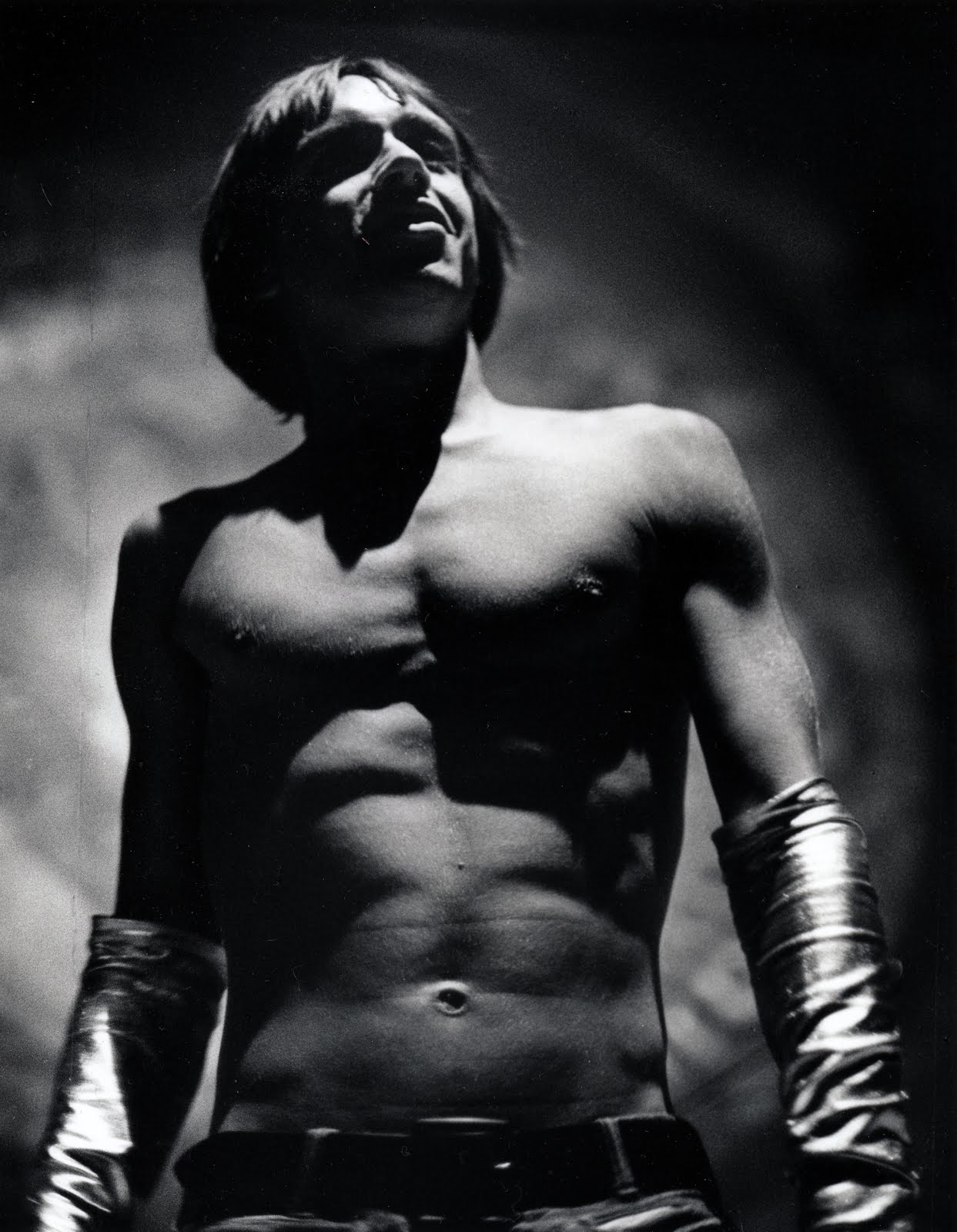
The Stooges- Triumph Of The Will

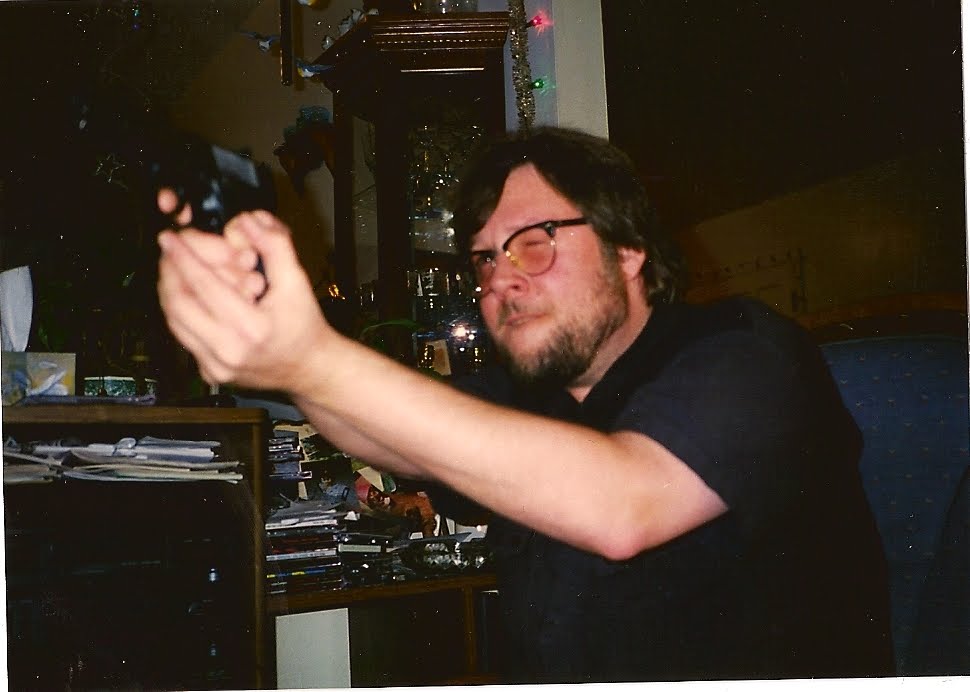
Ron Asheton takes aim, 1995 (photo by Gillian McCain)


Iggy Pop– “We Won!”


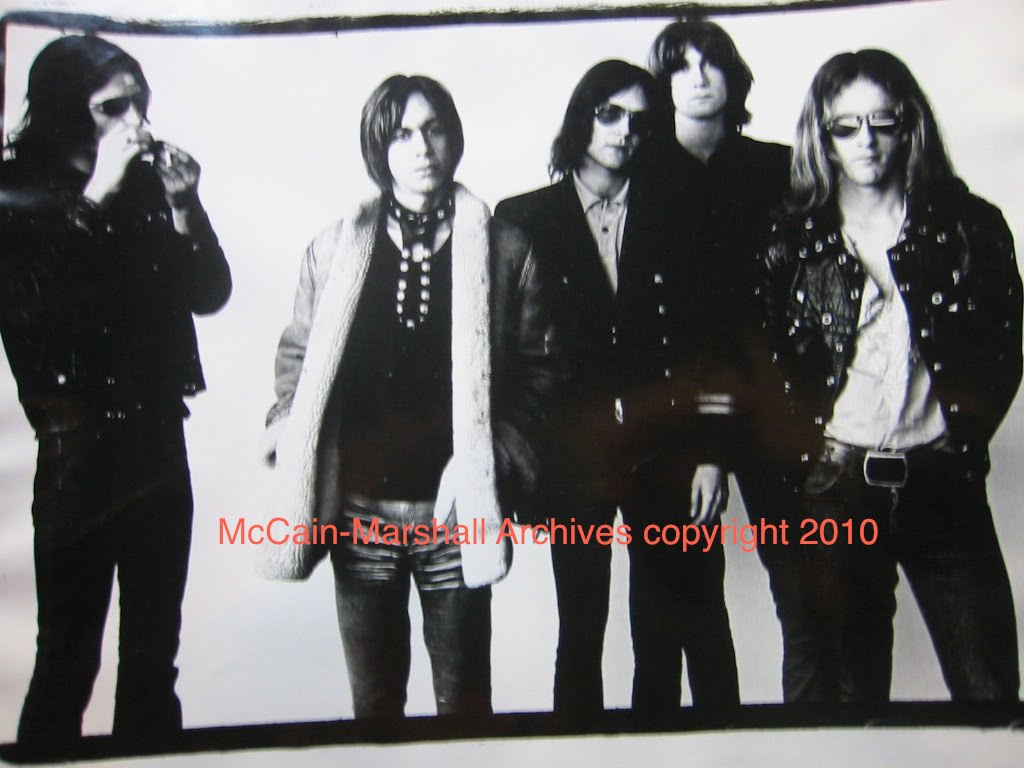
Stooges: Alive & Dead: Scott Asheton, Iggy Pop, Ron Asheton, Zeke Zettner, Bill Cheetam, 1971. (Photo by Peter Hujar).
We went over to Danny Fields’ apartment to watch the Stooges get inducted into the Rock’n’Roll Hall Of Blowhards, a few thoughts on the subject:
* It was nice that Iggy gave a shout out to Danny Fields (the cheap pricks who run the thing wouldn’t give Danny a free invite). Danny had to tell Iggy before hand not to mention his last name as whenever he gets mentioned in full, his name gets beeped out. I guess somebody up there doesn’t like him.
Proof positive he’s the coolest guy in the world.
*It was great to see Kathy Asheton in the audience, I hope she got a free ticket!
* It was very cool that all four dead Stooges were mentioned– Ron Asheton, Dave Alexander, Tommy “Zeke” Zettner and Bill Cheetam.
* It was also nice to that the little twerp doing the inducting gave a shout out to Please Kill Me (Gillian McCain & Legs McNeil, Grove Press, 1996), still the book with the best Stooges stories.
* They sounded fantastic! It was a first for that particular line-up– Scott Thurston was back in the piano slot for the night, I don’t think he’s ever been onstage with Steve McKay and Mike Watt before. I’ve never heard Williamson play I Wanna Be Your Dog before, and he did a fantastic job, a real tribute to Ron Asheton’s style.
* There was one short piece of film footage in the introductory montage I don’t think I’ve ever seen before. I hope it’s included in its entirety on the “Making Of Raw Power” DVD that comes with the Raw Power Deluxe box (release date: April 15th). You can read my thoughts on the Raw Power box from last months entry here.
* More Stooges rarities on the way. Rhino Handmade has the first Stooges LP with more alternate takes and the never heard before tune Asthma Attack on its release schedule. Twenty six tracks in all! Can’t wait!
* Write to Rhino Handmade and demand they release the Stooges Live at Ugano’s tape that they purchased last year!
* I loved Iggy’s comments to the audience! What a dead assed, lame crowd that was.
* The first half hour of the show was taken up by a band called Phish, whom I’ve never heard before. They are without a doubt the worst and ugliest excuse for a rock band I’ve ever seen.
I wanted Rock Action to push that singer’s smarmy, chinless, face through a glass door!
* If you’ve been hiding under a rock, the 4 CD set You Want My Action, which consists of four live sets of the late ’71 Stooges line up (Iggy, the Asheton brothers, James Williamson and Jimmy Recca) is a must have, even though the sound quality isn’t so great. It’s still a great package done by a class label, and the music is fantastic, including many tunes never heard before in any form. My posting on the subject from last October can be found here.
* Iggy should run for president.
ADDENDUM: More death. Here’s Richard Williams obit for Charlie Gillett from today’s Guardian, author of The Sound Of The City (The Rise Of Rock’n’Roll) the first really great book on the subject and host of many BBC radio shows. He will be missed. As will Alex Chilton about whom I don’t have much to say, I didn’t know him really well but we always got along, and had some fun together, until small town politics forced us into opposing corners of New Orleans small social world. I’ve always loved Big Star’s Sister Lovers and parts of Flies On Sherbert. The last conversation I had with him he was raving about how great Avril Levine is.
I think he enjoyed being perverse.
Here’s Alex’s obituary from the Memphis Commercial Appeal. Alex was paid tribute from the floor of the House Of Representatives today, you can watch the C-Span tape of it here.

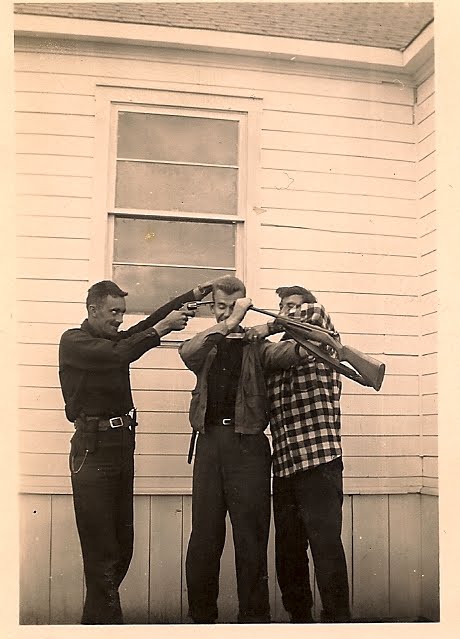
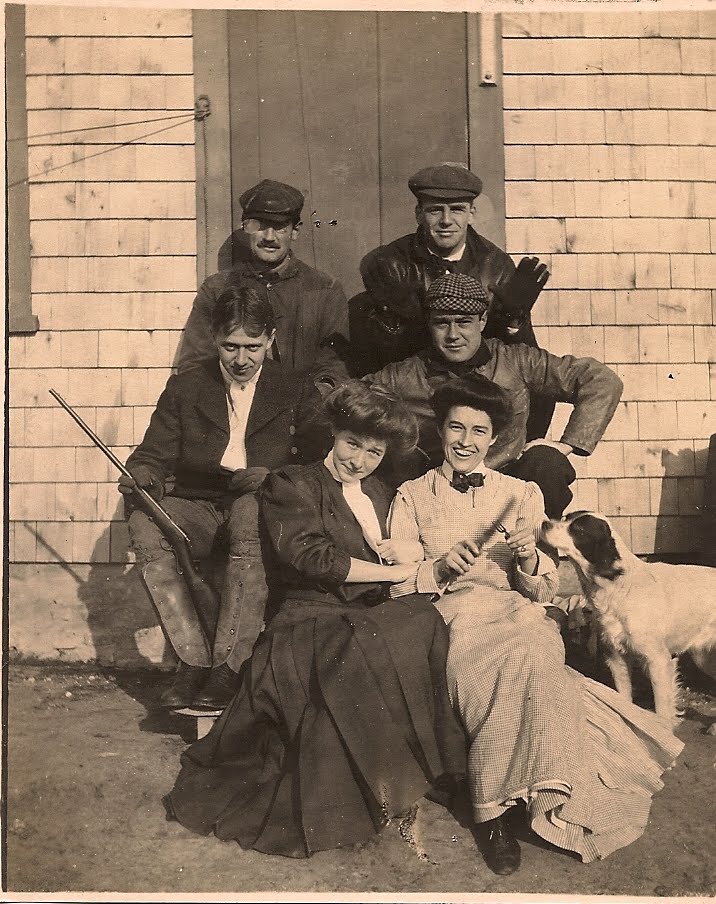
Gillian’s Found Photo #42

It seems that Mac and Max Sweet (left and right) have found themselves a mark, in fact their victim (identified on the rear of the snapshot only as “me”) is certainly co-operative enough, even to the point of keeping himself covered, while the Sweet brothers rob him.

Given that he has the firepower over them, perhaps he’s simply practicing Christianity as laid out in the New Testament (as in “turn the other cheek”). No matter, he’s unlikely to escape.
Check out the look in Mac’s eyes, this guy’s done some time! Date and place unknown. I bet at least one of these guys has a junkie’s cross tattooed somewhere on their body.

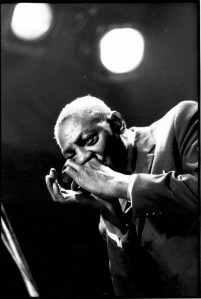
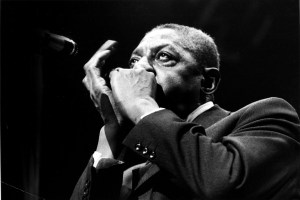
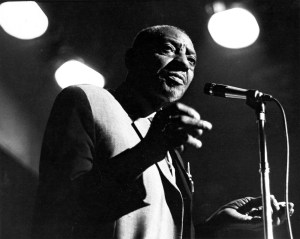
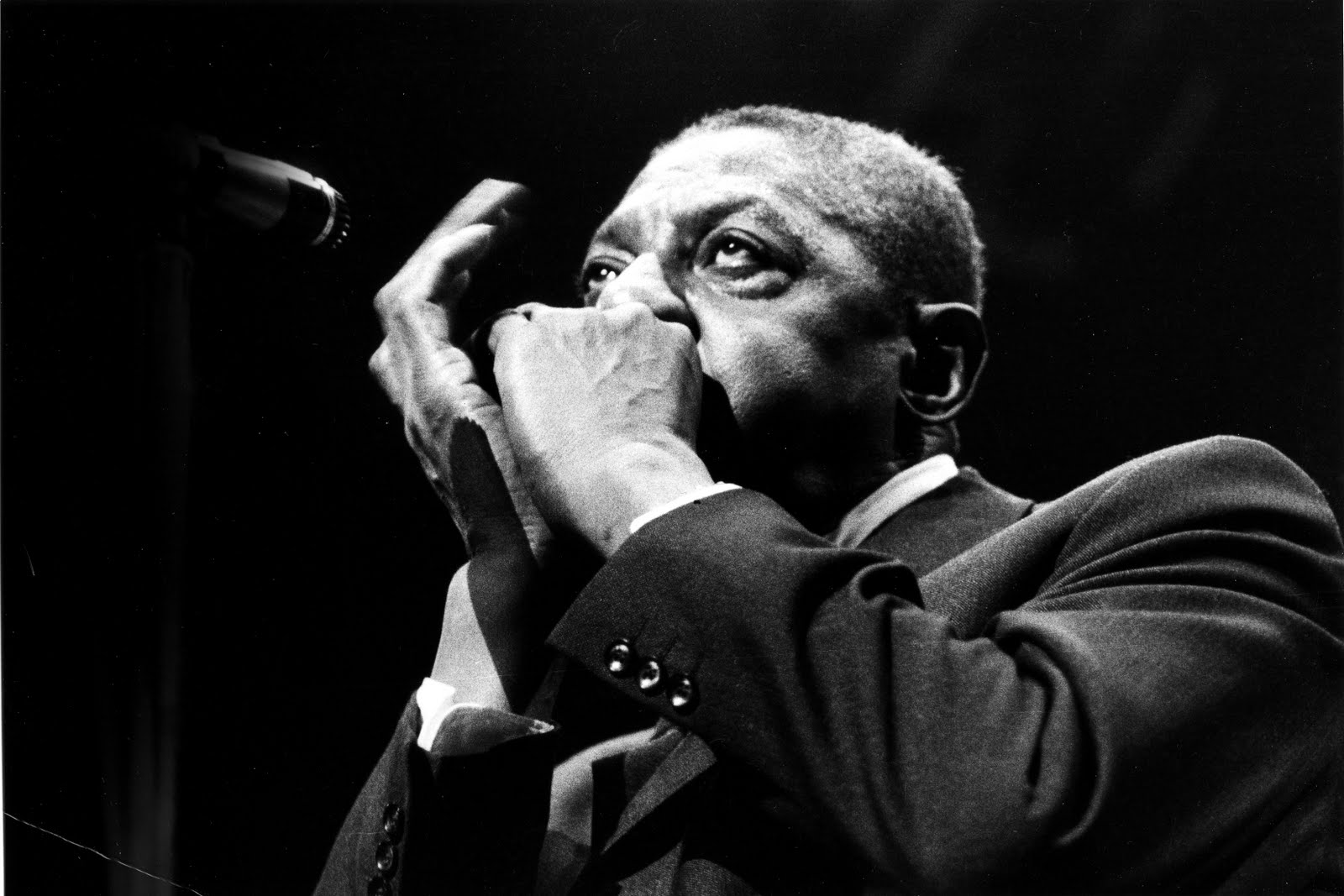
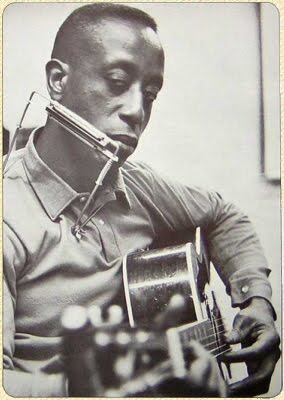
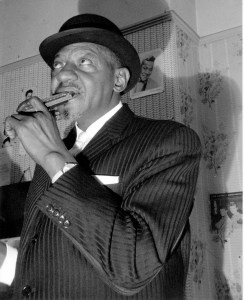
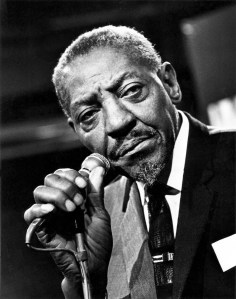
Sonny Boy Williamson II (Rice Miller)

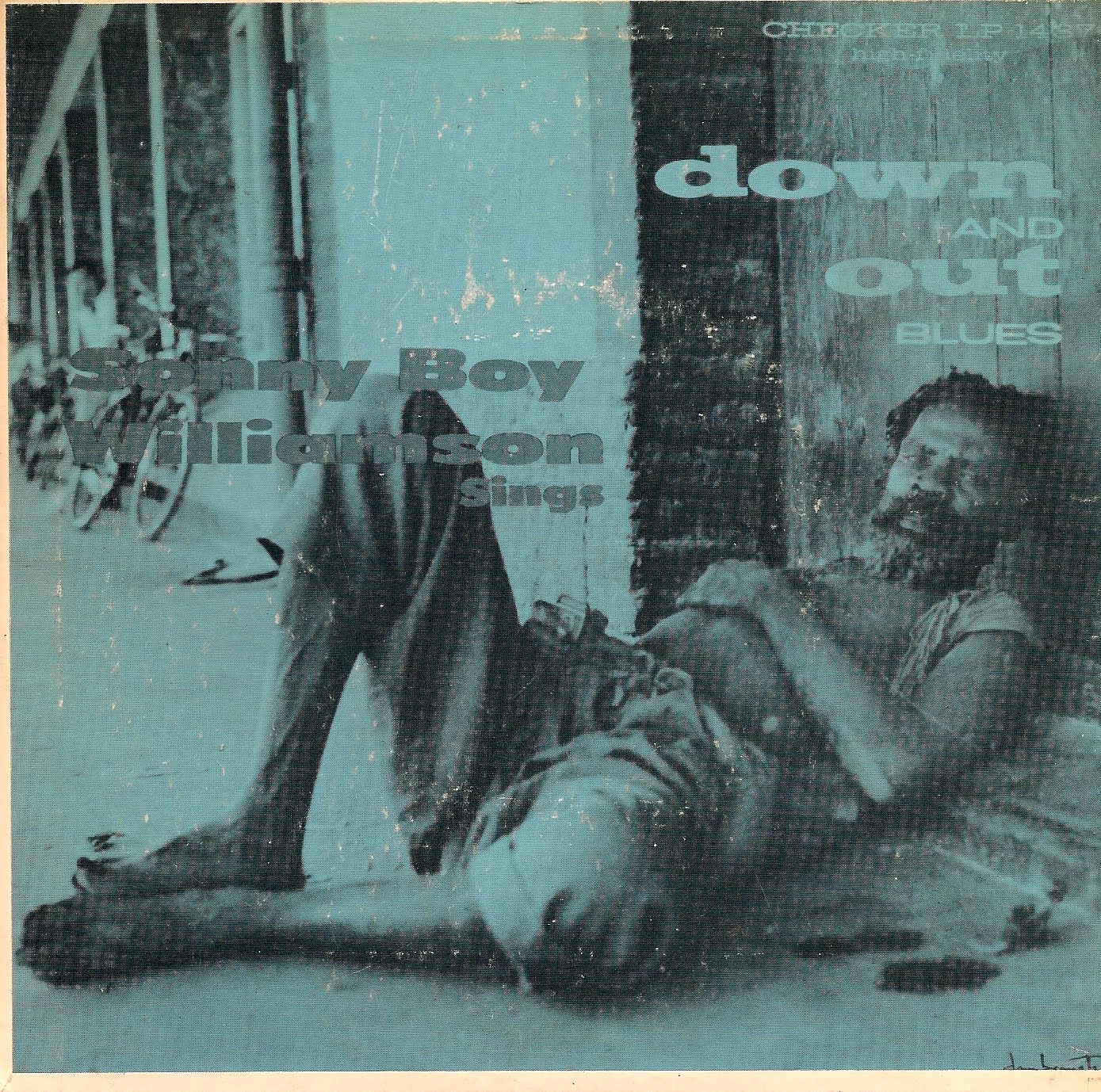
Rare Checker 33 1/3rd seven inch EP, that’s not Sonny Boy on the cover.


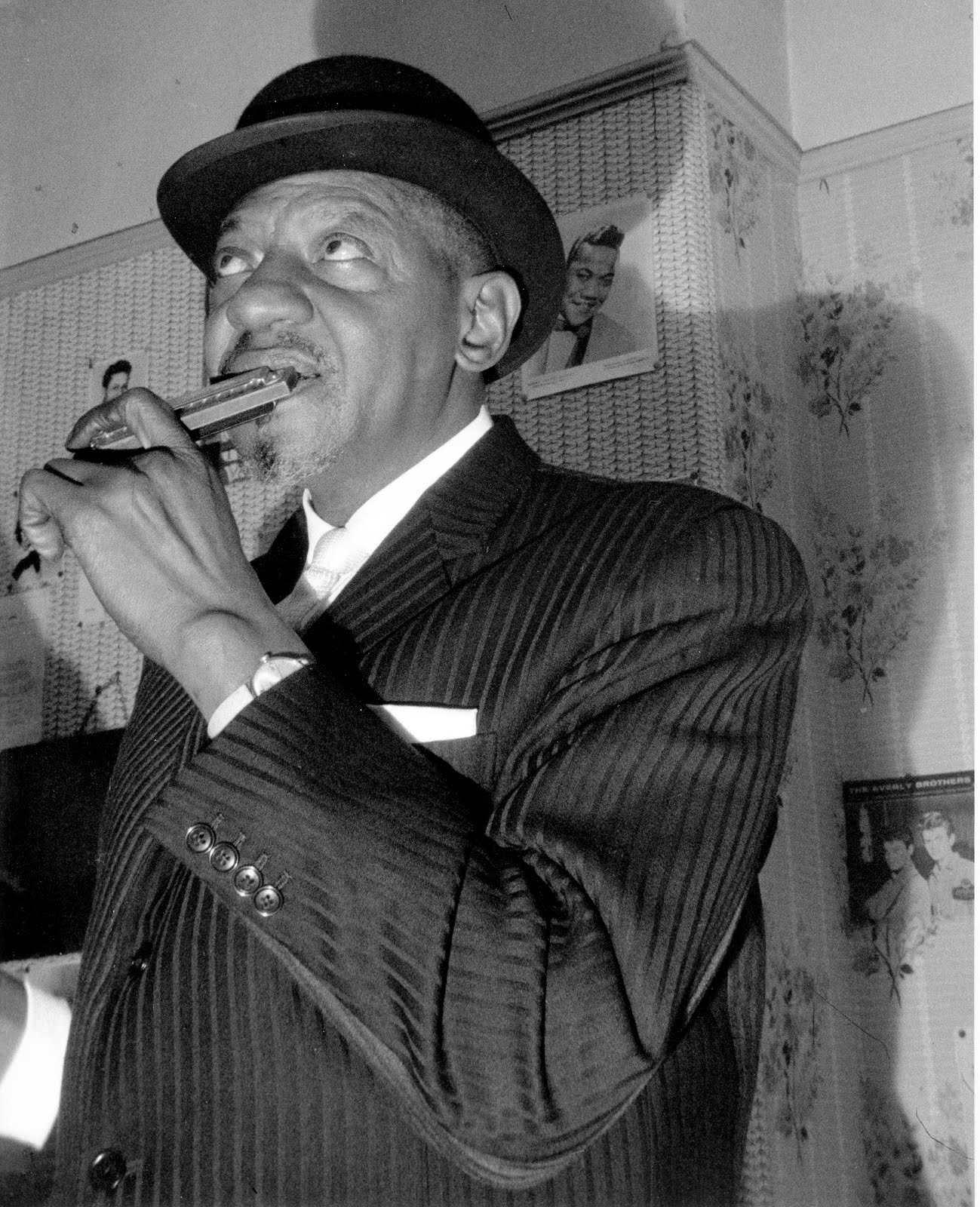
Sonny Boy, back from England in a bowler hat and tailored suit, 1965.

Wearing the famed two tone suit.


Onstage in the U.K., 1964.

Your Funeral, My Trial, from some European TV Show, mid-60’s


with Matt “Guitar” Murphy, Otis Spann, Willie Dixon and Bill Stepney, 1963.

Playing for the squares, nice set….


Born Alec Ford on December 5th, 1899 (according to him), or 1912 (according to census records uncovered by researcher David Evans), or March 11, 1908 (according to his headstone), today’s subject soon took on the last name of his stepfather– Miller and for reasons no one has ever explained the first name Rice. So begins our story of this fellow named Rice Miller who popped out from between his mama’s legs on the Sara Jones Plantation in Tallahatchie County, Mississippi, and would later find fame under the name Sonny Boy Williamson, often given the suffix II, to distinguish him from John Lee “Sonny Boy” Williamson, whose name he found it gainful to adopt for his own purposes. Confused yet? Let’s see if I can’t further complicate the story.
It seems young Rice hung around the Plantation, working the fields with his stepfather Jim Ford and mother Millie, learned to play harmonica, and by the early 30’s had set off to earn his keep as a musician. In these lean years of the first great Depression he would cross paths with, travel with, and often play music with bluesmen like Robert Johnson, Robert Junior Lockwood, Elmore James, Houston Stackhouse, Robert Lee McCoy aka Robert Nighthawk, as well as acquiring a soon to be famous brother in law– Chester Arthur Burnett aka the Howlin’ Wolf, whom he taught to play the harmonica. He played on the street, in juke joints and country frolics, developing a huge repertoire of tunes and great talents as an entertainer, including the ability to play two harmonicas simultaneously, one in his mouth and the other in his nose. Don’t try that one at home kids, you’ll only hurt yourself.
In 1941 he was approached by a the King Biscuit Flour Company to promote their product via a morning radio show on KFFA in Helena, Arkansas. To add celebrity value to their partnership,
Miller took on the moniker of Sonny Boy Williamson, the same as aforementioned John Lee Williamson, then living in Chicago and recording for Bluebird Records under the tutelage of Lester Melrose. John Lee (now called Sonny Boy Williamson I, or #1 to distinguish him from his pretender) was one of the biggest blues stars of the era, whom often in tandem with Big Joe Williams and/or Yank Rachell had scored many “race” hits starting in 1937 with Good Morning Little Schoolgirl, Bring Me Another Half Pint, Bluebird Blues, Sloppy Drunk, et. al. When he found about the character in Arkansas using his name, John Lee took legal action, which went nowhere, since Rice Miller’s defense was that he was calling himself “Sonny Boy Williams”, of course, most blue fans at the time pronounced Williamson as Williams, and the case was thrown out of court. John Lee Williamson would take minor revenge later by recording his own version of Rice Miller’s King Biscuit Stomp, a move that would further complicate matters in everyone’s mind, and most especially in this blog entry. Miller’s radio show was a hit, and soon the King Biscuit folks named their cornmeal after Sonny Boy, with a drawing of Rice Miller on every bag. You can still get it, it makes nice corn muffins. Here’s a recording, not an aircheck, but a behind the scenes at the radio show recording of Rice Miller on KFFA, recorded sometime in the sixties. In 1951 Miller signed to Lillian McMurray’s Trumpet Records of Jackson, Mississippi, and backed by Willie Love (piano), Elmore James and Joe Willie Wilkins (guitars) and Joe Dyson (drums) cut his first session in January of that year. One 78 RPM was issued– Eyesight To The Blind b/w Crazy ‘Bout You Baby, but few people have heard this disc. This is because, after the initial pressing, a fire destroyed the tapes and the metal stampers, and Ms. McMurray had Miller recut the the tune, re-issuing it in version without Elmore James. Several years ago George Paulus of Barrelhouse Records fame wrote a short review of the original pressing for Blues & Rhythm:The Gospel Truth magazine. According to Paulus the first recorded versions of these tunes are far superior to the second pressings, and can be distinguished by a deep, red label and the matrix #’s DR1-15/16 in the grooves. At the time few collectors even knew of the existence of this original version. The more common second pressing have the familiar purple label and the DRC 15/16-2 carved into the run off grooves. As far as I can figure the first pressing has never been re-issued (if I’m wrong please correct me), but the more common disc is still a fine recording (the Who would cover Eyesight To The Blind on their mindbogglingly over rated “rock opera” Tommy). Crazy ‘Bout You Baby is an uptempo, rocker, which showcases Miller’s instantly identifiable percussive harmonica style over Willie Love’s pounding piano. Anyone out there with an original pressing willing to sell or trade please contact me through this webpage. In July of the same year another session was cut in Jackson, Mississippi, but none of these tunes were released, and McMurray called Miller and his band back in August for a session that would be mined for their next four Trumpet releases.
Issued under the name Sonny Boy Williamson, his Harmonica and House Rockers (in this case the House Rockers being Willie Love or David Cambell on piano, the guitars of Elmore James and Joe Willie Wilkins, bass player Leonard Ware and an unknown drummer) and released in quick succession were Cool Cool Blues b/w Do It If You Wanta (Trumpet 139), Stop Crying b/w Come On Back Home (Trumpet 140), West Memphis Blues b/w I Cross My Heart (Trumpet 144) and in time for the holiday season Sonny Boy’s Christmas Blues b/w Pontiac Blues, the flip being the hardest rockin’ disc of his career (except maybe the first version of Crazy ‘Bout You Baby, which, since I have never heard it, cannot make a comparison). I love these records, mint copies of the 78’s were quite common and reasonably priced right up until the early 1990’s, and they sure sound good. I think Trumpet and Ace must’ve used the same pressing plant for their 78’s, because both companies issued shellac 10 inchers that were twice as loud as their competitor’s product, and sound like their sound is jumping out of the speakers. They sound even better on old jukeboxes. Musically, they are equally as dynmaic, over the rollicking, shuffle groove, Sonny Boy sings, jive talks, pops his fingers into the mike, and uses his harmonica as both a lead and rhythm instrument, often synchronously. His records are instantly identifiable, they’re what we can safely refer to as “the good shit”.
Two more singles were cut in December of ’51 with the same band– Nine Below Zero b/w Mighty Long Time (Trumpet 166) and Stop Now Baby b/w Mr. Downchild (Trumpet 168) as well as two tunes that would be issued with flip sides from later sessions– Too Close Together (released on the flip of the instrumental Cat Hop as Trumpet 212) and She Brought Life Back To The Dead used as the b-side to Gettin’ Out Of Town (Trumpet 215), a horn riff driven R&B styled bopper.
Trumpet kept recording Rice Miller, who, using his morning radio show to publicize his live appearances was becoming a well known draw all over the Mississippi delta, Arkansas, Memphis and beyond. The musicians on these later Trumpet discs were not the same as his original band, and the discs suffered from the loss of Elmore James, whose 1951 Trumpet recording of Dust My Broom (Trumpet 146) had made him into a good size star in his own right, and the others. The best of the rest of his Trumpet recordings was an instrumental leased to Trumpet’s cross town rival Ace, Boppin’ With Sonny Boy (aka Clowning With The World) b/w No Nights By Myself (Ace 511). Just cuz I feel like it, I present an alternate take of said disc for your listening pleasure.
By 1955 Trumpet was in receivership, poor distribution and an expensive lawsuit over the services of Elmore James with the Bihari brothers of RPM/Modern/Flair/Kent label fame had left Lillian McMurray in bad financial shape, and the creditors who ended up with Rice Miller’s contract sold it to the Chess brothers in Chicago who brought Rice/Sonny Boy north to record for their Checker subsidiary. For his first session, held in August of ’55, the brothers Chess brought together an all star band with Muddy Waters and a teenage Jody Williams on guitars, Otis Spann on piano, Willie Dixon thumping an upright bass and the propulsive Fred Below on drums.
From this session came Don’t Start Me Talkin‘ b/w All My Love In Vain (Checker 824), a mighty fine rockin’ disc, which would be covered by everyone from Bob Dylan who preformed it on the David Letterman Show standing in front of a Marshall half stack and three bewildered punk rockers (the Plugz?) to the New York Dolls who got lipstick all over the harmonica. The Chess brothers took to recording Rice Miller once or twice a year for the next nine years, usually with his old pal Robert Junior Lockwood on guitar along with Luther Tucker (guitar), and the Dixon/Below rhythm section heard on his Checker debut. They issued five LP’s (Down and Out Blues, The Real Folk Blues, More Real Folk Blues, Bummer Road and One Way Out), the classic Down & Out Blues was resplendent with Don Bronstein’s portrait of a filthy, street bum on the cover which most white folk at the time took to be Sonny Boy himself. Some of my favorites from the Checker years are Checkin’ Up On My Baby (only issued on the LP Real Folk Blues, Checker 1503), The Goat (Checker 943), The Hunt (Checker 975), and his final session from ’65 with Matt ‘Guitar’ Murphy in support– Bye Bye Bird (Checker 1036) Also there is this classic bit of studio patter between Leonard “Mother” Chess and Rice/Sonny Boy, issued in it’s entirety on the LP Bummer RoadLittle Village, it is great entertainment.
In the early 60s Rice Miller, now the only Sonny Boy Williamson in the business, since John Lee Williamson had been murdered on his way home from gig in Chicago (back in ’48), began touring the UK and Europe where he cut LP’s backed by the Animals, the Yardbirds, Memphis Slim and others. They’re all sub-par, as Sonny Boy said– “These English kids want to play the blues so bad… and they play the blues so bad”. Eric Clapton, “gentleman bluesman” and all around cheapskate, still bitter about Sonny Boy’s refusal to kiss his ass, managed to take time out to bad mouth him in his 2009 autobiography. I bet he wouldn’t have said any of it to Sonny Boy’s face. In Europe, Rice Miller appeared on TV, and took to wearing a bowler hat and custom made two toned suit, affecting the style of a regal hobo. But he knew his time was short, and after his last European tour in ’65 he returned to the south, taking his job back at KFFA plugging King Biscuit Flour and Sonny Boy Corn Meal, and on May 25th of that year he died, insisting to the end that he “was the original, the only Sonny Boy Williamson”. His Trumpet and Chess sides are readily available (try the Captain Crawl link to the right), including all the un-issued material, it’s been re-issued by Arhoolie, Charley, Audio Archives, and other labels (avoid anything he cut overseas unless you’re a completest). These recordings are must haves. The Essential Sonny Boy Williamson double CD of Chess material is a good place to start. Or a mint, black label copy of Down & Out Blues on Checker, which might run you $200 on Ebay if you’re rich. His Checker 45’s and Trumpet 78’s aren’t that hard to find (although the Trumpet 45’s are getting pretty scarce). Rice Miller aka Sonny Boy Williamson #2, an American original.
Re-Post: Jimmy Reed for Gypsy Rose Wine

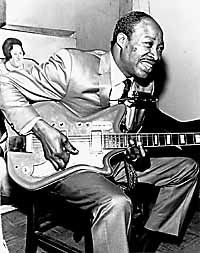
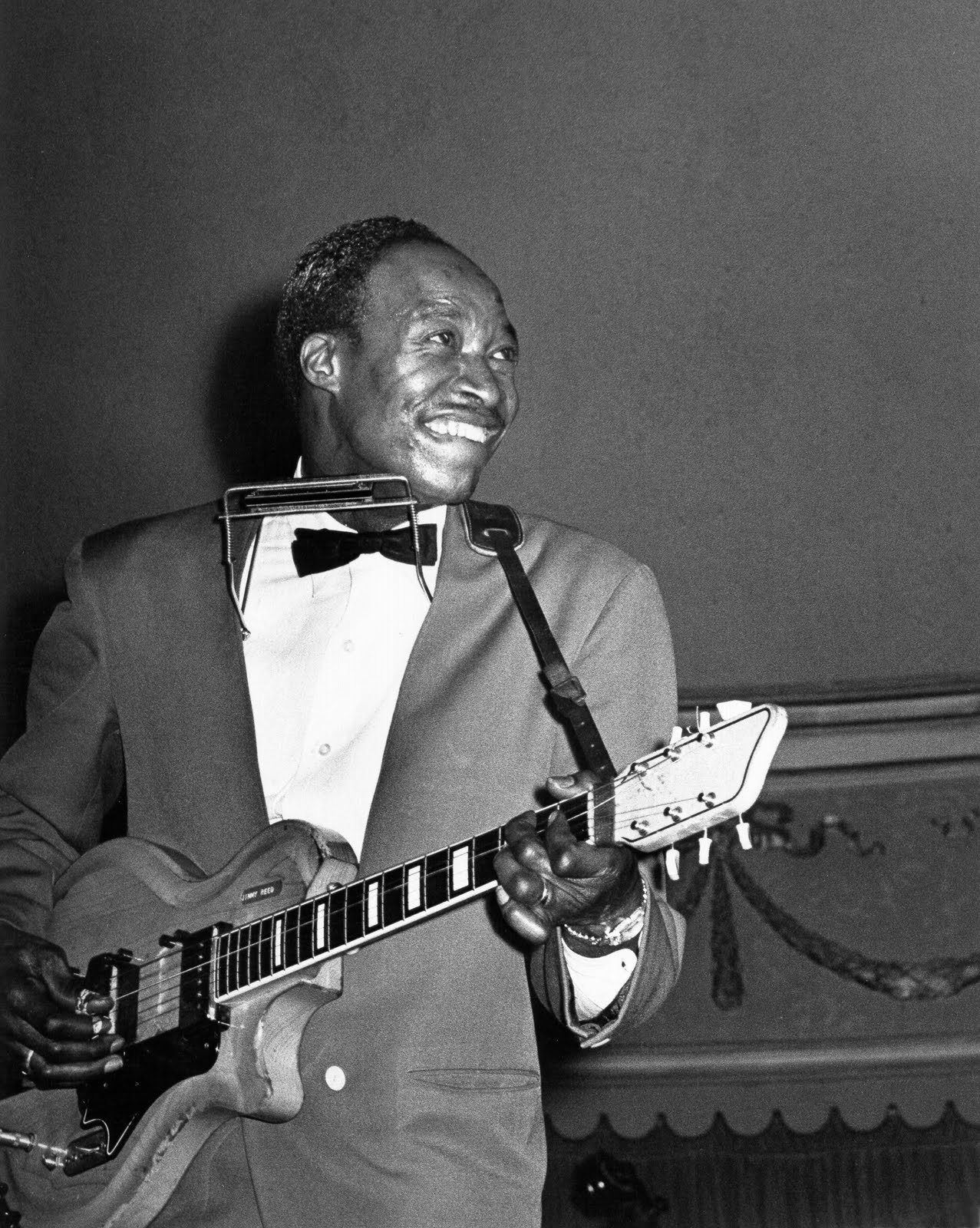
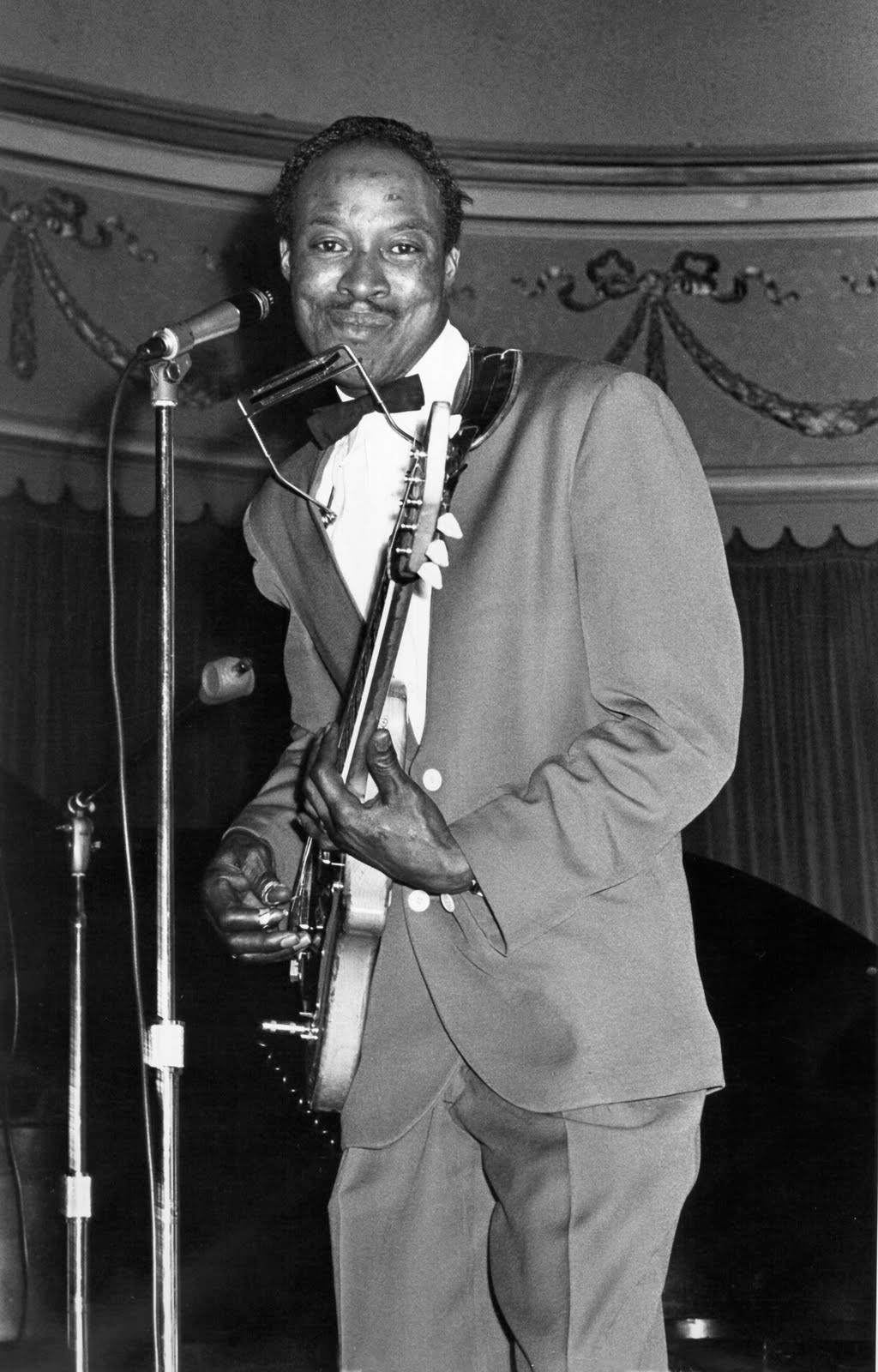
Jimmy Reed in a very shiny suit.

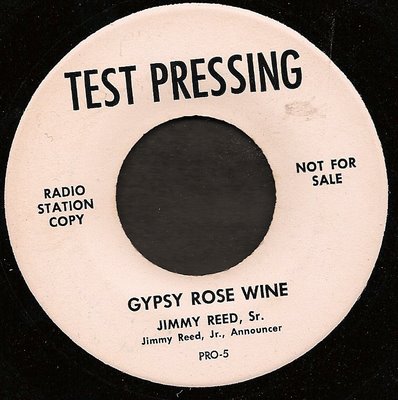
One sided radio spot.


Jimmy Reed, before the toupee.


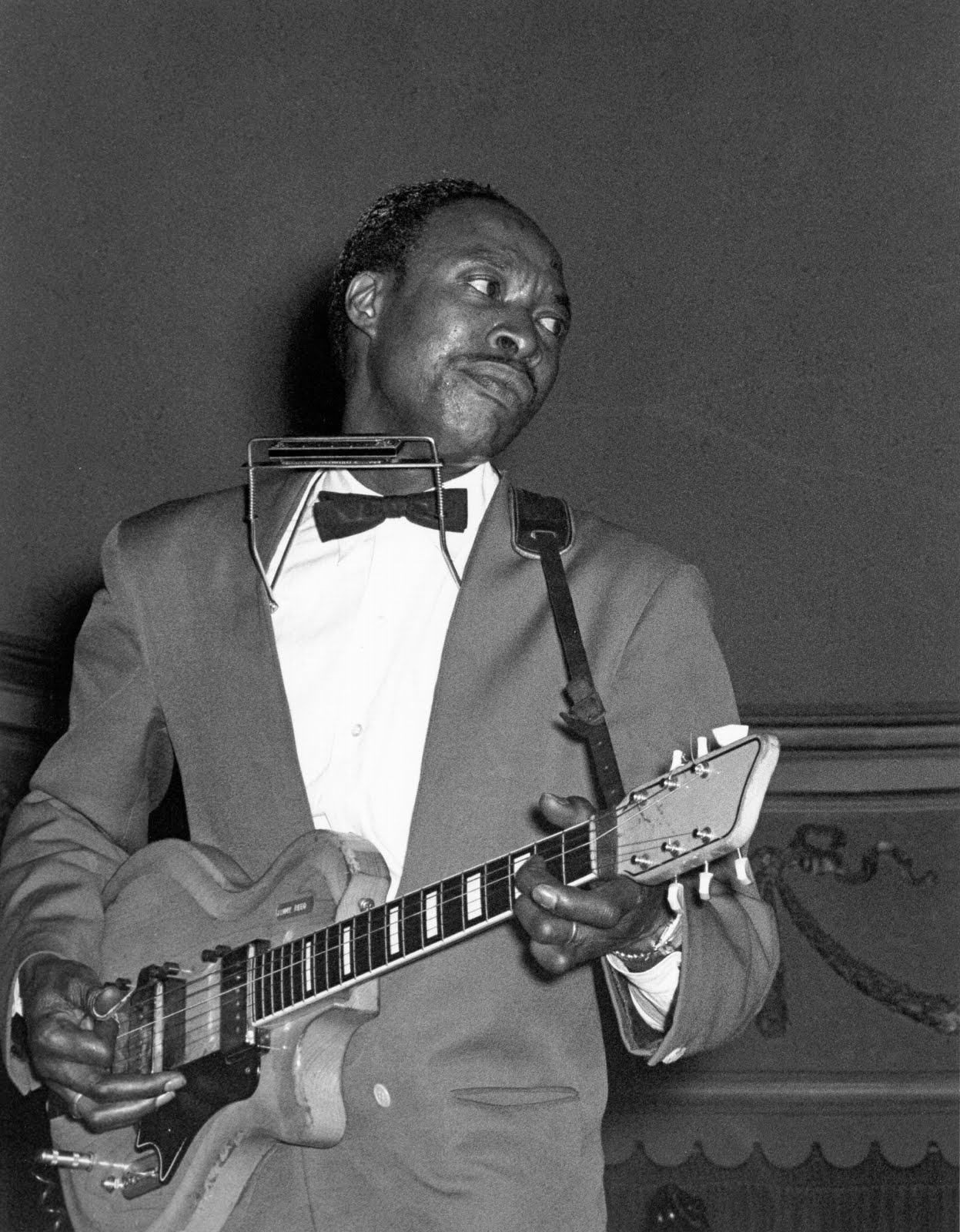
And a cool Supro Airline model guitar.

Notice the finger pick.
Since the link for this one came down back in October, I thought I’d repost it, along with some snazzy photos I’ve just uncovered. The radio spot is from the early 70’s, Jimmy Reed doing an ad for Gypsy Rose Wine. The Gypsy Rose Wine (a fortified wine like MD 20/20, Night Train and Thunderbird) folks really understood their market. I remember hearing it at night on Butterball’s show on WMBM out of Miami (where I first heard Slim Harpo, and just about every great R&B record of the era with a transistor radio pressed to my ear under the covers), and also on WLAC out of Nashville when the weather was really bad and the signal traveled all the way down the coast to Florida where I grew up. Jimmy gets some help from his son Jimmy Reed Jr. aka Boonie. For my money, Jimmy Reed was just about the greatest thing there ever was. He was more of a rock’n’roll, or in his own words–a pop singer than a bluesman, but what ever you call his music, he was as close to a genius as a moron can get. If you don’t have all of Jimmy Reed’s Vee Jay recordings, you really need to reassess your priorities in life.

Gillian’s Found Photo #41

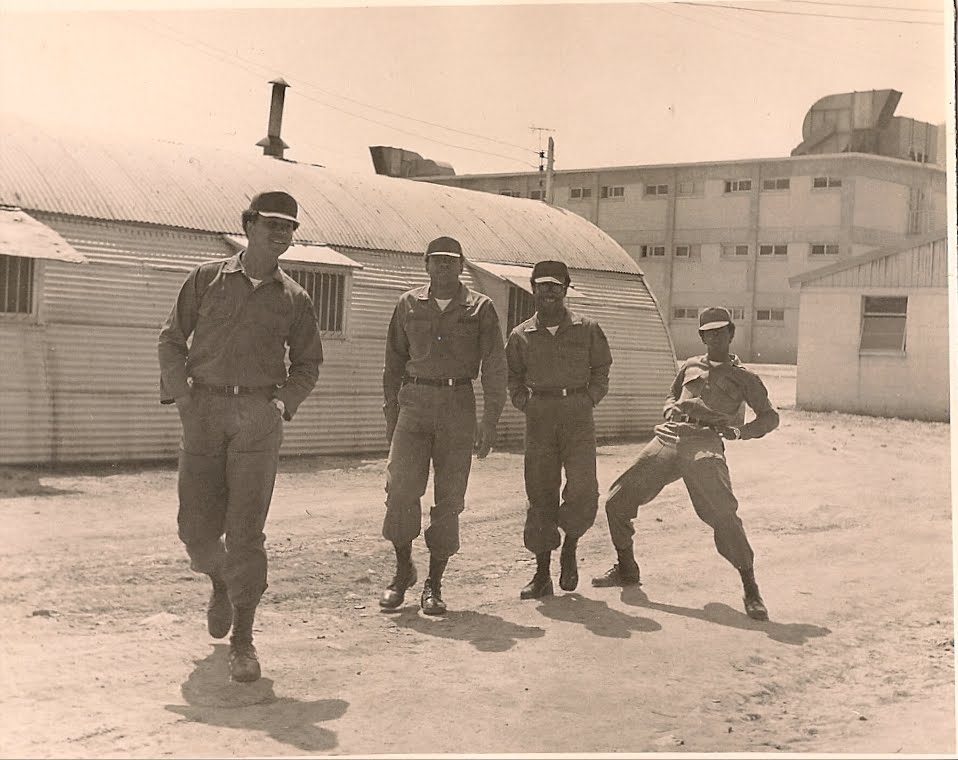
This week’s found photo was taken in Korea in the mid-60’s, and these young grunts are about to be deployed to Viet Nam, a place they probably didn’t know existed a few years before. Inner city cannon fodder for the military industrial complex, the guy on the right seems to know the score. I wonder how many of them made it back alive, and in what kind of shape?

I remember back in Florida in the late 70’s a group of crazed Viet Nam vets set up camp in a putrid piece of swamp under I-95 and took to robbing passing cars by posing as stranded motorists, and sometimes they’d knock over local drugs stores for their dope supply, keeping the cops at bay for over a year. No way the cops were gonna drudge through that gator invested muck to try and flush ’em out. Eventually they all escaped, I don’t think anyone was ever prosecuted. As for the above crowd, as later photos in the Fang’s collection show, they all would become Black Panthers while in Nam, more photos of them to follow.

Flamin’ Groovies #2

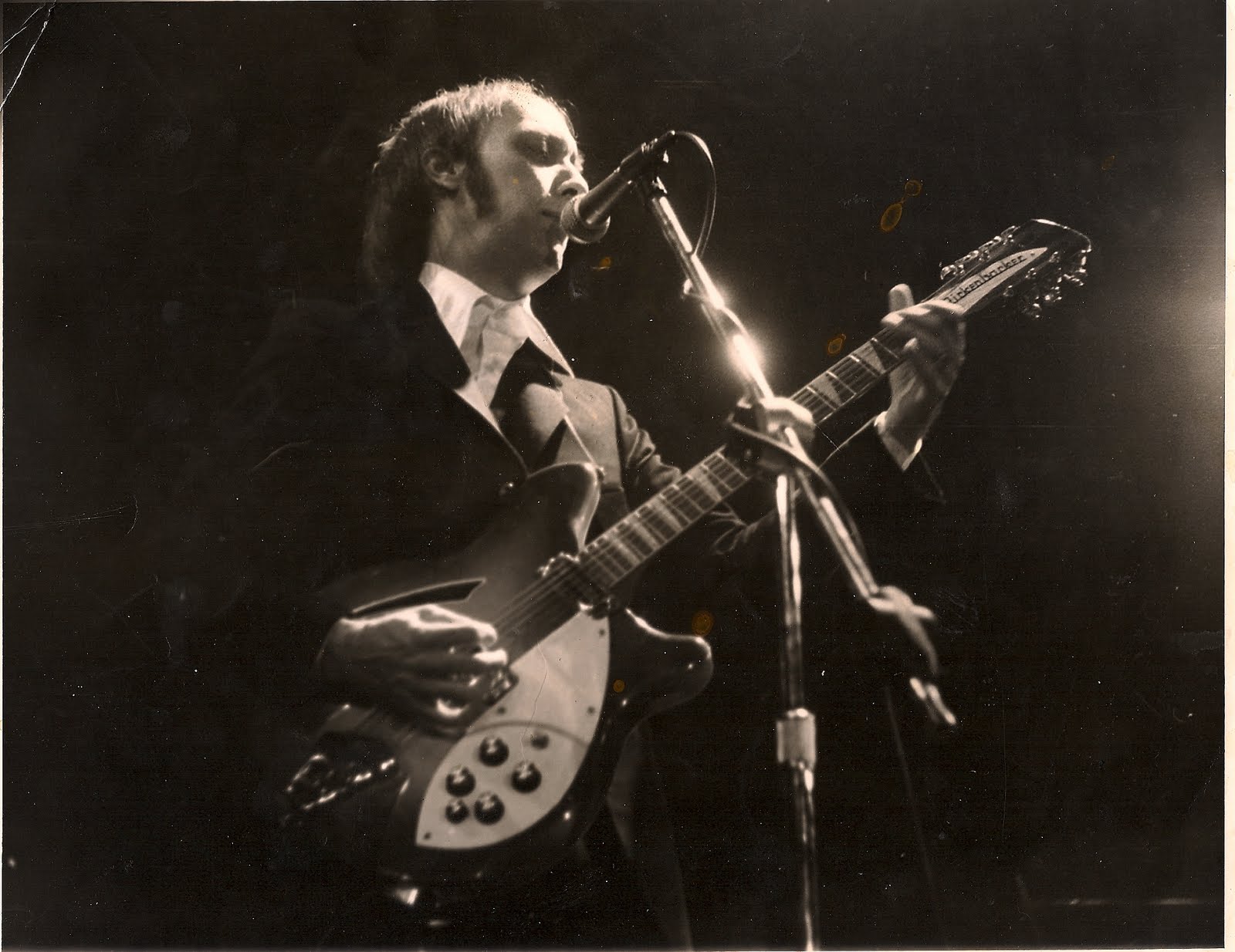
Cyril Jordan with 12 string, 1976.

I never saw this clip of Little Queenie before, from French TV, 1972.

Slow Death live at the Marquee, nice crotch point of view shots of James Ferrell.


Simply by being a great rock’n’roll band the Flamin’ Groovies always seemed to be in the wrong place at the wrong time. When the original line up was rockin’ out with albums like Supernazz , Flamingo, and Teenage Head, their hometown, San Francisco preferred bad acid rock jams (insert name of your least favorite Frisco band here). When the second, equally great line-up made their masterpiece Shake Some Action, which wasn’t released until 1976, it was the safety pin through the face crowd that ridiculed them, having bought the Clash’s line “no Elvis, Beatles and the Rolling Stones”, the Groovies were again deemed unfashionable. I’m amazed at how few good live tapes of the second line up have surfaced, but I stumbled upon a good one from L’Olympia, Paris, 1975 over at the Boogie Disease blog or use their direct link to the download (here). France was one of the few places that appreciated the Flamin’ Groovies. Although it sounds like it’s from an audience recorded cassette tape, the sound is better than the other two bootlegs from that era that I’ve heard (one from the Roxy in LA and another from the Roundhouse in London) and the performance and set list are fantastic, including tunes they didn’t play very often like Teenage Head, Sometimes (which Chris introduces as a Paul Revere & the Raiders tune, I guess he never heard Gene Thomas’ original), Shake Some Action (which they had to stop playing for awhile when Cyril injured his hand), as well as great renditions of the Pretty Things’ Big City, the Stones’ Miss Amanda Jones (one of five Stones covers here if you count Don’t Lie To Me and She Said Yeah, which the Groovies seemed to have learned from the Stones versions, Chris Wilson even introduces She Said Yeah as a Stones tune, again, perhaps unaware of the Larry Williams original). Anyway, the Groovies story has been told many times, and I won’t bother telling it again, but they will always be one of my favorite bands. If you can track down copies of Miriam Linna’s Flamin’ Groovies Monthly, a digest size fanzine she published when she took over their fan club from Greg Shaw in ’77, it’s one of the best fan mags of all time.
One funny story. When they played the Bottom Line in NYC after Shake Some Action came out, they stalled and stalled before going onstage, waiting for their coke dealer to show. When he didn’t turn up, they finally went on and halfway through the second song they spot the guy walking into the club. The promptly excused themselves from the stage, hit the dressing room, copped, got high, and returned to restart their set from the top, noticeably more energetic. I’ve never even seen Johnny Thunders’ do something that blatant, especially with their entire record company (all five Sire employees) in the audience. What a great band.

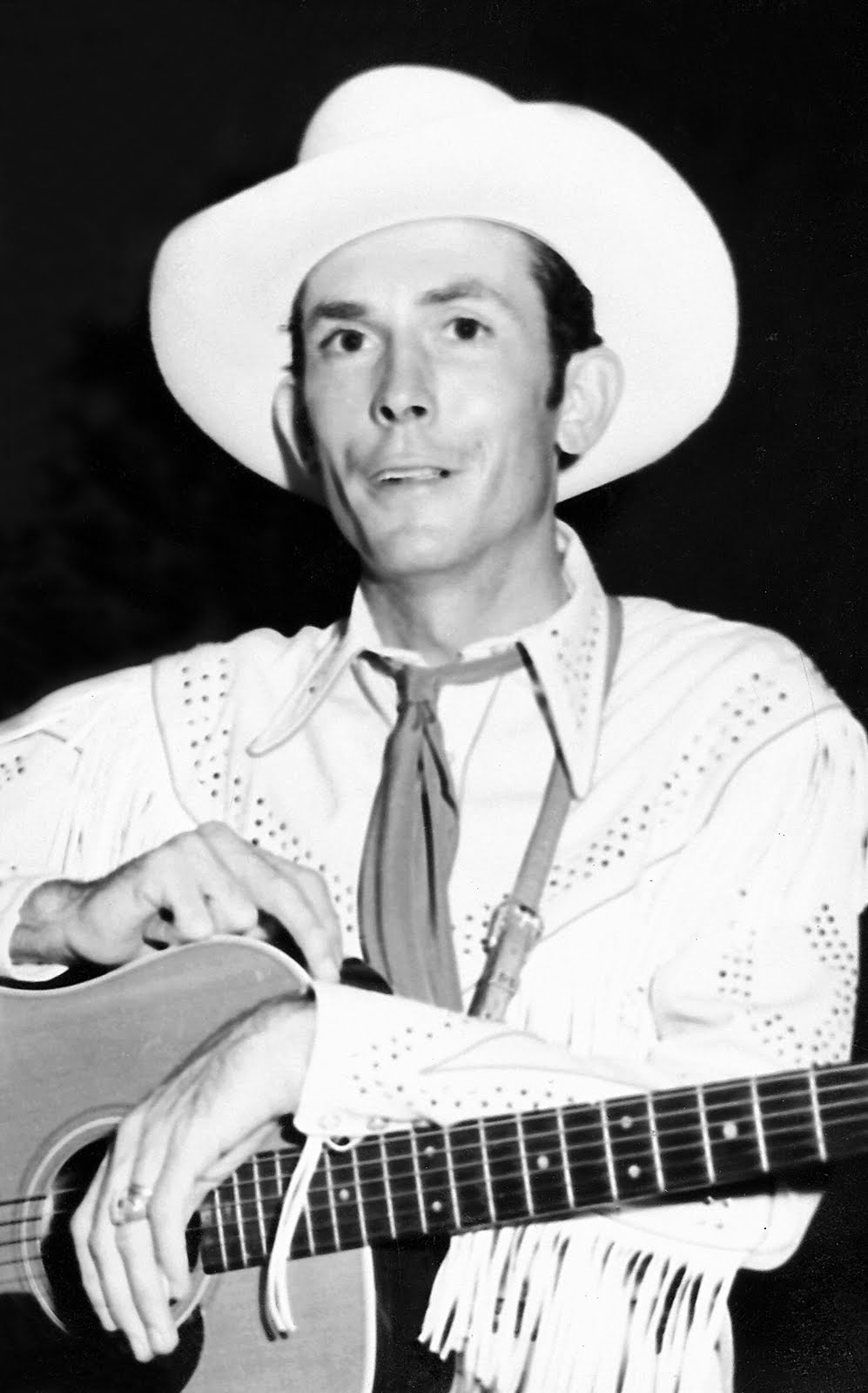
Hank Williams for Mother’s Best Flour

Hank in the Slammer, 1951.


Hank in a good mood.


Hank Williams & the Drifting Cowboys

Hank Williams: The Ole Sorry Ass, Himself.
Hank on TV, except the camera doesn’t seem to be plugged in.
Hank Williams with the Drifting Cowboys in a peculiar pose.


Where the lost highway ended, Hank in his casket, 1953.


You’re not really dead unless you have the paperwork to prove it, Hank’s death certificate.

Dorks like Bruce Springsteen make a big deal about not taking advertising money, but that’s because they don’t need the money. I hate that holier than thou shit. Radio never played the Stooges, so if people hear ’em on TV commercials, good for the Stooges, who deserve a pay day.
Ray Charles (Pepsi), Jimmy Reed (Gypsy Rose Wine), Little Richard (Royal Crown hair dressing), Sonny Boy Williamson (King Biscuit Flour), the Rolling Stones (Rice Krispies), Dave Bartholomew (Jax beer) , and Howlin’ Wolf (C.V. Wine), all did commercials, and it didn’t hurt their music one bit. For several years Hank Williams did a morning radio show (this one, aimed at the rural farm crowd was 7:00-7:15 AM, ouch!) for various sponsors, the ones presented here were for Mother’s Best Flour. Here are five airchecks, they’re fifteen minutes each, and are presented exactly they way they were heard back in 1949-50 when they were aired. There are some songs he never recorded commercially as well as some of his hits. Even his wisecracks are sometimes pretty funny, and he’s singing his ass off on most of these tunes. Hell, even tin-eared wife Audrey doesn’t sound so bad. Enjoy: Hank Williams’ Mother’s Best Show: #1, #2, #3, #4 and #5.
Some fun facts about Hank Williams:
*His favorite song was Death Is A Dream, here’s the best version (by Rev. Edward Clayborn “the Guitar Evangelist”).
*His favorite saying was “Don’t worry, nuthin’s goin’ be alright anyhow”.
*He died from a combination of alcohol, morphine and chloral hydrate.
*Had he lived, he might have invented rockabilly, since in his final years he had chronic hiccups (the day before he died his doctor gave him two morphine shots for the hiccups).
*His real name was Hiriam, he named himself Hank as a kid.
* He charged admission to his second marriage (to Billy Jean Jones), and sold out four shows, so he married her four times (if they got divorced would he have had to pay four alimonies?).
* He’s playing the guitar solo on his version of My Bucket’s Got A Hole In It. He’s pretty good too.
* For a really great look at Hank’s final days, check out John Gilmore’s Laid Bare.

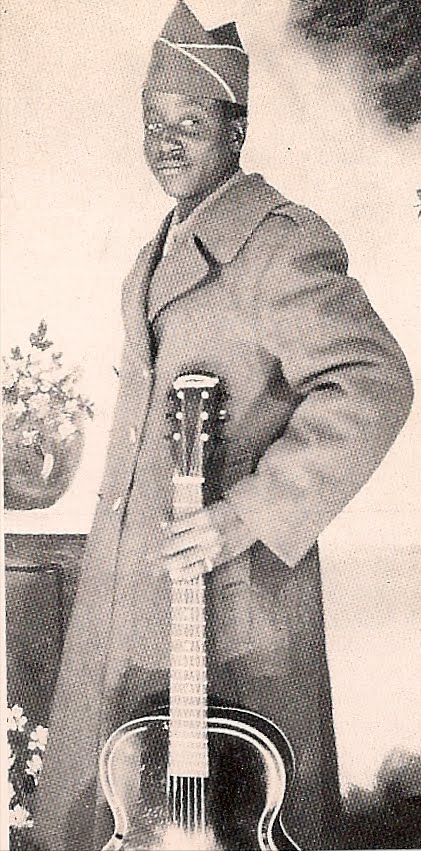
Doctor Ross

Doctor Ross holding his weapon at parade rest.


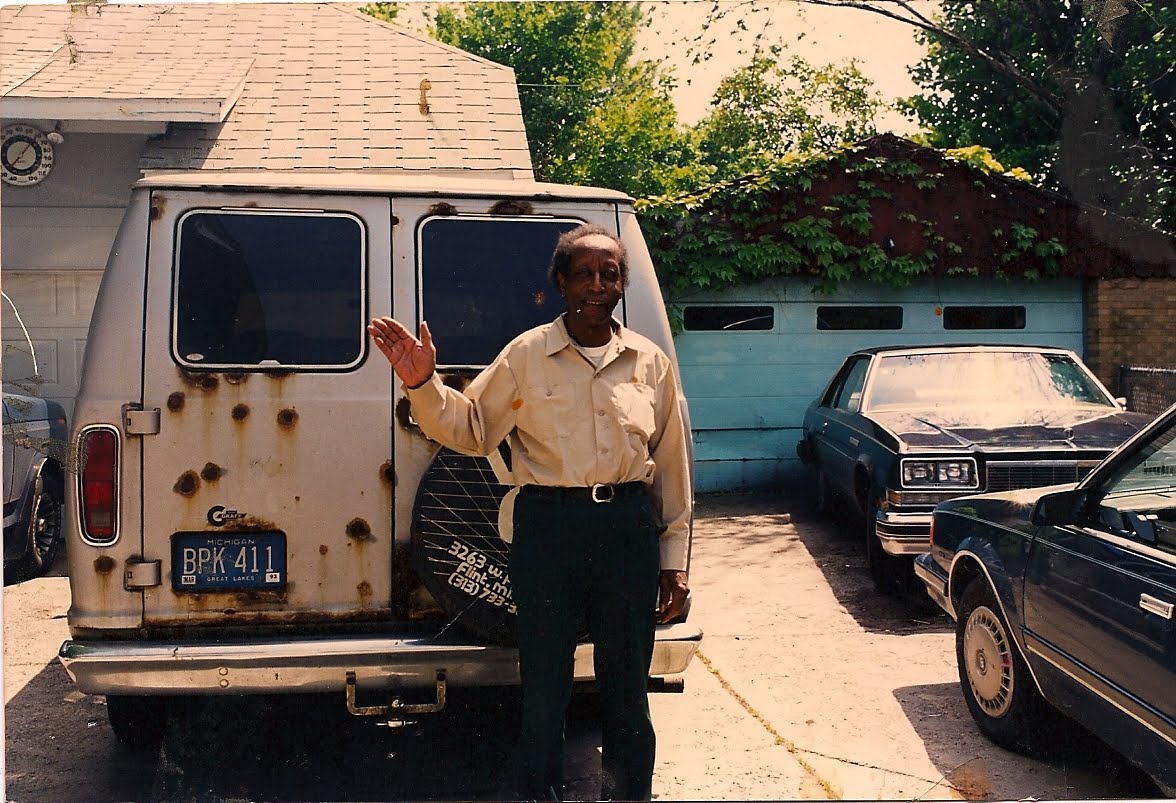
Waving goodbye, the last photo taken of Dr. Ross, 1993 (photo by Dan Rose)

Playing left handed and upside down.

Some European TV Show, mid-60’s.


In his final months, still rockin’….


Charles Isaiah Ross was born in Tunica, Mississippi on October 21, 1925. That’s on Highway 61, about 40 miles south of Memphis, a few miles east of the Mississippi river. He wasn’t a real doctor, the title added to front of his name was a nickname said to come from his habit of carrying his harmonicas and a bottle of booze in a black, doctor’s bag. He was one of eleven children who grew up on a plantation, working the fields. His father Jake taught him to play harmonica. He did two stints in the army and by 1951 was back in Mississippi trying to make a living with his harmonica. Soon he was appearing on various radio stations including KFFA in Helena, Arkansas (where Sonny Boy Williamson hosted the King Biscuit Flour Hour), KLCN in Blyetheville, Arkansas, WROX in Clarksdale, Mississippi, and WDIA in Memphis where he was billed as “Medical Director of the Royal Amalgamated Association of Chitlin’ Eaters of America”. In 1951 he was one of the first musicians to be recorded by Sam Phillips at his newly christened Memphis Recording Service, and on November 21st of that year recorded several songs, two of which Phillips would send north to brothers Leonard and Phil Chess in Chicago who released them on their Chess label– Doctor Ross Boogie b/w Country Clown (Chess 1504), on which Ross was accompanied by only guitarist Wiley Galatin (although the label credited “his Jump and Jive Boys”, only Ross and Galatin can be heard on the record). It was a good a start in show biz, although not a hit, it was certainly a unique sounding record. Although quite rare today in its original Chess pressing, someone must have bought it because Phillips called Ross back for another session in early ’52, this time Ross was playing guitar himself, upside down since he was left handed, and brought along pianist Henry Hill and the clattering washboard playing of Reuben Martin. Five or more songs were recorded that day, none of which saw release until the 70’s when they’d show up on various Arhoolie and Charley albums, the best of which was a version of Polly Put The Kettle On, a song much older than the blues. A year later Phillips had Ross back in the studio again, this time without the piano player, and among the tunes he waxed were his first Sun release– Chicago Breakdown b/w Texas Hop (Sun 193), a clattering, rocking, boogie on both sides of the shellac. Another year passed, by now Ross was mastering his one man band approach to music, playing guitar, harmonica and drums simultaneously. But when Phillips recorded him in July of ’54 (only weeks before Elvis’ first session) he used Tom “Slam Hammer” Troy on second guitar and drummer Bobby Parker, although I can’t hear a second guitar, perhaps one of them was unplugged. The disc issued from that session– Boogie Disease b/w Jukebox Boogie (Sun 212) was an absolute classic, and perhaps the finest song ever written about the clap (the Flamin’ Groovies would re-arrange it and record it as Dr. Boogie on their 1971 classic Teenage Head, giving themselves writing credit). “I may get better, but I’ll never get well…gimme one of them penicillin shots”! shouts the good Doctor over a distorted blues shuffle. Phillips would record Ross only one more time in a solo session from which no discs would be issued until the titles showed up on an Arhoolie LP (and later extended CD) in the 70’s and the Charley Sun Blues Box in the 80’s.

Meanwhile, Ike Ross as his friends knew him packed up and headed north looking for work, landing in Flint, Michigan (later home to ? & the Mysterians, the greatest and longest running American rock’n’roll band ever, and Terry Knight & the Pack who would morph into Shea Stadium packing Grand Funk Railroad). Ross got a job on the G.M. assembly line, which he would hold down for the next thirty years, from here on music would be a sideline.
On the music front, in 1958, Doctor Ross tried his hand at the record biz, releasing his next disc on his own DIR (guess what that stand for?) label– Industrial Boogie b/w 32-20 (DIR 101). Although recorded with just an acoustic guitar, Industrial Boogie showed the change in his music working on the assembly line brought. His sound now had the churning, propulsive rhythm of an automobile plant. But running your own label after eight hours on the line is hard work, and he would release no more discs on DIR. In 1959 he was recording for Jack and Devora Brown’s Fortune label, and backed by a group called the Orbits, about which we know nothing other than their name, he cut his greatest masterpiece– Cat’s Squirrel b/w The Sunnyland (Fortune 857), it’s thundering beat takes the normal blues/boogie shuffle and turns it into a supercharged throb. The tune would be covered by U.K. rock bores Cream in ’68, I hope Ross got a big check out of that deal.
Doctor Ross was back in Fortune’s back room studio in 1961 where he recorded with Little Joe’s Band, a double sided winner– Cannonball b/w Number’s Blues issued on Fortune’s HiQ subsidiary (HiQ 5027), and again in ’63 recording as a one man band on Call The Doctor b/w New York Breakdown (HiQ 5033). His fourth session (date unknown) saw him backed by a group called the Disciples of Soul and the single issued as Fortune 538– Sugar Mama b/w I’d Rather Be An Old Woman’s Baby Than An Young Girl’s Slave was released. Fortune had amassed enough tunes to issue an LP, bearing the same unweildly title as his last b-side, it featured such classics as I Am Not Dead and My Black Name Ringing as well as the best of his Fortune 45’s.
By 1965 the white blues audience had “rediscovered” (as if he’d been lost) Doctor Ross, who was recorded solo at the University of Chicago and then again for the Testement label. He began doing package tours of Europe were he entertained other blues singers on the tour bus by dancing something called “The Flying Eagle”. He cut an LP on Blue Horizon called The Flying Eagle, so rare only a handful of copies have ever been seen. He also cut live LP’s in Germany, Switzerland and maybe a few others I missed out on. He even had a track on the Grammy winning LP Rare Blues in 1981. In Japan, P-Vine issued a now rare LP of his best Sun recordings. Despite all this activity he still worked at G.M. to pay the rent and it’s unlikely he ever saw any royalties other than some songwriting mechanicals for Cream’s version of Cat Squirrel. He finally retired from G.M. in 1992. A year later, a day before he was to begin filming his first film role, in Dan Rose’s Wayne County Ramblin’ (an indie feature starring Iggy Pop along with appearances by Jeff “Mono Man” Connelly, the late Bill Pietsch, the Dirtbombs’ Mick Collins, Nathaniel Mayer (the narrator), Tav Falco, Lorette Velvette, and Otha Turner amongst others), he died of a heart attack. I was supposed to have him on my radio show a few days later. Doctor Ross was as great and unique an artist as had ever been heard in American music, and one of only two to have cut sides for both Sun and Fortune Records, perhaps the two greatest and strangest labels ever (the other was Johnny Powers). An illustrated discography can be found here. Doctor Ross, they sure don’t make ’em like that anymore. Come to think of it, they only made one of ’em like that back then.

Gillian’s Found Photo #40

“A few lives were taken in defense of life, home or property but most occurred in what Kentucky law terms “sudden heat of passion”. Such cases arise in “sudden affray”, when the killer is aroused by such provocation on the part of the person slain as “is reasonably calculated to arouse the passions of an ordinarily prudent person beyond his control”. When such a killing occurs, Kentucky law permits the jury to reduce the homicide from murder to manslaughter and to impose a relatively lenient prison sentence. This is precisely what occurred in most cases.” –from Night Comes To The Cumberlands by Harry M. Caudill (Jesse Stuart Foundation, 2001)

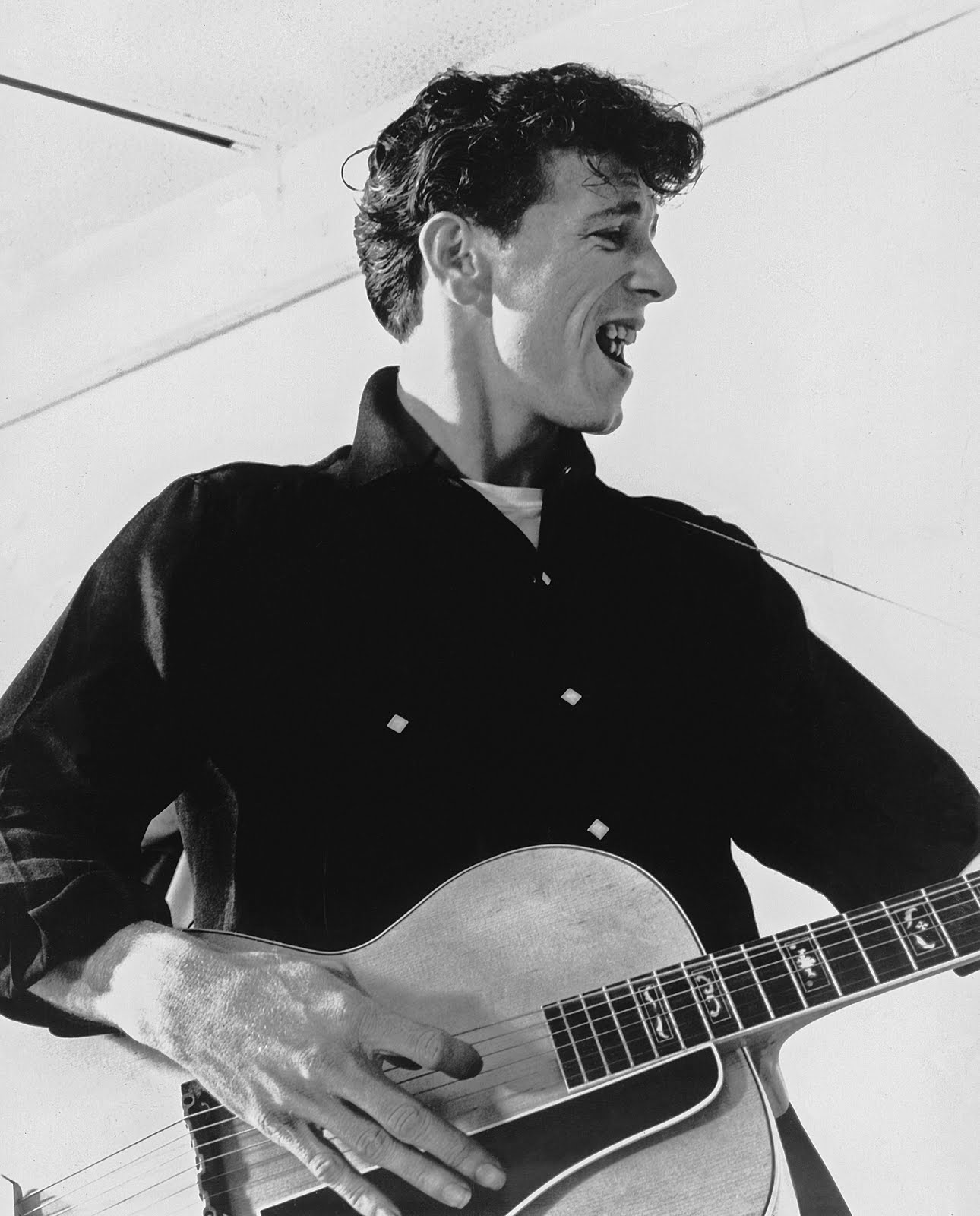
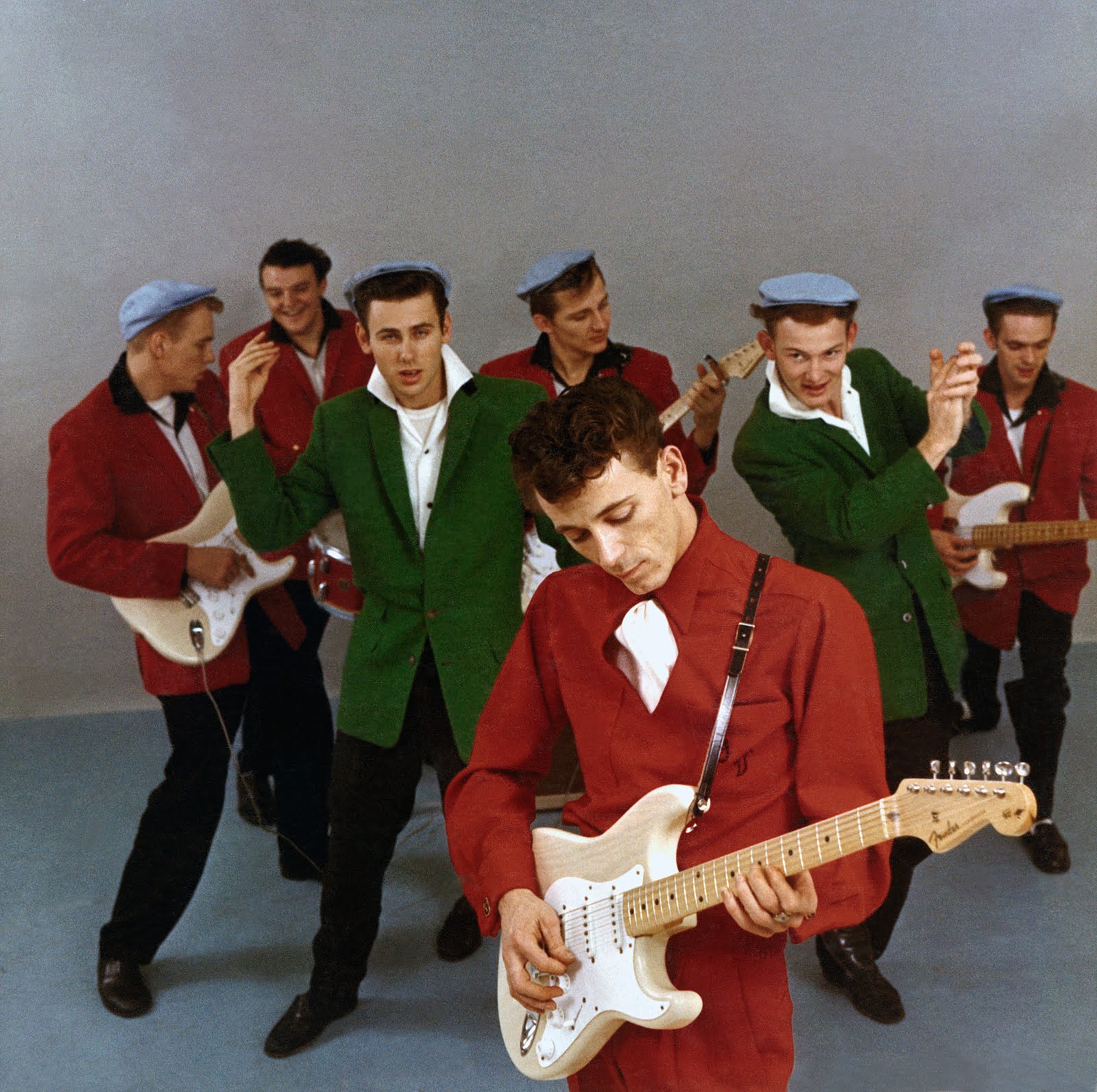
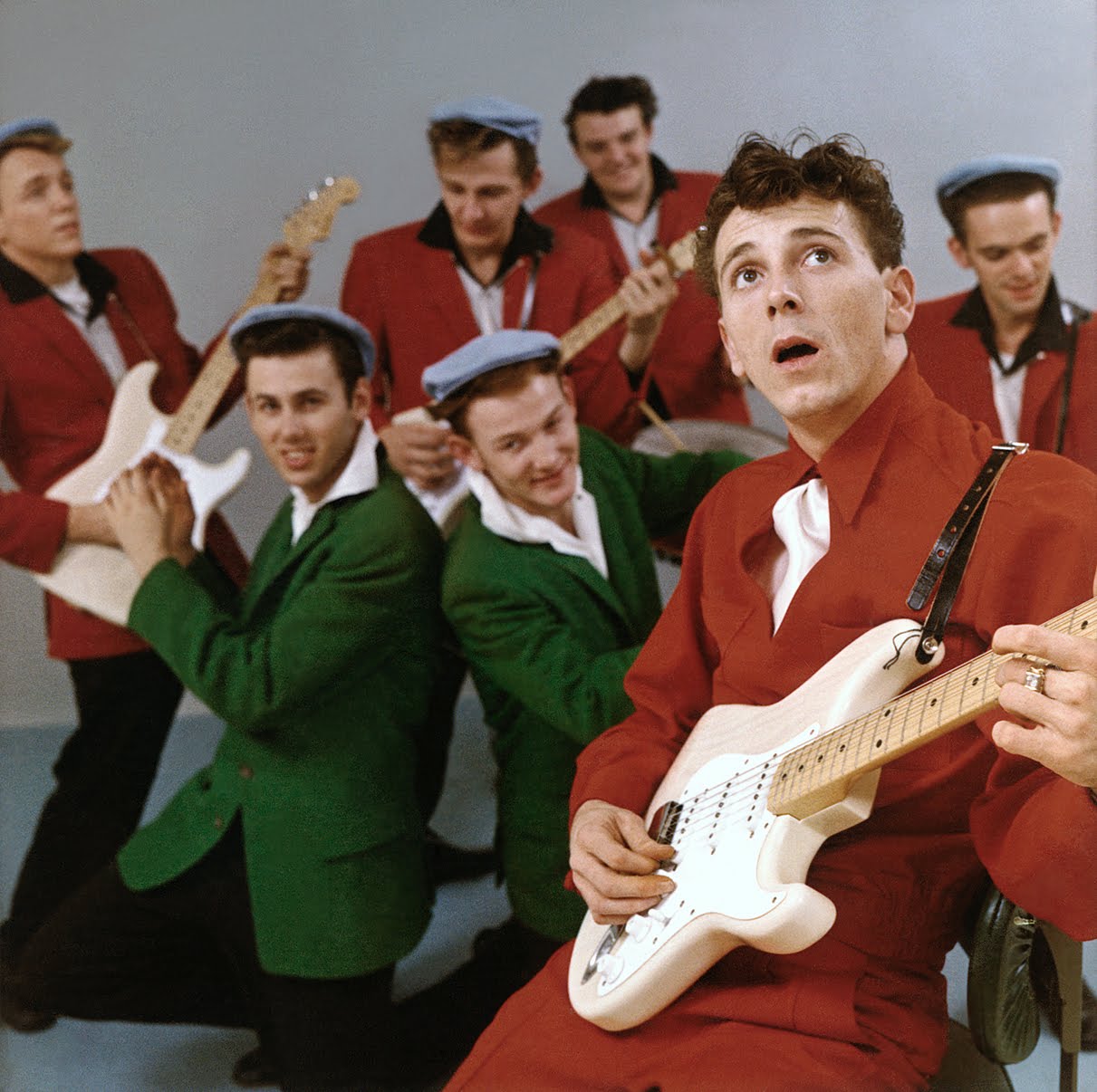
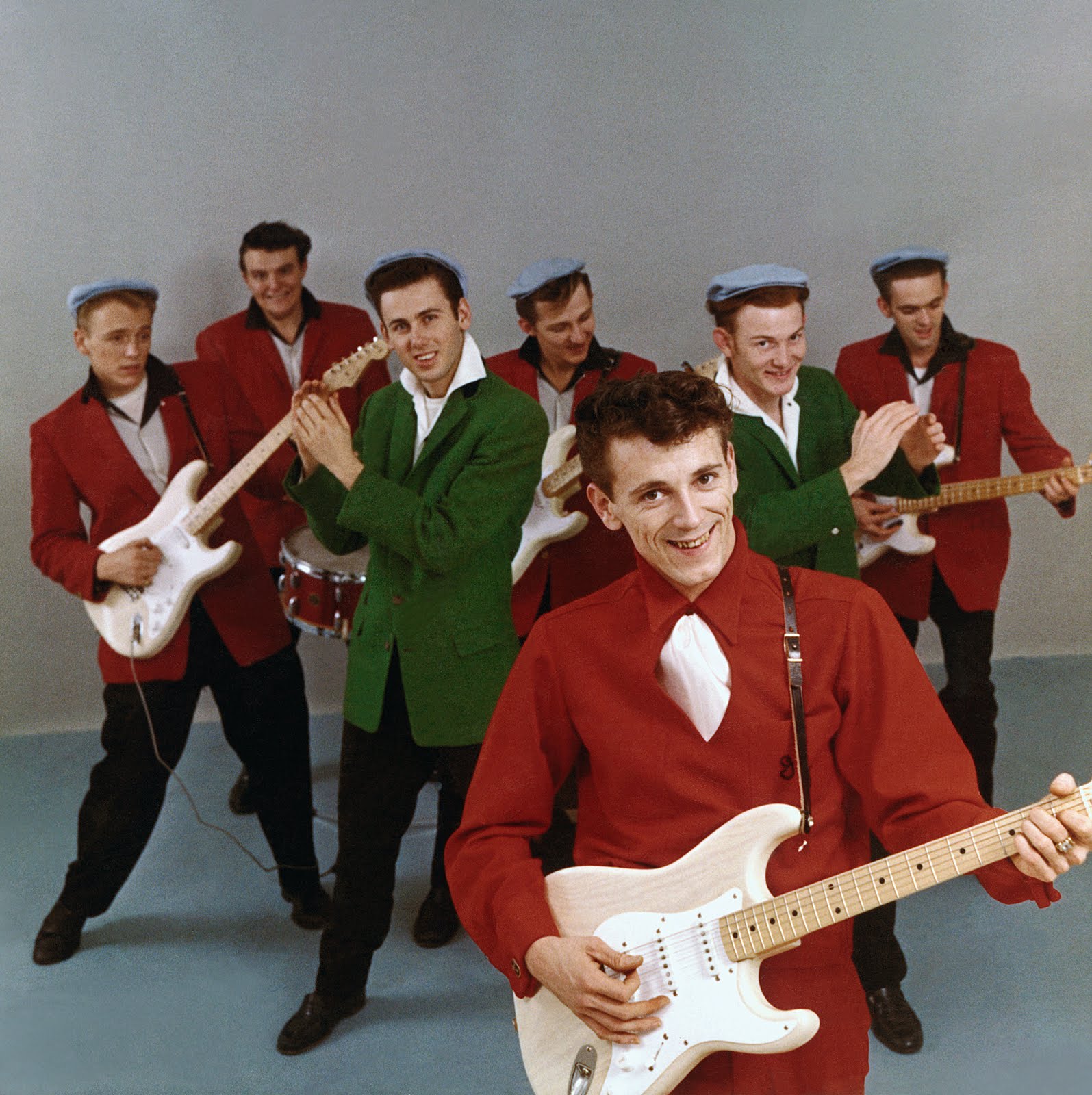
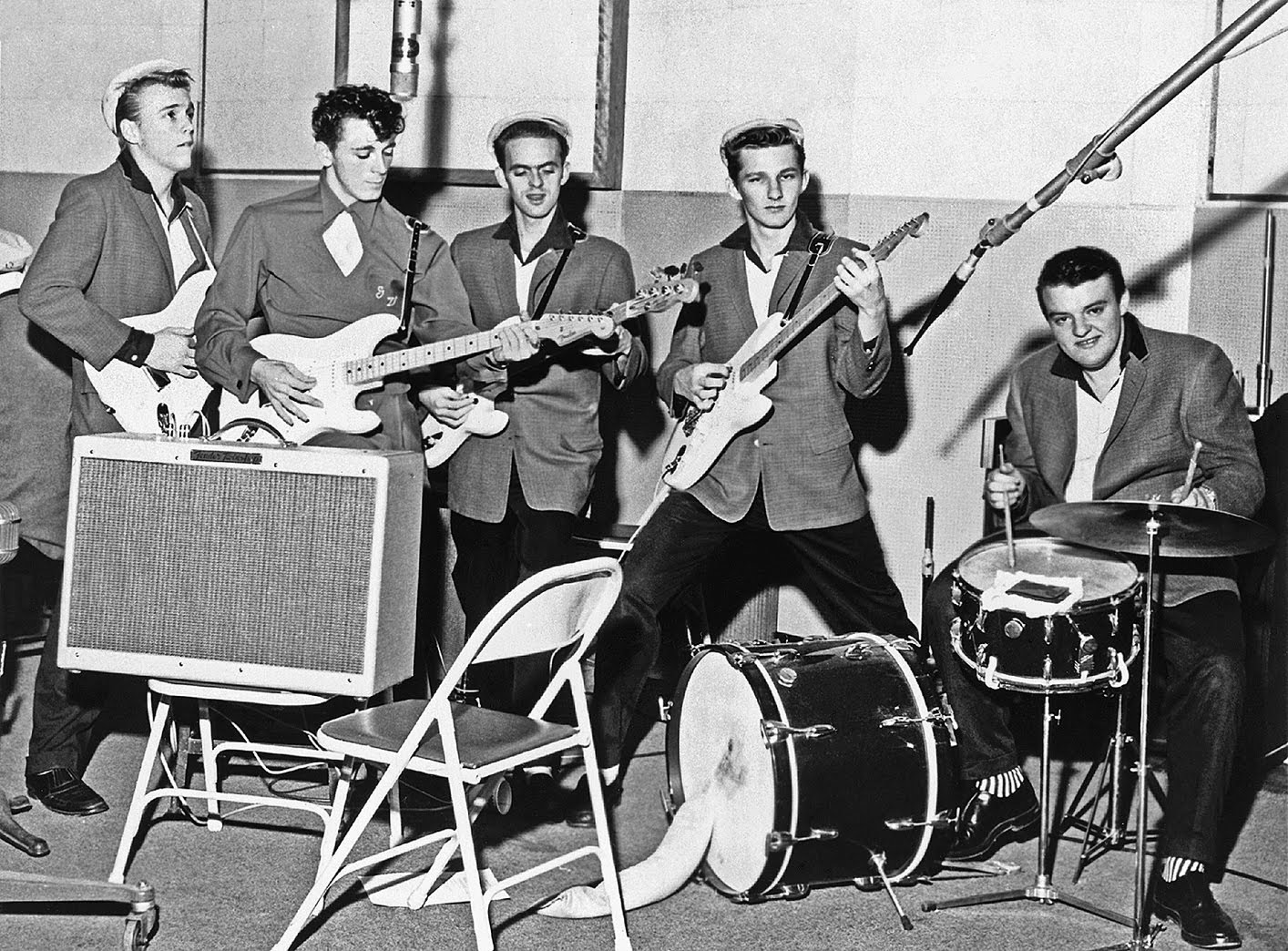
Gene Vincent & the Bluecaps

Gene Vincent in a typically tortured pose.
With the Blue Caps and white Stratocaster, where’s that Strat today?

Clapper boys Paul Peek and Tommy Facenda in green jackets.


More pix from the same photo shoot.

Johnny Meeks, second from right replaced Cliff Gallup in early ’57.


The Blue Caps were colorful even in black and white. Cliff Gallup on the left.

From the TV show Town Hall Party, 1958.


From the movie Hot Rod Gang.

1965, already looking old.

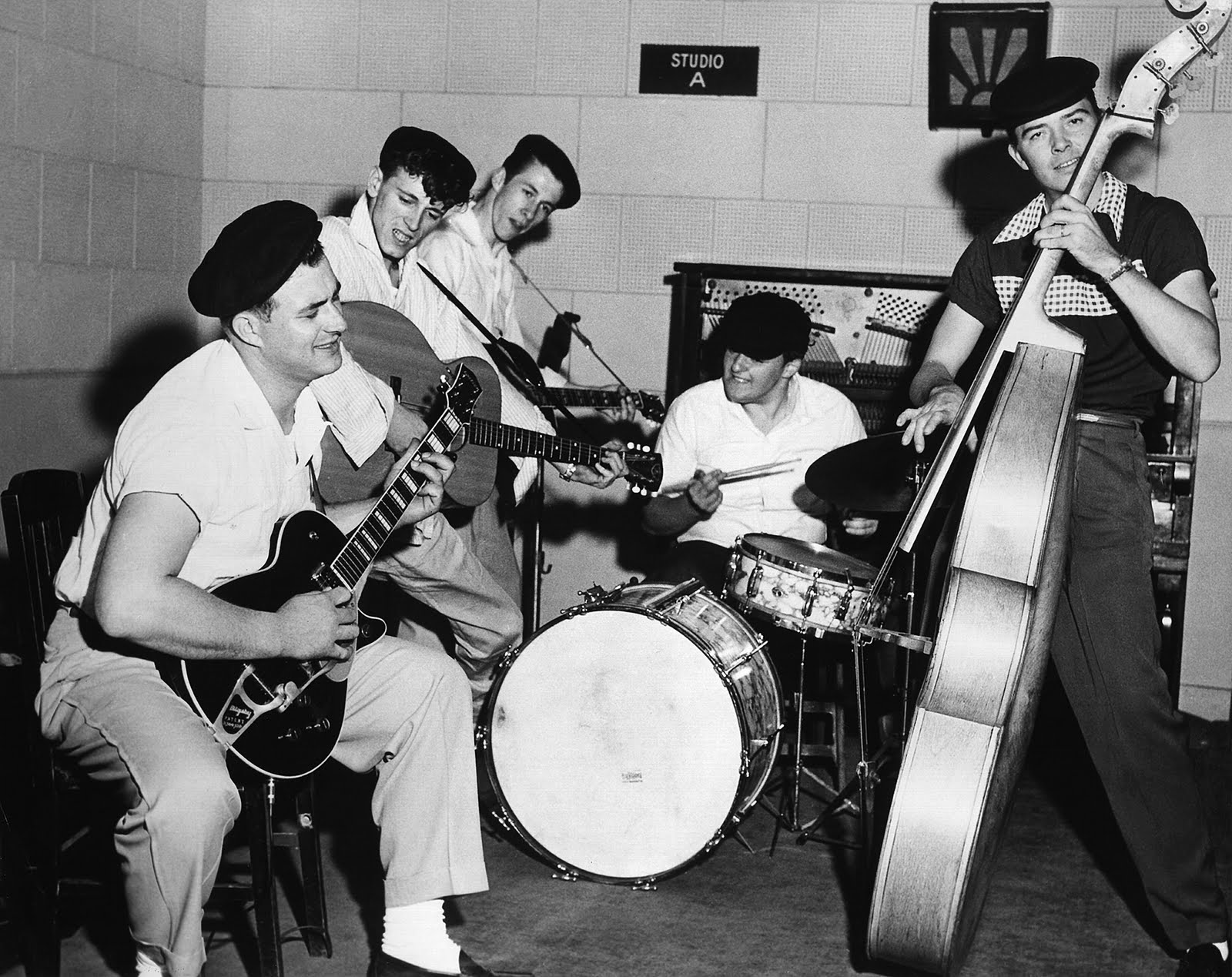
Gene Vincent. He sure was photogenic. I thought I’d share these photos, outtakes from photo sessions of which you’ve probably seen the more common shots. Gene had a short and sad life. Born in Norfolk, Virginia, Feb. 11, 1935, Vincent Eugene Craddock joined the Navy at age sixteen and was discharged after a motorcycle accident shattered his leg. While recuperating, he wrote the song Be-Bop-A-Lula which came to the attention of Sheriff Tex Davis who became Gene’s manager. After cutting a demo at a local radio station, Davis took it to Capitol Records’ A&R man/producer Ken Nelson who brought Gene and his newly assembled band– the Blue Caps to Owen Bradley’s Nashville studio to cut it with three other tunes in May of ’56. Capitol issued it in June with the incredible Woman Love on the flip side (kicking off years of debate as to if Gene is saying “huggin'” or “fuckin'” underneath all that echo). Be-Bop-A-Lula shot to #1, most people thought it was the new Elvis record (including Elvis’ mom who sent Elvis a post card to congratulate him on his latest smash). Gene never could follow up the incredible sucess of Be-Bop-A-Lula but he cut five great albums for Capitol– Bluejean Bop, Gene Vincent & the Blue Caps, Gene Vincent Rocks…and the Bluecaps Roll, A Gene Vincent Record Date and Sounds Like Gene Vincent (a sixth album Crazy Beat was issued in the UK), as well as a couple of dozen great singles, many of which aren’t on the albums. The Blue Caps were an incredible band, their first lead guitarist– Cliff Gallup a rather anti-social genius who played with a flat pick and two finger picks, quit the band in early ’57 and was replaced by Johnny Meeks who was nearly as good. The other original members- Willie Williams- guitar, Jack Neal- upright bass and Dickie Harrel (who cut a solo LP for Capitol of all drum solos)- drums stayed together until late ’57 until drifting off one by one. The ever changing line up included two “clapper boys” who basically jumped around the stage since Gene, with his bum leg, was basically immobile. One of these guys was Paul Peek who was responsible for Gene seeing Esquerita who he brought to Capitol in 1958. Peek also cut a couple of excellent singles for NRC including The Rock A-Round with Esquerita on piano. The other, Tommy Facenda is best remembered for the single High School USA which was issued in fifty different versions with local high schools named for each region. By 1958 Bobby Jones who had replaced Jack Neal was playing electric bass and the sound of the Blue Caps was never quite the same, although they still made some great records including Get It with Eddie Cochran’s voice quite audible singing back up. Here’s a few more favorite tunes that never made it to 45– Flea Brain, Cruisin’, Rollin’ Danny, Brand New Beat, and Time Will Bring You Everything (Gene really excelled at ballads).

When Gene’s raw style of rock’n’roll went out of style in the U.S. he headed for the U.K. where promoter Jack Good dressed him up in a leather sweat suit. The Teddy Boys loved Gene and he was always a good draw in England. He married Mickie Most’s sister Shelia and cut some sub-par discs over there. In the U.K. he was in a car accident that killed his best pal Eddie Cochran, and aggravated his already painful leg injury. When he parted ways with Capitol he cut some good, almost garage band style sides for Challenge (the best being Bird Doggin’) and two mediocre LP’s for Dandelion.

Gene was a bad alcoholic who blew through his money in record time, he had plenty of problems with the IRS, alimony, and his own self destructive behavior. He drank himself to death, his liver finally packing it in in October of ’71. He was only 36 when he died. He was drunk, bloated, paranoid, and broke. Gene’s final days are as sad as it gets. But these photos remind us of Gene Vincent, when he really was Gene Vincent. A photogenic little greaseball if there ever was one.