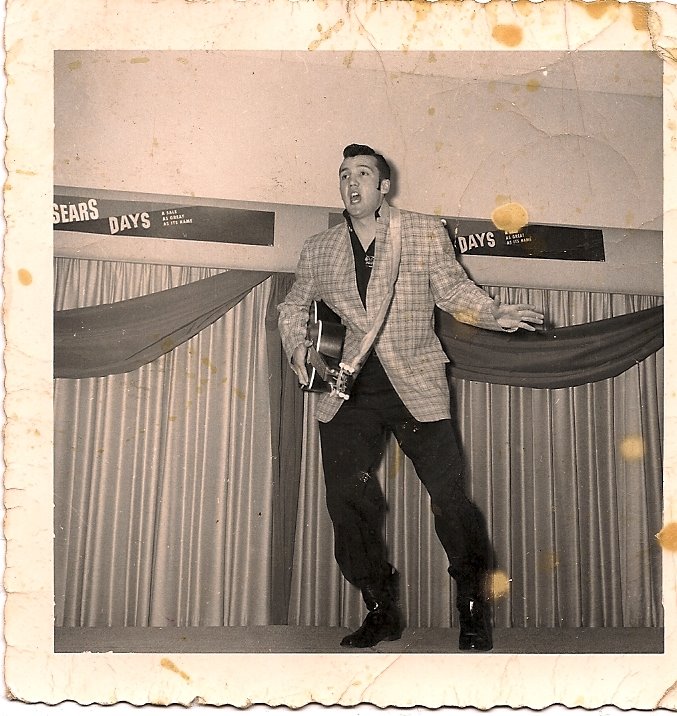
 This week’s found photo from the Fang dates to May, 1957. The fellow’s name was Larry Boyter, maybe it still is. I’ve never heard of him, he doesn’t seem to had any records released, at least none I can find listed anywhere. Place unknown but it seems to be a place where every day is Sears day. Larry certainly seems to have caught Elvis fever– the pegged pants, upturned collar, sideburns, guitar hanging by the strap (which is attached at the top of the neck, just like Elvis wore it), this cat is gone! Anybody know anything about him? What song do you think he’s singing? My guess is Shake, Rattle and Roll.
Month: June 2009
Jeremy Spencer
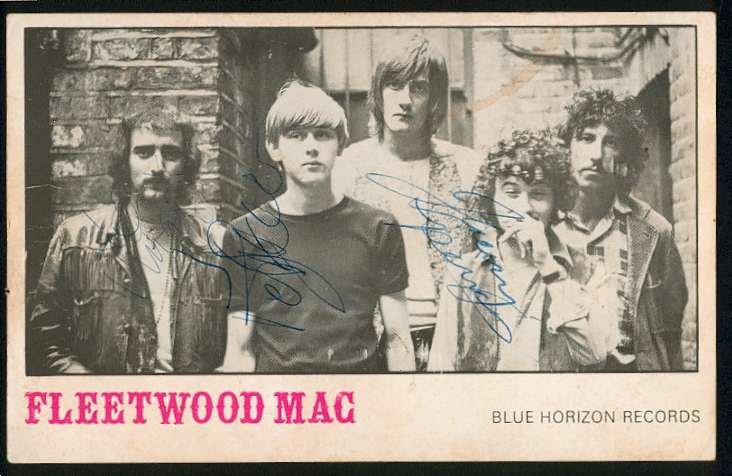 Fleetwood Mac, 1969: John McVie, Danny Kirwan, Mick Fleetwood, Jeremy Spencer, Peter Green
Jeremy Spencer and the very early ‘Fleetwood Mac’
http://mediaservices.myspace.com/services/media/embed.aspx/m=7120851,t=1,mt=video
The original Fleetwood Mac (1968-1971) were a very different band than the one that conquered the American airwaves in the late seventies and became on of the biggest bands in history.
The originals group– Peter Green (guitar/vocals), Jeremy Spencer (slide guitar/vocals), John McVie (bass) and Mick Fleetwood (drums), supplemented in 1969 by Danny Kirwan (guitar/vocals) were a hard rockin’ blues band, one of the best ever, with a great rhythm section and a triple threat front line who took their American blues influences and created a totally unique sound. I prefer them to anything Eric Clapton ever did, not to mention anything Jeff Beck or Jimmy Page did after the Yardbirds. Much has been written about Peter Green so I’ll leave the subject alone for today to concentrate on Jeremy Spencer’s contributions, but we can’t talk about Fleetwood Mac without mentioning Green, it was his band, he was main singer/writer and guitarist. For the two cents my opinion is worth, I’d say that Green, a working class Jewish kid from London’s east end (real name Peter Allen Greenbaum), was the only British blues guitarist to emerge with his own completely unique style. He never aped the licks of his American heroes like Clapton did, he had a beautiful tone and touch, and at his peak his guitar sound could shimmer like quicksilver or boom like thunder, often in the same four bars. He wrote classic tunes— Oh Well, Rattlesnake Shake, Albatross, Green Manalishi, Love That Burns, Black Magic Woman, etc. that practically assured his stardom. Stardom, when it came was not Green’s cup of tea, and with a naturally introspective personality and a huge dose of strong acid he soon fell apart, leaving the band at the peak of their U.K. stardom in 1970, shortly after their best selling (in the U.K. and Europe) LP Then Play On. It’s really a shame what happened to him. He gave away his money and guitars, took a job as a gravedigger, spent time on a kibbutz, in mental hospitals and wandering the streets endlessly. By the time he was ready for a comeback in the late eighties, that undefinable x-factor that separates genius from hackdom had slid through his fingers, and he could never recapture his unique sound or subtle touch so evident in his first recordings. But he’s not our subject today, for this posting I shall examine the contributions of Jeremy Spencer, Green’s foil in the band, an incredible talent in his own right.
Born in 1948 in West Hartlepool, Cleveland, England, Jeremy Spencer grew up worshipping Elvis Presley and Buddy Holly until, like Brian Jones before him, coming under the spell of the great American slide guitarist Elmore James. Spencer, a talented guitarist and singer and a gifted mimic soon mastered Elmore James’ style in a manner that was damn near uncanny. He put together a trio called the Levi Set who were discovered by blues collector/producer Mike Vernon, then running the British Blue Horizon label. Vernon was putting together a group around Peter Green, fresh from a stint with John Mayall’s Bluesbreakers. Vernon put the pint size dynamo Spencer (just over five feet tall) together with Green and ex-Mayall rhythm section Mick Fleetwood and John McVie (although McVie , the band’s first choice for bass player wouldn’t join until the band had been together for a few months, unwilling to give up a steady L 40 a week paycheck with Mayall, when their success seemed assured he finally joined the band that already bore his name in part). The new group, dubbed Peter Green’s Fleetwood Mac featuring Jeremy Spencer gave all four original members some sort of billing. Their first single was a version of Elmore James’ Dust My Broom retitled I Believe My Time Ain’t Long, backed with a Peter Green original Ramblin’ Pony Blues, Spencer sang the a-side, Green the b-side. Their first LP appeared in 1968 and was a huge hit in the UK staying on the charts for over a year, the LP (called oddly enough Fleetwood Mac) contained no less than five of Spencer’s Elmore James impersonations: My Heart Beats Like A Hammer, Shake Your Moneymaker, My Baby’s Good To Me, Cold Black Night and Got To Move. Like Elmore, he had two basic songs– the fast boogie (Shake Your Money Maker, Hawaiian Boogie, etc.) and the standard Dust My Broom blues, so all his Elmore James influenced material sounded pretty much the same. Their second LP Mr Wonderful had another five in the exact same vein (including Dust My Broom). Given his single minded approach, Green brought another guitarist/writer, Danny Kirwan into the band to widen their scope.
Like everyone who has had the unfortunate job of playing guitar in Fleetwood Mac, Jeremy Spencer found rock stardom more than he can handle and basically lost his mind, quitting the band abruptly after being wooed into the Children Of God cult in L.A., his mind somewhat unhinged after having landed at L.A.X. during an earthquake and after having a bad mescaline trip in San Francisco several days before. But we’re getting ahead of our self by three years. I digress.
The years 1968-70 were big ones for Fleetwood Mac who had a #1 U.K. single with Green’s moody instrumental Albatross (an earlier single, Green’s Black Magic Woman failed to chart but would become a smash hit in the U.S. two years later via Santana’s cover version). These singles were not issued on LP in the U.K. but a third album English Rose made up of 45’s and outtakes was issued for the U.S. market in 1969. They were literally selling as many records as the Rolling Stones and Beatles in the U.K. and Europe and gaining a steady audience in the U.S. with blues and boogie loving hippies. These were the years of rock with groups like CCR, the Band, the Rolling Stones, the Flamin’ Groovies and the Mc5’s Back In The USA leading the backlash against psychedelia by re-examining their (God I hate this word) “roots”, that is, returning to the music they grew up on. It had only been thirteen years since Elvis hit the TV screen and changed everything but the music had been in a constant state of flux and change for better and worse. Fleetwood Mac were a great rock’n’roll and blues band, but very much of their time. They were given to long jams, although in their case, in testament to Green’s talent, could keep in interesting as heard in this extended workout on their classic ode to onanism Rattlesnake Shake from a BBC broadcast (although Spencer only plays maracas on it). A great selection Mac’s incredible 1969-70 BBC recordings can be found here.
Getting back to Jeremy Spencer. A part of Fleetwood Mac’s set during his years with the band
always involved Spencer, often in a gold lame suit and quiff, re-appearing onstage as Earl Vince and doing impersonations of Elvis Presley, performing old tunes by Buddy Holly (Buddy’s Song), Conway Twitty (Heavenly), Johnny Burnette Trio (Honey Hush, oddly enough Johnny’s nephew Billy would join the band in the eighties), Freddie Cannon (Tallahassee Lassie), Little Richard (Can’t Believe You Want To Leave) and as well as Jeremy Spencer originals in the same vein (Jenny Lee, Linda, When I See My Baby, Somebody’s Gonna Get Their Head Kicked In Tonight). The audience loved it, especially when he introduced Harold, a huge dildo as part of the act. This side of Fleetwood Mac wouldn’t make it to vinyl until their first post- Peter Green LP Kiln House with the exception of Somebody’s Gonna Get Their Head Kick In Tonight which appeared as the b-side of the Man Of The World 45 in the U.K. Instead of using the rocker material on their LP’s, Spencer became the first member of the group to record a solo LP, called simply Jeremy Spencer it was issued by Immediate in 1969, and a killer record it was and still is (it’s never made it to CD). Opening with the Buddy Holly sounding Linda, Spencer boogies through The Shape I’m In, wails the blues on Mean Blues and Don’t Go Please Stay, delves into doo wop with String A Long, takes on Bo Diddley in Here Comes Charlie, throws in some rockabilly with Jenny Lee and Ray Smith’s Sun classic You Made A Hit, creates a perfect teenage hard on ballad with Teenage Love Affair, lets out a belch that beats the one that opens Raw Power on Take A Look Around Mrs. Brown, he even tries his hand at surf with Surfin’ Girl, the LP ends with an Elvis style ballad– If I Could Swim A Mountain that is more than a little tongue in cheek (file it next to the Bonzo Dog Band’s Canyons Of Your Mind). This LP has gotten a bad rap over the years, but I’ve always thought it was a killer, just a notch below the Flamin’ Groovies’ Flamingo, issued the same year, and on par with Dave Edmunds’ Rockapile which spawned a worldwide hit with his revival of Smiley Lewis’ I Hear You Knockin’, another forgotten classic of that year. You can find Jeremy Spencer’s solo album here (password is stuckinthepast).
When Peter Green left Fleetwood Mac in 1970 the band was shaken and depressed, neither Spencer nor Danny Kirwan wanted the responsibility for filling his gigantic shoes, so Christine Perfect aka McVie, wife of bass player John McVie and a star in her own right in the U.K was brought in to help front the band, play keyboards and write new material. While Spencer contributed three excellent tunes to Kiln House— a rocker This Is The Rock, the country ballad Blood On The Floor, and the country/rockabilly One Together whose self doubting lyrics are a good look into a troubled mind, as well as singing Honey Hush (retitled Hi Ho Silver) and the Buddy Holly medley Buddy’s Song, they would be his last contributions to the band. You can find Kiln House here (password is stuckinthepast).
Spencer was always something of an enigma, only 19 when he joined the band, he was married to his 17 year old childhood sweetheart and had two young children. Something of a split personality, he was remembered as quite and shy, given to reading his Bible which he kept sewn into the lining of his jacket, yet onstage he became a different person, given to down and dirty performances (Harold the dildo was his idea), he would often insult the audience, even calling out an audience member to fight when the poor guy got up to go piss during Spencer’s Elvis/oldies set– “Nobody walks out on Elvis”! he screamed.
In January of 1971 the band arrived in San Fransisco to begin their first post-Peter Green tour with a show at the Filmore West (Mick Fleetwood remembered it as one of the best performances Spencer ever gave, especially during the Elvis part of the show– “that night he played with a manic fire we’d never seen from him before” It would be his last show. He took some mescaline and had a hard time coming down. Mick Fleetwood knew there was something wrong. In his book Fleetwood: My Life And Adventures in Fleetwood Mac (with Stephen Davis, Avon, 1990), Fleetwood recalls Spencer had a horrible foreboding and didn’t want to go to the next shows, a series of sold out gigs in L.A. at the Whiskey A-Go-Go. “Something bad’s gonna happen Mick, you wait and see”, Spencer told him. He was convinced L.A. was full of evil, ugly vibes. Which it was, and still is. It was just months after the Manson murders and all sorts of nuts were highly visible like the Process Church in their black shrouds and German Shepard dogs on leash. When they landed at LAX the aftershocks of an earthquake were still rumbling. It was one of the worst earthquakes in L.A. in the 20th century, with dozens killed and many buildings toppled. The band checked into their hotel, Spencer told the band he was going out to a bookshop he’d been to last trip, it was the last time they saw him. After a search that made the TV news broadcasts and much ground beating, they found him a few weeks later, he’d taken up with the Children Of God, a creepy pseudo Jesus freak cult given to classic brain washing techniques. The idea that he’d run off with a cult was one of the first things that ran through Mick Fleetwood’s mind when Spencer went missing–“he was ripe for the picking”.
The Children Of God over the years have been accused of child abuse among other unsavory charges. Spencer himself was cited in several legal documents for child abuse charges within the cult, including having sex with his own children as well as allegations by his ex-wife, and was also accused by a woman named Celeste Jones in the U.K tabloid The Daily Mail in 2007 who claimed Spencer abused her as a child growing up in the Children Of God. Part of her statement read– “The routine was by now was familiar – undress, pray, kiss and then give him (Jeremy Spencer) a hand job”. You can examine these various charges if you like at the bottom of his Wikipedia bio (here) as well as his response to them. Spencer has stayed with the Children of God for almost forty years now (they changed their name to the Family of Love, then more recently to Family International). In the mid-70’s Spencer released an awful LP called Jeremy Spencer and the Children, which may not even be him, there’s much speculation as to who is actually on the LP. Spencer, the former rock star, was used by the Children Of God to recruit other members and evidently treated much better than the average recruit once the initial brain washing process had worked its unsubtle magic earasing his personality. He seemed to grow into his role as part of their propaganda machine over the years.
More recently he’s attempted a half assed comeback of sorts, playing a few blues festivals and scattered gigs, now living in Ireland after stints in C.O. G. compounds in Texas, Oregon, India, Brazil, the Philippines and Italy. Like most of the higher ups in the Children of God cult he does his best to keep one step ahead of the law. He was inducted into the Rock’n’Roll Hall Of Fame in 1998 as an original member of Fleetwood Mac. Some of his many children are in an English band called JYNXT. He released a live LP cut in India (1999) and an album called Precious Little appeared in 2006, I’ve heard neither of these. As far as all the allegations against Spencer, I don’t know what to say, or even think. I certainly won’t defend the guy. The Children Of God are known creeps. They used to engage in something they called “Flirty Fishing” where they’d send sexy young girls out to seduce men and lead them back into the fold. This is well documented as are other examples of behavior too cretinous to comprehend.
As far as his music goes, for four years- 1968-71 Jeremy Spencer was one of the greats. Although he was overshadowed by Peter Green’s incredible talents, I think a major reassessment is in order. Especially his solo LP (which really should be re-issued) and his material on Kiln House. The double CD of Fleetwood Mac’s BBC recordings is a must have for every rock’n’roll home (I used to have a tape of a 1970 Jeremy Spencer solo gig on the BBC doing Cliff Richard’s Move It and tunes from his solo LP but lost it over the years. Anyone out there have a copy?). Even my old pal Hank Ballard, who did not give praise lightly, loved Jeremy Spencer. He told me “I closed my eyes and thought it was Elmore James”. You get the feeling if a stadium full of today’s Fleetwood Mac fans showed up and the original band walked on the stage and played Rattlesnake Shake and Shake Your Money Maker they’d get booed off the stage. I guess that’s a good thing, after all, Dr. John was booed this year at Jazz Fest in his own hometown by fans waiting to see Bon Jovi, scheduled to follow him on the same stage. I can’t imagine too many Stevie Nicks fans would groove to Jeremy Spencer in a gold lame suit pounding out Somebody’s Gonna Get Their Head Kick In Tonight or Honey Hush. Baby, that’s rock’n’roll…
Rene Hall
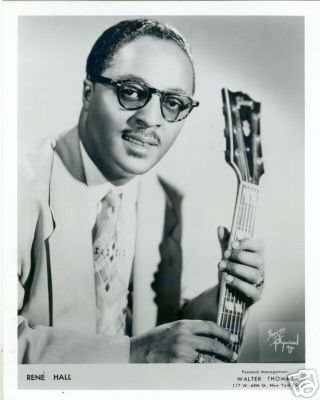
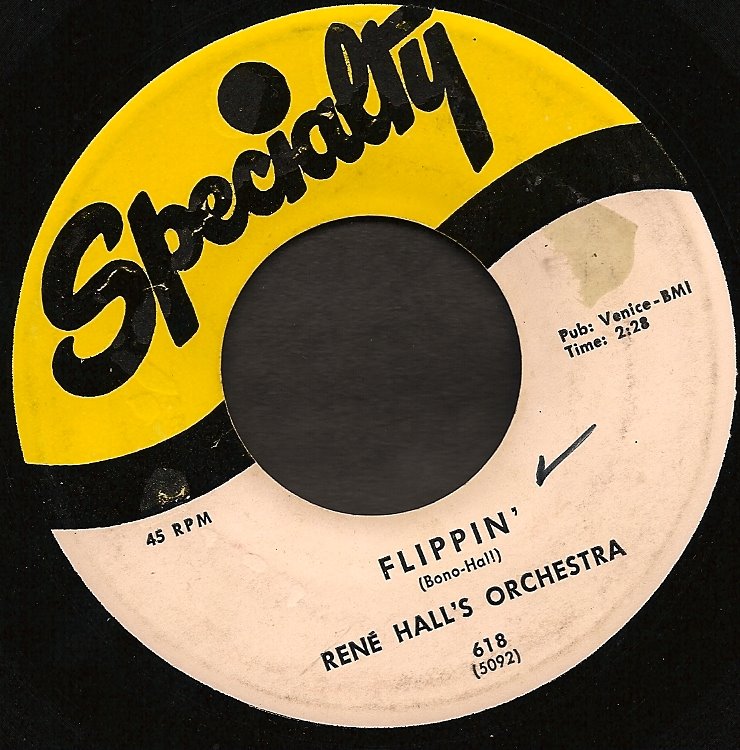 Rene Hall, as an arranger and session guitarist was one of the most influential men behind the scenes of rock’n’roll and rhythm and blues for over twenty years, yet he has been ignored and/or written out of history to such an extreme that I can’t even find one photo of him to go with this posting. * He gave one interview in his life, to the U.K. collector’s mag New Kommotion in 1980.
Hall had a long career and was in demand constantly, he never seemed to lack for work, mostly as an arranger. Today’s posting however will examine only a small part of that career, his work as a session guitarist, and from there we will focus on the years 1957-60 when he recorded the records that best fit my own personal definition of what great rock’n’roll is. After all, it’s my blog.
Rene Hall was born in New Orleans in 1912 and began his musical career picking six string banjo in Papa Celestin’s Orchestra, playing traditional New Orleans jazz. He worked on the riverboats in the 1940’s with Sam Morgan’s Orchestra and later with Sydney’s Southern Syncopaters. Somehow he ended up in Tulsa, Oklahoma where he switched to guitar and played with Ernie Fields’ band (he’d record with Fields in the fifties). With Fields he moved to St. Louis where he got a job writing arrangements, conducting and playing trombone with jazz piano giant Earth “Fatha” Hines. For an example of Hines genius find a copy of Louis Armstrong’s Weather Bird.
Hall hit New York City in 1945 where he got arranging work at the Apollo Theater in Harlem, working with acts like Roy Milton and Louis Jordan. At the Apollo he discovered Billy Ward and the Dominos, with their incredible lead singer Clyde McPhatter and got them their first record deal with Federal Records out of Cincinnati, a subsidiary of the R&B/C&W giant King. He appeared playing guitar on many of their early hits including Do Something For Me, the 1951 smash. He toured with the Dominos, making it as far as England where they played army bases, then moved with them to Las Vegas when they settled in for a long term job at the Dunes Hotel.
He stayed with Billy Ward and the Dominos two and a half years. He also had started a solo recording career before leaving New York, his earliest sides appeared on the Jubilee label in 1950– Blue Creek Hop (sorry about the messed up beginning, it’s the only copy I could find)
was his first release. Jubilee issued a second single — Rene’s Boogie later that year, but I’ve never heard it. He also recorded for Decca and Victor in 1952-3, these sides are very rare, and are in the same light jazzy R&B style as Blue Creek Hop. Well executed, but lacking the spark of true genius that would mark his playing a few short years later.
Pardon the digression, back in Vegas, Hall was growing bored with the Dominos and soon headed for Los Angeles where he found a job at club at 42 Street and Western but trouble with the musician’s union forced him to give it up (they required a six month residency in state, so as a new comer he was shut out of any steady gigs) so on the recommendation of a friend– Carl Peterson at Universal Attractions he approached Art Rupe the owner of Specialty Records, then flying high on the success of Little Richard, for a job, which he got. Rupe immediately put him to work with Bumps Blackwell working on a Little Richard session cutting Hey Hey Hey. Hall told New Kommotion’s Stu Coleman “That was my first experience with hard rock”, a style to which he would adapt well. He was sent to Bakersfield where Richard was appearing in a club, then worked out some arrangements for sessions that were later cut in L.A.. Rupe was so pleased with Rene’s arranging abilities that he put him in charge of his latest discovery– Larry Williams a pimp turned rocker being groomed by Rupe as the next Little Richard. Working with producer Sonny Bono and using many of the same musicians that appeared on Richard’s sides (Earl Palmer on drums, Plas Johnson on sax, Roy Montrell on guitar) they soon produced three hits with Larry Williams– Slow Down b/w Dizzie Miss Lizzy, Short Fat Fannie b/w High School Dance, and Bad Boy b/w She Said Yeah, tunes that would later be recorded by everyone from the Beatles and Rolling Stones to the Flamin’ Groovies. On some of these session Hall played guitar along with Roy Montrell. In the 1980’s Specialty issued two LP’s of Larry Williams outtakes (Unreleased Larry Williams and Hocus Pocus), recordings much rawer then the issued sides. These discs went out of print fast and much of the material has never appeared on CD**, but one of these included a version of Bad Boy where Rene Hall plays what must be one of the most out of control guitar solos of all time. You can practially smell the smoke coming from the tubes in his amp.
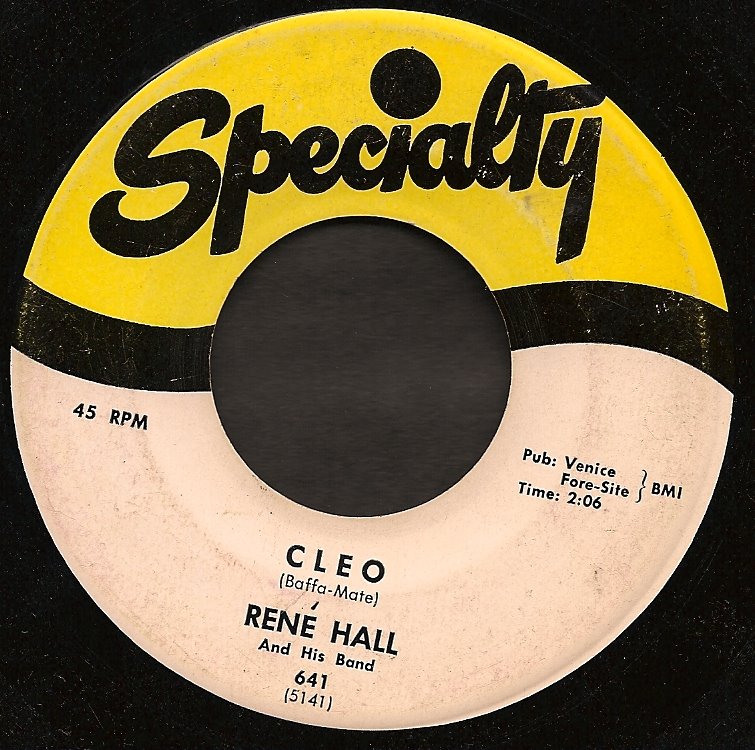
While at Specialty, Rene Hall also cut three solo 45’s, only one was a guitar instrumental, and he only played on one side, but it’s quite a classic– Twitchy b/w Flippin’. The a-side features Willie Joe Duncan, who played a Unitar (one string guitar), and the tune is basically a re-recording of Unitar Rock, which had appeared on the b-side of Bob Froggy Landers’ Cherokee Dance a year earlier. Duncan not only had one string on his guitar, he seems to have known only one tune, but a hell of a tune it is. Flippin’ features Hall’s guitar and is a pretty good rocker in it’s own right. His next Specialty 45, also issued in 1957 was a version of venerable wino classic Thunderbird b/w When The Saints Go Marching In. For more on the Thunderbird connection see my April posting on the subject. His final Specialty 45 came in early ’57, a slice of novelty exotica that I’ve always loved– Cleo, it was backed with an instrumental version of Frankie & Johnny that featured Plas Johnson’s blaring tenor.
Bumps Blackwell, with Rene Hall as arranger had taken Specialty gospel star Sam Cooke of the Soul Stirrers and recorded a pop tune, complete with white back up singers, called You Send Me, which Rupe hated and refused to release, fearing it would offend the gospel fans. Blackwell was sure he had a hit record and a future star in Cooke and worked out a deal with Rupe where in exchange for back royalties he was owed he could have Cooke’s contract and take You Send Me elsewhere. They took it to Bob Keane who issued it on the Keen label and of course it was a huge hit. Hall stayed on with Cooke as his guitarist and arranger until his death, but that’s away from our subject today.
Keene had just signed a chubby Chicano kid from Pocoima and needed someone to help develop his songs and his sound for recording. Keane put Rene Hall and Valens together and they created what I consider to be one of the coolest sounds in all of rock’n’roll history. Using Earl Palmer on drums, Bill Pitman on six string bass, Carol Kaye playing acoustic guitar, Ritchie Valens on electric rhythm and Rene Hall on lead guitar, he created the “Ritchie Valens sound”. Listen to the backing track to La Bamba (that’s Rene Hall playing the solo). Pure genius! The six string bass really gives the record drive, and Hall flat out rocks. Here’s a few other of my favorites– Ooh My Head (which Led Zepplin stole and retitled Boogie With Stu, later Valens mom sued and got her name on half the song, later still both parties were sued by Little Richard since the song is basically a re-write of Ooh My Soul), and this instrumental two sider that was issued under the name of Arvee Allens— Fast Freight b/w Big Baby Blues. Rene Hall arranged and played on all of Valens Del-Fi material except In Concert At Pocoima Jr. High and some scraps of demo tapes that were issued after Ritchie’s tragic death. Poor little guy, he was only 17 when he died. I don’t need to repeat that story.
Valens death left Bob Keane and Del-Fi records without a meal ticket, but soon a demo arrived in the mail from a Montana born Chicano with an uncanny ability to sound like Valens, so Robert Lee “Chan” Romero was brought to L.A. and Keane teamed him up with Rene Hall and using the same formula and musicians he used with Valens, Romero produced an absolute classic with Hippy Hippy Shake, which would later become a staple of early Beatles live sets and a smash hit for Liverpool’s other fab four– the Swinging Blue Jeans. Unfortunately for Romero his version didn’t sell so well. Here’s the demo if you’re curious. Hall worked with Chan Romero on several more records, the best of which was I Want Some More (and here’s the demo of that one). Great sides, but no sales. What became of Chan Romero I do not know. Rene Hall also cut a solo single for Del-Fi, The Untouchables, a pretty good record but lacking the fire of the Valens and Romero discs.
All through the late fifties Rene Hall kept busy free lancing, he did arrangements for Patience and Prudence, Jan & Arnie (Gas Money), Bumble B. & the Stingers (Nut Rocker) and others. As a guitarist he showed up on all of Googie Rene’s Class sides including this killer that Bob Quine turned me on to– Side Tracked. One of my favorite discs to feature a Rene Hall guitar solo is this raucous piece of slop by Earl Palmer & the Partytimers with the Jayhawks– Johnny’s House Party Part One which appeared on Aladdin around ’58. Everything about this record is great, in fact they all sound drunk, but it’s the guitar solo that gives it the extra push over the edge into what we can call genius.
Rene Hall would spend the early sixties doing all sorts of studio work, mostly as an arranger but his main meal ticket was Sam Cooke. As an arranger his greatest moment was probably A Change Gonna Come, Cooke’s last and greatest record. When Sam Cooke died he went back to free lancing, he never lacked for arranging work. He even returned to Specialty to play bass on a Little Richard session (Bama Lama Loo b/w Annie’s back, which also featured Don and Dewey on guitars). In the early 70’s he signed on as Marvin Gaye’s musical director, working on all of Gaye’s classic hits– Let’s Get It On, What’s Goin’ On, etc. When Gaye died he found himself one of the most in demand arrangers in the business and worked constantly until his death in 1988.
It’s not like Rene Hall was unsung in the industry, he was a highly paid professional, and a successful one at that. Rock’n’roll guitar playing was only a small part of his career, but one that should surely be acknowledged since he was so brilliant at it. So I guess it’s up to me, since nobody else seems to give a hoot. Rene Hall– I salute you.
*Well after two days, reader Tony Watson from Australia sent the above photo, thanks Tony.
** Again, from Tony Watson: “Your article also makes mention of the w Larry Williams albums of Specialty material which appeared in the 80s and the fat that alot of those tracks have not appeared on CD. I can tell you the reason for that – a lot of the songs were MANUFACTURED by Little Walter Devenne. He created quite a few of the tracks from various outtakes in the vaults, as well as playing around with the speed. This only came to light when I worked with John Broven & Stuart Colman in compiling the 2CD Larry Williams set for Ace – ‘The Specialty Rock & Roll Years’ in 2004. We felt it would be playing with history to reissue those ‘constructions’ rather than issue takes just as Larry recorded them. Hope that clarifies things.”
Stooges update
[youtube https://www.youtube.com/watch?v=tv8fV_RWkFM&hl=en&fs=1&%5D
Here’s some rare footage of the ’73 Iggy & the Stooges line up. Iggy sent out a press release a few weeks back announcing that James Williamson will be rehearsing with the Stooges in July for some as yet un-announced gigs–” the repertoire will be Raw Power” according to Iggy. After Ron Asheton died I assumed I’d never leave the house again, but I sure won’t miss this one.
By the way, that’s Nitebob’s Firebird Williamson’s playing (James had been compaining about how heavy his Les Paul was, so Nitebob who was their sound man lent him his Gibson Firebird), the footage was taken at the Academy of Music in New York City New Year’s Eve 1973/74, too bad Ron’s not visible, he was wearing one of his Nazi uniforms that night. CBS recorded the gig on a 24 track mobile unit but the tape has never surfaced, only a poor sounding audience recorded cassette that was issued as a bootleg called Night Of The Iguana.
Sam Butera
Louis Prima’s band leader and saxophonist Sam Butera died Wednesday morning, June 3rd at 6 a.m. at his home in Las Vegas, he was 81 years old. He was born in New Orleans on Aug. 17, 1927 and led Prima’s backing band the Witnesses from 1954 until 1975 when Prima went into the coma that would eventually kill him. He was on all of the best Louis Prima & Keely Smith Capitol LP’s: The Wildest (here), The Call Of The Wildest, The Wildest Comes Home, The Wildest Show In Tahoe (here), etc.) I caught him at the Tropicana in Vegas as recently as 1997 and he was still great. He made lots of good solo records including Easy Rockin’ (Capitol), Bim Bam (Capitol), Little Liza Jane (Prima 1) She’s A Kookamonger (Dot) as well as singing lead on many songs on Prima’s LP’s like his killer reading of Richard Berry’s The Next Time (from The Call of The Wildest it can be heard here along with the best of Louis Prima’s Capitol sides). He also made several solo LP’s for Capitol including The Big Horn (here). He had retired from performing in 2004, so I was already missing him. With Sam’s death comes the end of an era, that of the great rock’n’roll Vegas lounge acts which included the Treniers, Freddie Bell & the Bell Boys, Bill Ward & the Dominos, and of course Lous Prima with Sam Butera & the Witnesses.
DAVID CARRADINE DEATH: AUTO-EROTIC ASPHYXIATION? Check out today’s Smoking Gun. Sounds like a better explanation than suicide, after all, why would he have wrapped the rope around his genitals?
Billy Fury
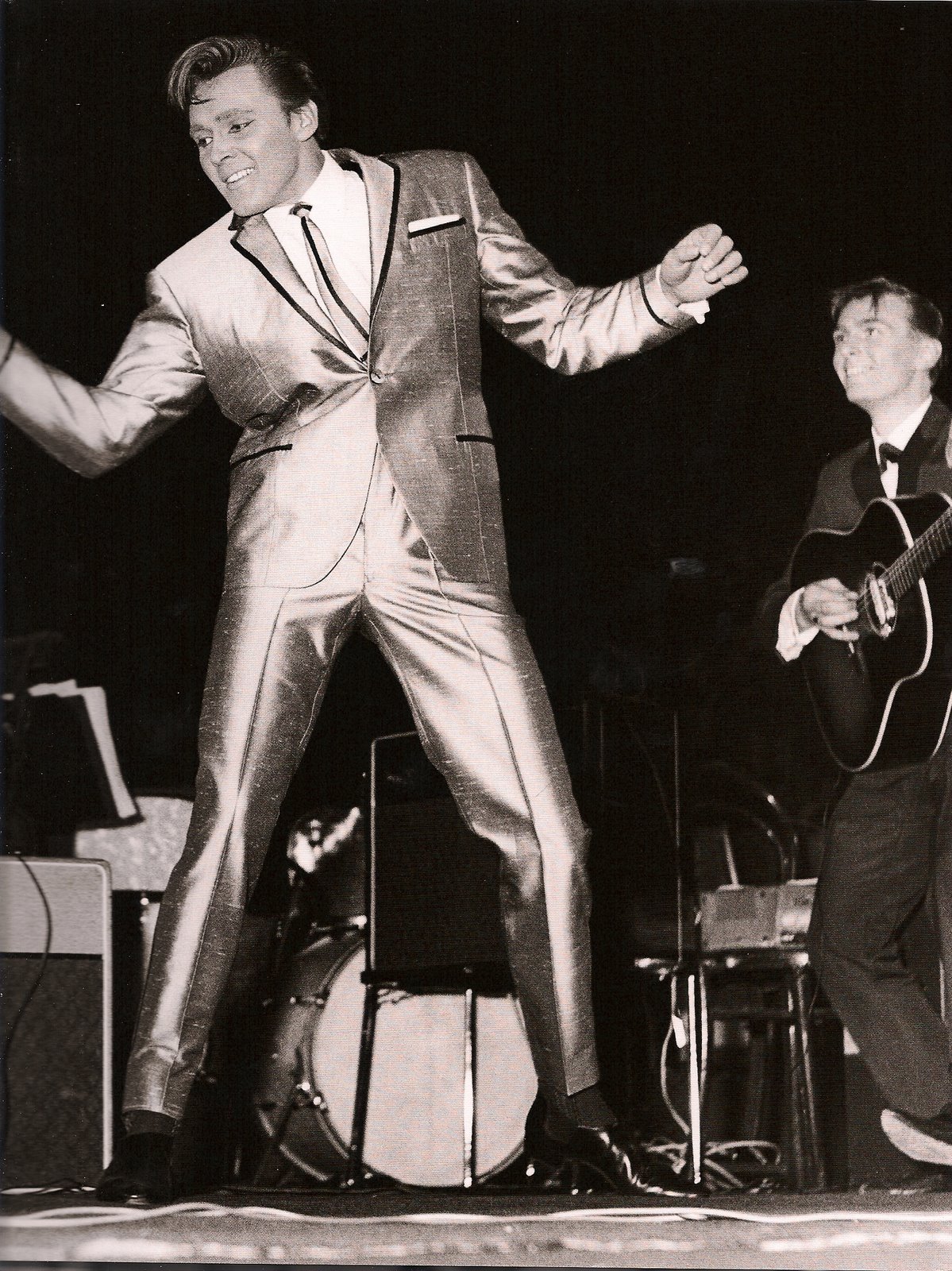 Nice suit, and check out the make up!
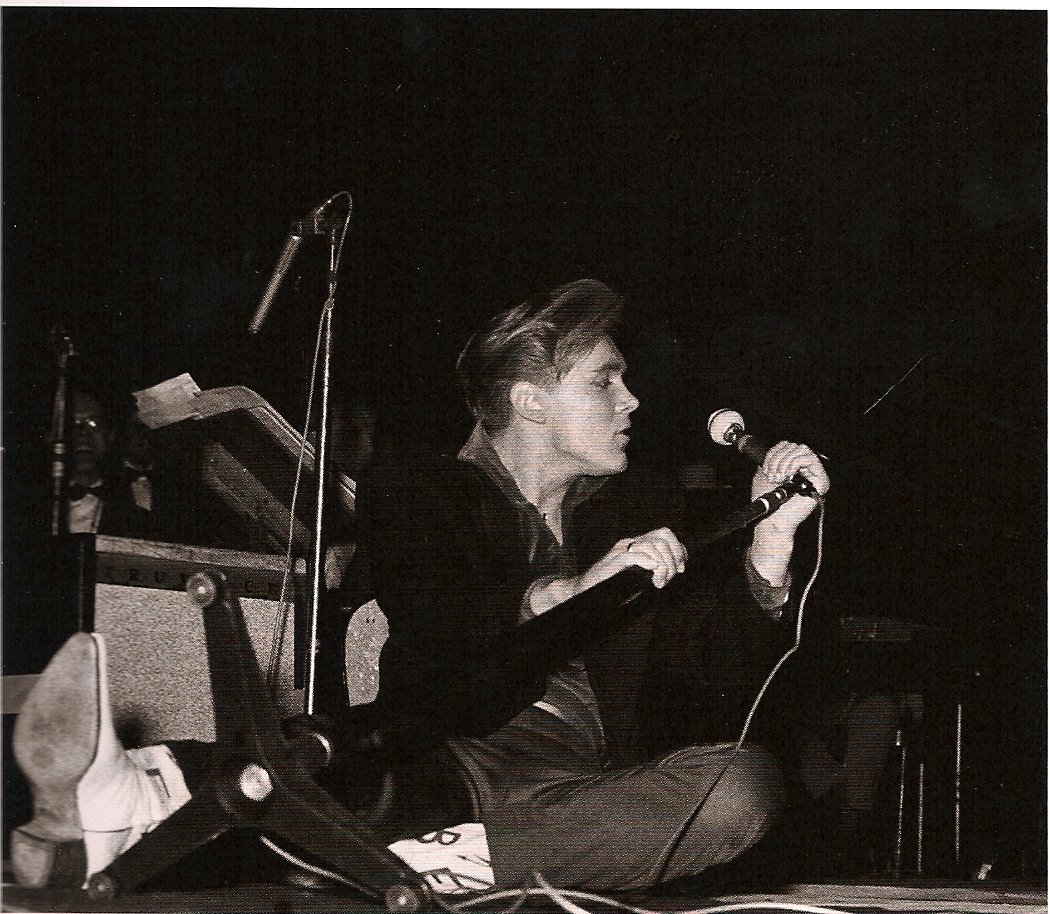 Not everyone can get away with white, cuban heeled boots….
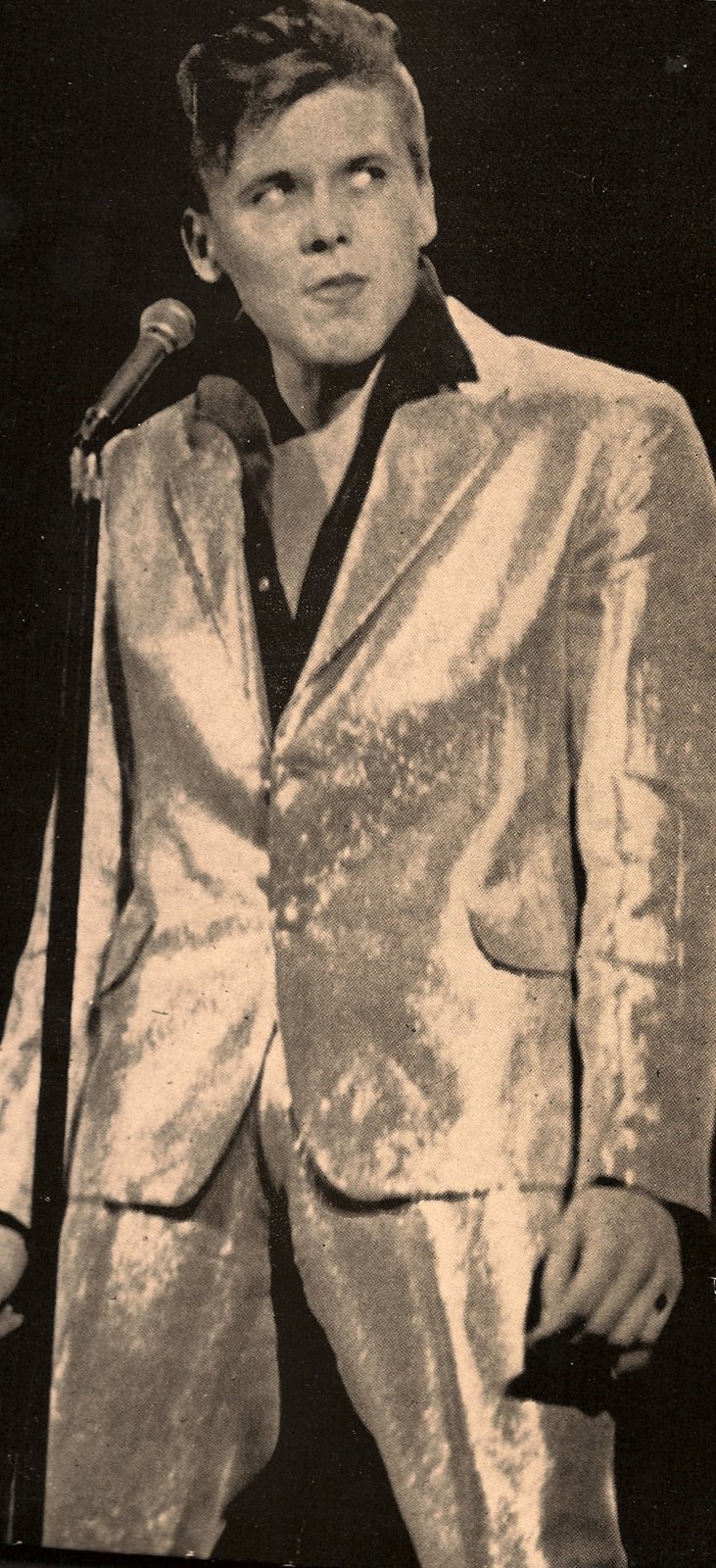 Yet another variation on the gold suit….
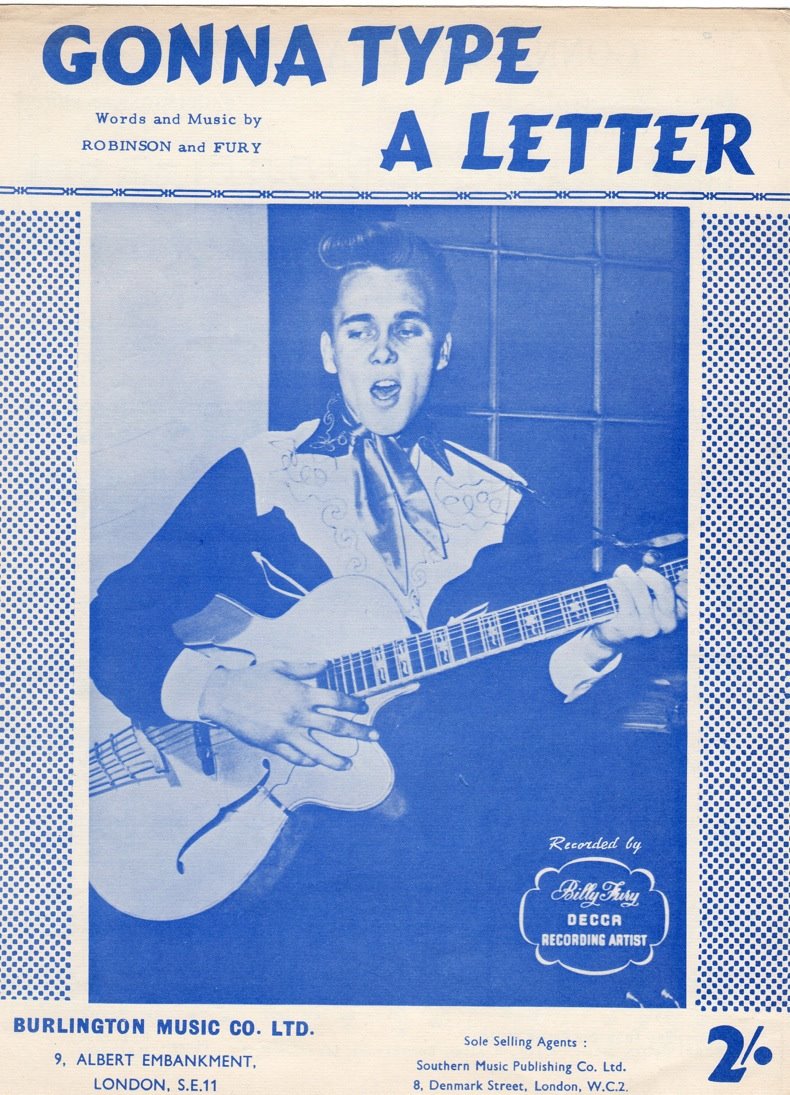
Early British rock’n’roll was a sad affair. With no decrepit old black alcoholics straight from the cotton fields, or speed wired hillbillies in sequin suits to teach them the licks, the style, the songs, they did the best they could by simply copying what American records they could lay their hands on. With no independent record labels or crazy all night disc jockey’s they had to then enter the already established British showbiz system and hope for the best. Recording studios were staffed by men in white lab coats and studio musicians wore jackets and ties (unlike in America where studios where staffed by cigar chomping gangsters and studio musicians guzzled cheap wine straight from the bottle and popped dexadrine like they were tic-tacs). Still, occasionally they’d hit the mark– there’s even a few genuine vinyl masterpieces from this era– Cliff Richard’s Move It, Johnny Kidd & the Pirates’ Shakin’ All Over, Vince Taylor & the Playboys’ Brand New Cadillac and Jet Black Machine, but these were rare occurrences, few and far between. What early British rock’n’roll did have was a guy named Larry Parnes, himself a failed singer turned manager/Svengali, he was known to get behind young talent and give a big push. He would buy them new clothes, teach them how to comb their hair, and re-name them (rumour has it the names Parnes chose for his acts came from their performance in his bed, hence a stable of catamites with names like Johnny Gentle, Duffy Power, Marty Wilde and Wee Willie Wayne). The closest England came to developing a real rocker was today’s subject— Billy Fury. He was no Esquerita, in fact at his very best he was sort of a second rate Ricky Nelson, but I love Ricky Nelson, and I have a soft spot for Billy Fury.
Fury came from Liverpool, born Ronald Wycherley in 1940. As a child he suffered from rheumatic fever which caused a permanent heart condition. Growing up in the rough, working class neighborhood known to locals as The Dingle, Fury who had spent much of his early school years in the hospital had few friends and and less education. At age 16 he left school and became a rivet thrower in the shipyards, then later signed on as a deck hand. Liverpool being at the time Britain’s biggest port city gave young Ronald exposure to American country music and rhythm and blues, and when the film The Girl Can’t Help It was released in 1956 he became infatuated with Eddie Cochran to whom he bore more than a passing resemblance. He got a guitar, changed his name to Stead Wayne and formed the Formby Sniffle (sic) Group, probably in that order. He also began writing songs. In 1958 he entered a recording studio in Liverpool and recorded four Elvis tunes and an original called Love’s A Callin’. He sent the tape and a photo of himself to Larry Parnes. In October of that year a Parnes package tour was playing in Liverpool and Parnes invited young Ronald to present himself, which he did, even pitching two tunes– Maybe Tomorrow and Margo to Marty Wilde backstage. Parnes could spot talent, and was taken by the youngster, putting him onstage that night where he performed for eight minutes, wowing the audience. He was added to the show and the next day he was headed for Manchester, an overnight sensation was born. Parnes signed him up, changed his name to Billy Fury, dressed him in a tight gold suit and black mascara and soon he was signed to Decca Records, Ronald/Stead/Billy was soon chartbound. His first single was Maybe Tomorrow and it rose to #18 on the U.K. pop charts. Soon Fury was appearing all over the country, onstage he was a wild performer, and like Elvis in the U.S. he was met with great dismay by the press and adult censorship organisations like the British Watch Committee (which tried to have him banned from all U.K. stages). As a result of the bad press his next single Margo reached only #28 and his next two releases didn’t chart at all. Fury was ordered to tone it down or he’d be back on the Liverpool docks before his stock of mascara ran out. He relented and toned his stage show down a bit, no more humping the mike stand, no Elvis-like hip swivels, etc. It didn’t matter, Billy Fury became a huge star in Britain, probably second only to Cliff Richard as far as home grown rock’n’roll stars went at the time. He churned out the records, and his recorded output was surprisingly good. His biggest hit– Halfway To Paradise, a cover of a tune that was a minor hit for Tony Orlando in the States was fairly typical of his hits, an Elvis style ballad, aimed at teenage girls, not half bad but nothing that would upset your parents. I Will, Jealousy and Please Don’t Go fall into the same category. His first really great record was Collette, an original that would have fit into Buddy Holly’s set list perfectly. I Can Feel It is an excellent country style rocker with a psuedo gospel style call and response refrain and a killer guitar solo from Joe Brown. Play It Cool is a cover of the Eddie Fontaine tune from The Girl Can’t Help It that bests the original, another good rocker of his was You Got Me Dizzy. Also worth mentioning is Don’t Jump, a teen snuff classic with a big, twangy guitar sound.His finest moment was the whacked out, out of tune sax section driven Gonna Type A Letter— you haven’t lived until you’ve seen a whole room full of aging Teddy Boys jiving in line to this one (as I witnessed back in the early 80’s).
Fury came from Liverpool, born Ronald Wycherley in 1940. As a child he suffered from rheumatic fever which caused a permanent heart condition. Growing up in the rough, working class neighborhood known to locals as The Dingle, Fury who had spent much of his early school years in the hospital had few friends and and less education. At age 16 he left school and became a rivet thrower in the shipyards, then later signed on as a deck hand. Liverpool being at the time Britain’s biggest port city gave young Ronald exposure to American country music and rhythm and blues, and when the film The Girl Can’t Help It was released in 1956 he became infatuated with Eddie Cochran to whom he bore more than a passing resemblance. He got a guitar, changed his name to Stead Wayne and formed the Formby Sniffle (sic) Group, probably in that order. He also began writing songs. In 1958 he entered a recording studio in Liverpool and recorded four Elvis tunes and an original called Love’s A Callin’. He sent the tape and a photo of himself to Larry Parnes. In October of that year a Parnes package tour was playing in Liverpool and Parnes invited young Ronald to present himself, which he did, even pitching two tunes– Maybe Tomorrow and Margo to Marty Wilde backstage. Parnes could spot talent, and was taken by the youngster, putting him onstage that night where he performed for eight minutes, wowing the audience. He was added to the show and the next day he was headed for Manchester, an overnight sensation was born. Parnes signed him up, changed his name to Billy Fury, dressed him in a tight gold suit and black mascara and soon he was signed to Decca Records, Ronald/Stead/Billy was soon chartbound. His first single was Maybe Tomorrow and it rose to #18 on the U.K. pop charts. Soon Fury was appearing all over the country, onstage he was a wild performer, and like Elvis in the U.S. he was met with great dismay by the press and adult censorship organisations like the British Watch Committee (which tried to have him banned from all U.K. stages). As a result of the bad press his next single Margo reached only #28 and his next two releases didn’t chart at all. Fury was ordered to tone it down or he’d be back on the Liverpool docks before his stock of mascara ran out. He relented and toned his stage show down a bit, no more humping the mike stand, no Elvis-like hip swivels, etc. It didn’t matter, Billy Fury became a huge star in Britain, probably second only to Cliff Richard as far as home grown rock’n’roll stars went at the time. He churned out the records, and his recorded output was surprisingly good. His biggest hit– Halfway To Paradise, a cover of a tune that was a minor hit for Tony Orlando in the States was fairly typical of his hits, an Elvis style ballad, aimed at teenage girls, not half bad but nothing that would upset your parents. I Will, Jealousy and Please Don’t Go fall into the same category. His first really great record was Collette, an original that would have fit into Buddy Holly’s set list perfectly. I Can Feel It is an excellent country style rocker with a psuedo gospel style call and response refrain and a killer guitar solo from Joe Brown. Play It Cool is a cover of the Eddie Fontaine tune from The Girl Can’t Help It that bests the original, another good rocker of his was You Got Me Dizzy. Also worth mentioning is Don’t Jump, a teen snuff classic with a big, twangy guitar sound.His finest moment was the whacked out, out of tune sax section driven Gonna Type A Letter— you haven’t lived until you’ve seen a whole room full of aging Teddy Boys jiving in line to this one (as I witnessed back in the early 80’s).
Around 1959 Decca issued the ten inch LP– The Sound Of Fury, probably the best pre-Beatles British rock’n’roll LP and one that has been cited by Keith Richards, Jimmy Page and Jeff Beck as highly influential in their formative years. Consisting of ten original tunes, and showing off Joe Brown’s guitar to great effect this little disc had some actual rock’n’roll classics including Don’t Leave Me, My Advice, That’s Love and Turn My Back On You. Fury kept up the furious pace, girls mobbed him where ever he went, he was on the package tour that ended with the car crash the killed his hero Eddie Cochran (and maimed Gene Vincent).
In the early sixties he hired the Tornados (of Telstar fame) as his backing band and together they cut a live LP– We Want Billy! One of the first Brit live albums and while not exactly Jerry Lee Lewis Live At The Star-Club (Phillips) or Bo Diddley’s Beach Party (Checker), it does have a sort of perverse appeal for me, especially the more rockin’ cuts like his renditions of Sweet Little 16, I’m Movin’ On, Just Because, and That’s Alright Mama. I don’t think it’s ever been re-issued.
Bill Fury’s career wound down considerably after the Beatles and the Rolling Stones changed the game. He would make an appearance in the 1973 movie That’ll Be The Day, stealing the show as an old rocker. Later Billy Fury played the supper club circuit, appeared in dozens of U.K. television shows, and finally in 1983 his heart gave out. He’d been running on borrowed time since a teenager, the rheumatic fever had permanently damaged his ticker and he knew he’d never live to a ripe old age. But for a few years there, Billy Fury rocked harder than anyone else on that little island. Once the Beatles opened the door all manner of mania would issue from the place from inexplicably brilliant Rolling Stones, The Pretty Things (and their maniacal drummer Viv Prince), the sonically visionary Yardbirds, and a seemingly endless supply of groups devoted to reproducing the sounds of Bo Diddley, Jimmy Reed, Elmore James, even Chan Romero. But if Billy Fury hadn’t have gotten there first, they’d have had to do it without the eyeliner.